MATU
Matson Container Tracking
 Yuri Kan Trackers opened and tested Updated
Matson is the speed outlier of the Pacific: its CLX China–Long Beach Express is the fastest transpacific service afloat, roughly ten days Shanghai to Long Beach with cargo available next day — so a Matson timeline moves faster than transpacific intuition says it should. Tracking lives at matson.com/shipment-tracking.html, which accepts container, booking or bill-of-lading numbers. Containers carry the single prefix MATU; MATS is Matson’s SCAC, its carrier code in US tariff filings. The other half of the story is the Jones Act: sailing to Hawaii since its first voyage in 1882, Matson is the lifeline operator for Hawaii, Alaska and Guam.
Track a Matson container by number
4 letters + 7 digits, printed on the doors. It is on your bill of lading too.
The answer appears as you type. Nothing is sent anywhere.
Few carriers serve two such different customers at once — island communities that depend on scheduled US-flag sailings, and transpacific shippers paying a premium for the CLX because ten days beats everyone else by roughly half.
Whichever lane your cargo rides, the number formats are the same, and the validator here confirms a MATU serial before matson.com sees it.
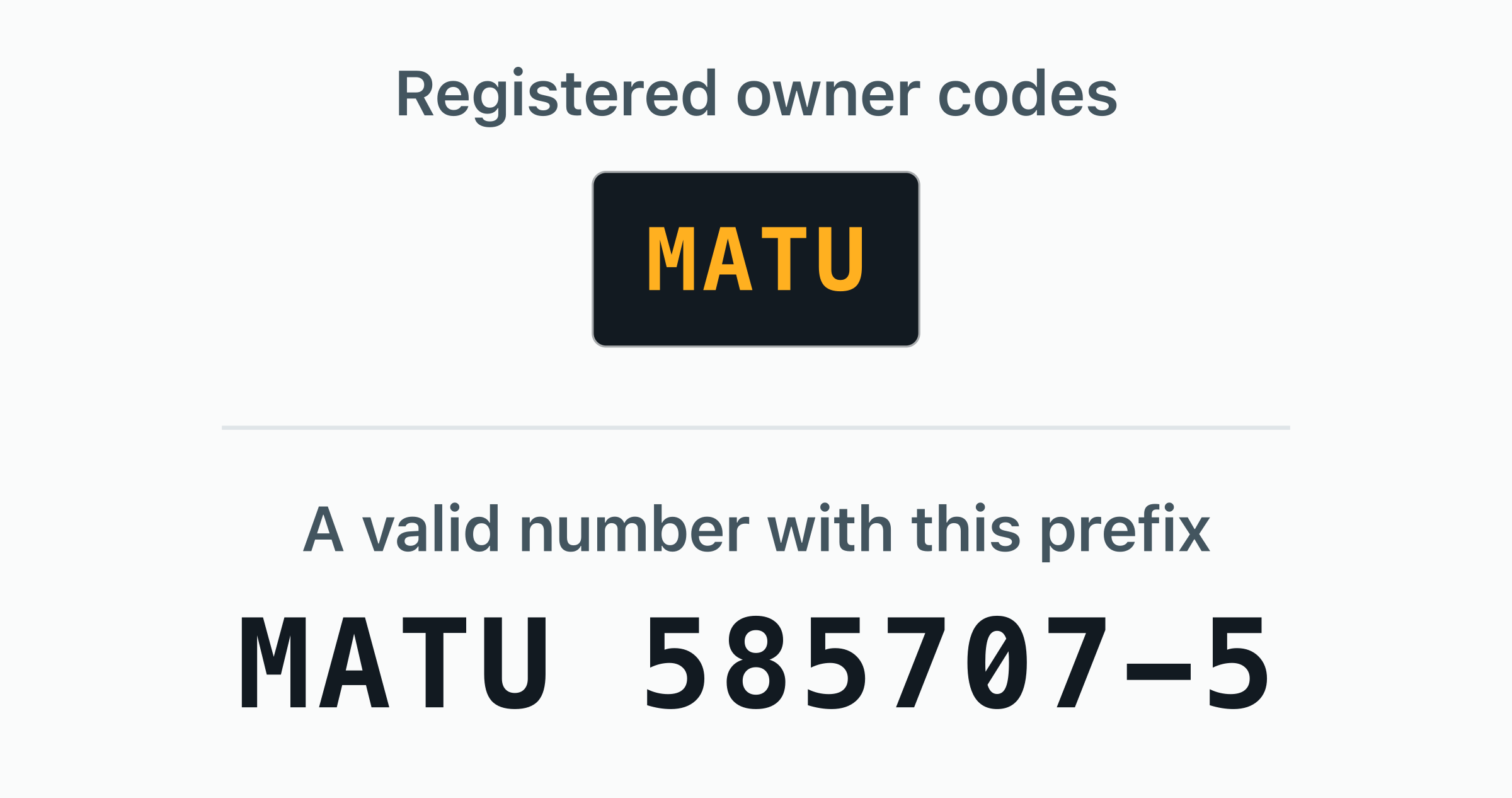
Matson containers carry the prefix MATU; its check digit worked through and the code’s history are on the prefix page of Matson.
The MATU prefix
Matson Navigation registers one owner code, MATU — no merger residue, no sister codes, which reflects a company that grew organically on its own trades rather than by absorbing rivals. If the prefix reads MATU and the check digit passes, the box is Matson’s.
| Prefix | What it is |
|---|---|
MATU | A house code of Matson, registered to it directly. |
Data: BIC Container Prefix Register · ISO 6346 (1995 text, read in IS 6928:2001)


The numbers in this chart
| Route | Service | Days |
|---|---|---|
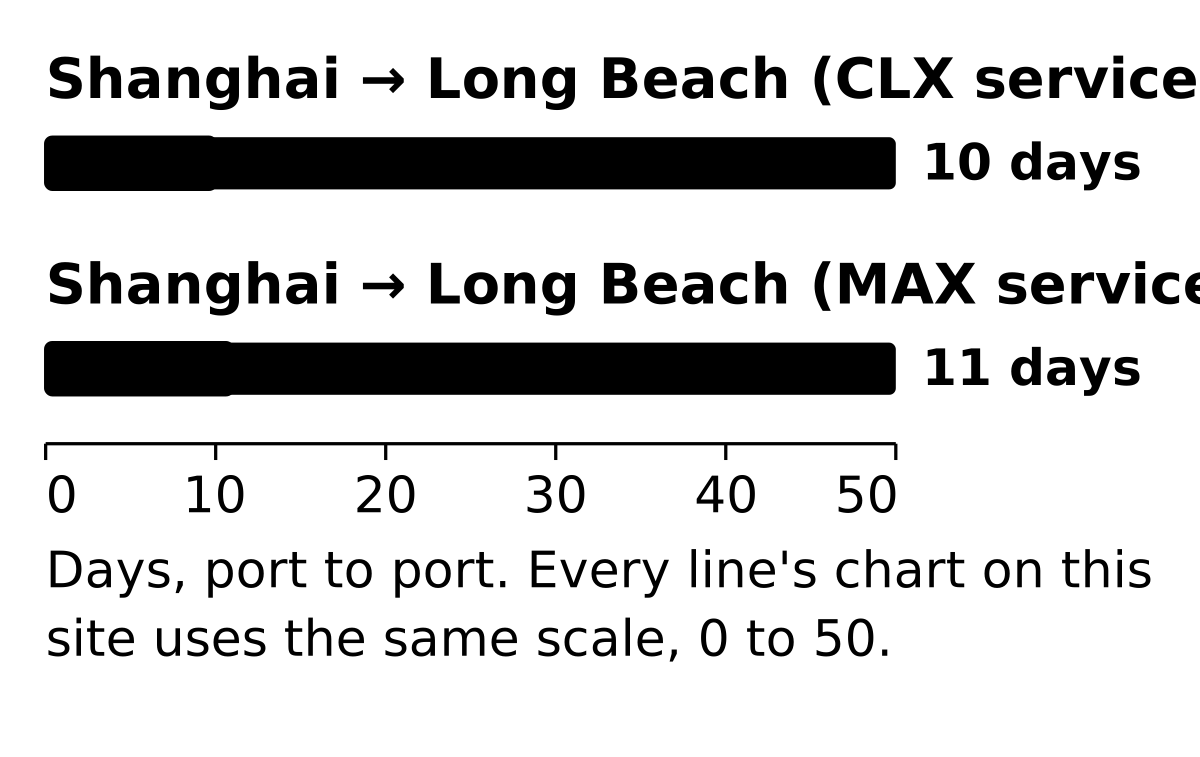
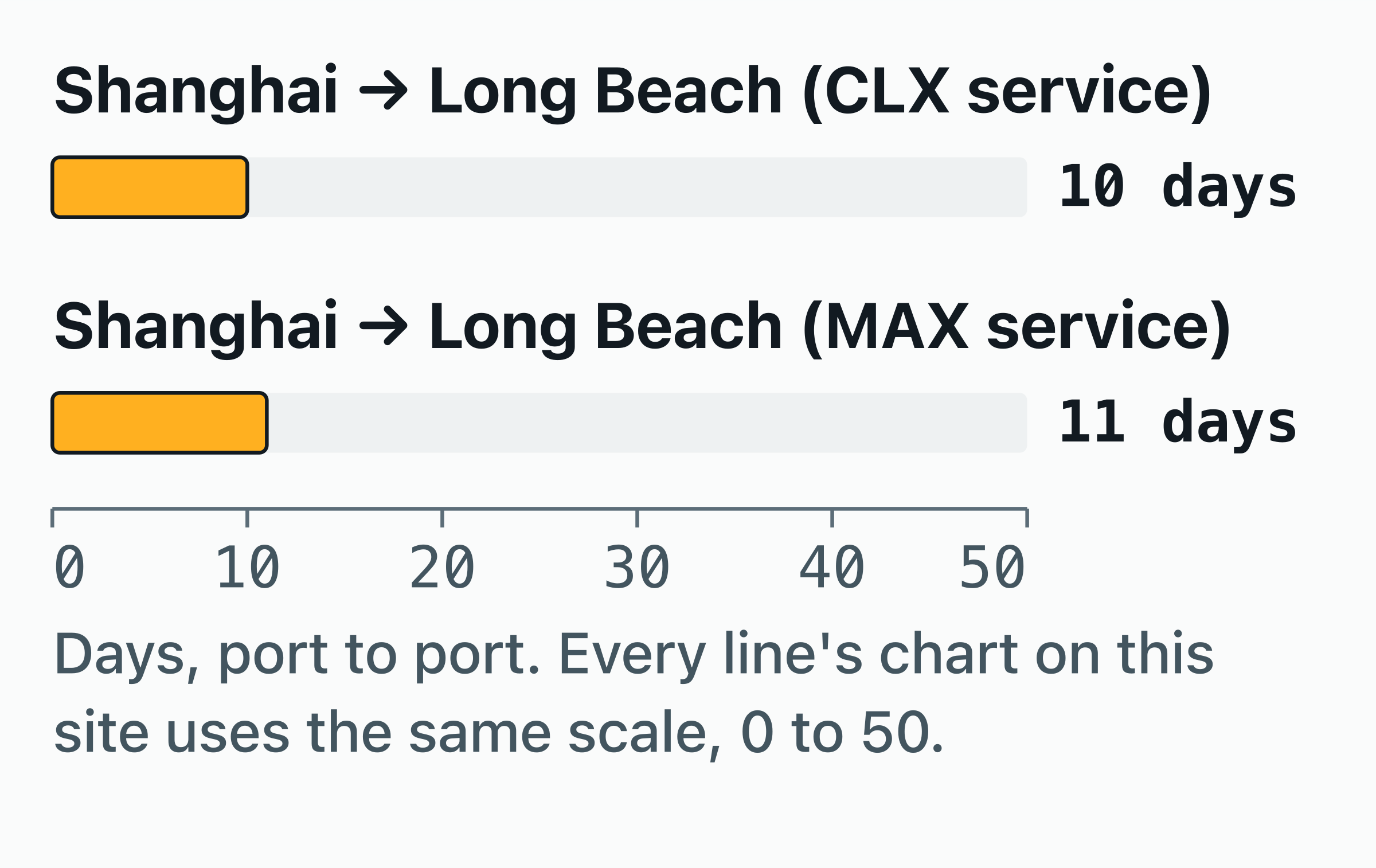
| Shanghai → Long Beach | CLX | 10 |
| Shanghai → Long Beach | MAX | 11 |
Matson B/L numbers and the MATS code
MATS is the SCAC Matson names in its filings with the US Surface Transportation Board; boxes carry MATU. No Matson document we read says its bill of lading numbers begin with MATS, so enter a B/L exactly as printed. Booking references are accepted in the same search too, making Matson one of the few carriers on this site whose tracker takes all three identifier types.
Using the matson.com tracker
The shipment-tracking page posts your query as a form, so URL parameters do nothing — we verified there is no way to deep-link a result. Type or paste the number instead. On mobile, Matson ships two dedicated apps: Matson Track My Container for boxes and Track My Auto for the vehicle-shipping business that is huge on the Hawaii and Alaska lanes.
| Container number | ✓ yes |
|---|---|
| Bill of lading (B/L) | ✓ yes |
| Booking reference | ✓ yes |
| Mobile app | ✓ yes |
| Pre-filled link | — tried it: the page ignores a number in the link |
| Its SCAC (carrier code) | MATS |
Browser-verified 2026-08-03
Can you see where the ship is?
Not from the container. A standard dry box has no power, no radio and no satellite receiver — it is a steel case with a number painted on it, and it reports nothing about itself. Every position you see against a Matson shipment was reported by something else: a terminal crane, a gate reader, or the ship.
A live map on a carrier’s tracking page is almost always plotting AIS, the transponder every large vessel broadcasts with its position, course and speed. That is genuinely useful at sea: it is a real position rather than a schedule, and an ETA recalculated from actual movement. It is also the ship’s position, not your box’s, and the two part company the moment the container is discharged.
On land the map goes quiet. Between the gate-out and the delivery there is no vessel to follow, and the road leg appears only as whatever events the terminal and the trucker report. A container sitting on a chassis in a yard shows the last position of a ship it left days ago. Only specialised IoT equipment reports its own location, and wherever that exists it is a paid product sold to the shipper, not something a tracking page gives away.
Matson transit times, as published
How long a container spends at sea on Matson services, port to port. Each figure below is stated by two documents for the same service and the same pair of ports — the line’s own schedule and one more — and both are linked beside it. Where we could not find two, the pair is not listed.
| Service | From → to | At sea | Sources |
|---|---|---|---|
| CLXTranspacific | Shanghai → Long BeachThe line’s sheet is dated February 2024; the confirming report is from 2018. | 10 days | Matson The Maritime Executive |
| MAXTranspacific | Shanghai → Long Beach | 11 days | Matson Linerlytica |
Sources read 2026-10-18
Data: Matson CLX Service, 2024-02-14 · The Maritime Executive — Matson CLX, 2018-11-07 · Matson MAX Service, 2024-02-14 · Linerlytica — Matson MAX, 2024-03-11
These are schedule figures between two ports, not delivery times: add the days before the vessel sails and after it discharges, and expect the real voyage to drift by a few days either way. A line can change a rotation at any time, so check the date on each source.
Matson’s trades are domestic, and the tracking reflects it
Matson has run the Hawaii trade since 1882 and its network is mostly US domestic — Hawaii, Alaska, Guam and the Pacific islands — rather than the international east–west strings everyone else on this site sails. That shows up in the feed: the schedules are fixed and frequent, the transits are short and predictable, and there is far less of the transshipment limbo that makes a box look lost for a week in an Asian hub.
It also explains the second tracker. Matson moves a large volume of vehicles alongside containers, and the two have separate apps — Track My Container for boxes and Track My Auto for cars. If you are chasing a vehicle rather than a container, the container number you are holding may not be the identifier the system wants.
When the Matson tracker returns nothing
MATS, not MATU. MATS is Matson’s carrier code (SCAC) and MATU is the prefix on its boxes. A container number always starts with MATU; a document number goes in exactly as printed.
No link can carry the number. We opened the page with a number in the URL and the search is posted as a form, so the parameter does nothing. A shared link always opens an empty page here, whatever the sending site implied.
MATU is the only container prefix. One code, no merger residue — so a different prefix on a Matson sailing is leased equipment, and it still tracks here.
Short trades archive sooner. A Hawaii run is measured in days, so the window before the shipment leaves the live system opens earlier than on an ocean crossing.
Carrier profile
Matson at a glance
- World fleet rank
- #30by capacity · Alphaliner, read 18 October 2026
- First voyage
- 1882144 years ago
- Container prefixes
- 1verified against the BIC register
- Alliance
- Independentnot a member of Gemini, Ocean or Premier
The company
- Headquarters
- Honolulu, USA
- Mobile app
- Yes, published by the line
On your paperwork
- Owner codes on the container door
- MATUThe first four letters of the container number.
- SCAC (carrier code)
- MATSMATS is the code the line files under; none of its documents we read says its bill of lading numbers begin with it.
- Official tracking site
- matson.comFree, no account needed.
William Matson started with a schooner run to Hawaii in 1882; the modern company, about 68,000 TEU and 30th on Alphaliner’s list as read on 18 October 2026, still treats those islands as its reason for existing — Jones Act US-built, US-crewed ships on a schedule communities can plan around.
Data: Alphaliner Top 100 · BIC Container Prefix Register
Checked 2026-08-03
Frequently asked questions
How fast is Matson’s CLX service really?
About 10 days Shanghai to Long Beach, with cargo typically available the next day thanks to a dedicated terminal — versus 15–20+ days port-to-port on conventional transpacific strings. It is the fastest scheduled ocean option across the Pacific.
What does the Jones Act mean for my Matson shipment?
Domestic US routes — mainland to Hawaii, Alaska, Guam — must use US-built, US-flagged, US-crewed vessels, and Matson is one of the carriers meeting that bar. Practically, it means fixed weekly schedules and no substitution onto foreign tonnage.
What are MATS and MATU on Matson paperwork?
MATU is the BIC container prefix; MATS is Matson’s SCAC, the carrier code in its US filings. Container, B/L and booking numbers all work at matson.com, so search with whichever identifier your document shows, as printed.
Can I track a car I’m shipping with Matson?
Yes — vehicle shipments have their own app, Track My Auto, separate from Track My Container. Auto bookings use their own reference numbers from your Matson receipt.
Does matson.com support pre-filled tracking links?
No — the search submits as a POST form and ignores anything appended to the URL. Validate the number here, then enter it manually; the mobile apps remember shipments between sessions.
One page, every owner code
Know whose box it is before you search
All 85 owner prefixes mapped to their line or leasing company, with the leased ones marked — so you can tell at a glance when to track with the line instead. It comes in the container pack, with every container’s dimensions.
The bot check did not finish, so nothing was sent. Send the form again; if it stops again, allow challenges.cloudflare.com in your blocker or write to info@contsize.com from the address the file should go to.
Nothing was sent: the address could not be read, or a required box was not ticked. Check them and send the form again.