US market · USD
How Much Does a Shipping Container Cost?
 Yuri Kan Sellers’ pages read Updated
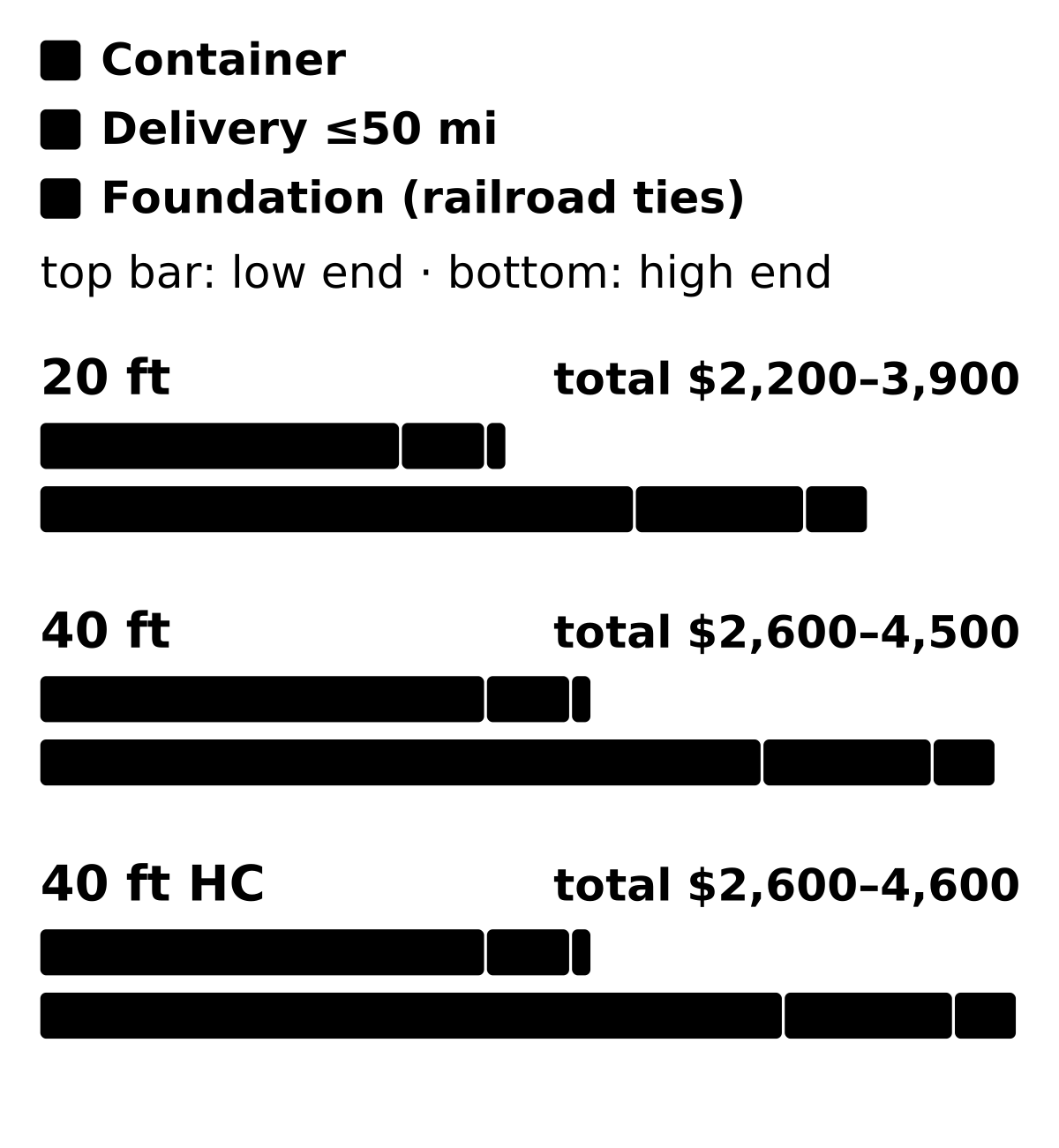
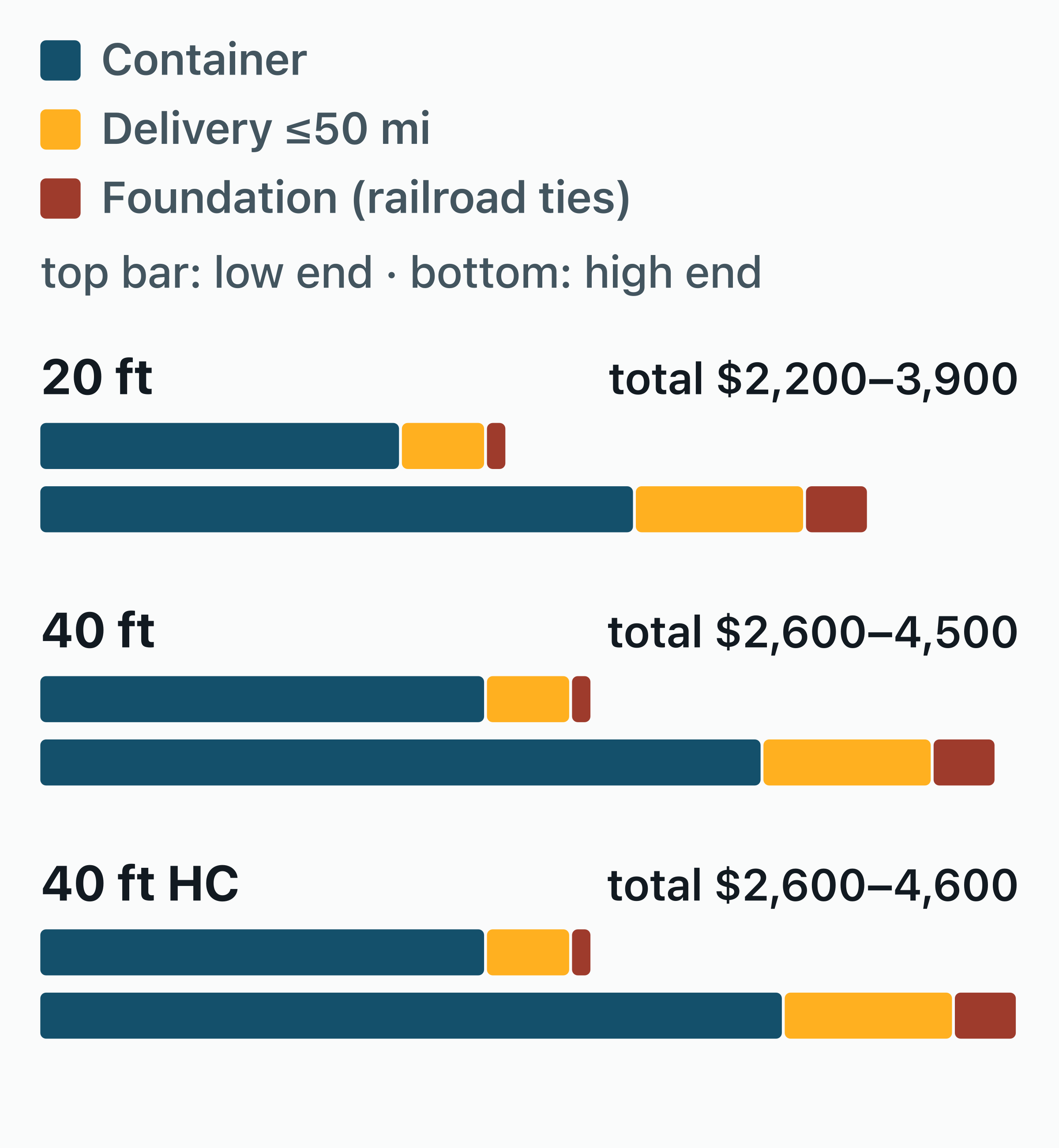
A used cargo-worthy 20 ft container costs $1,700–2,800 in the US in October 2026 and a used 40 ft high cube $2,100–3,500; new (one-trip) they run $2,800–4,400 and $4,000–5,600. Delivered within 50 miles and set on railroad ties, a used 20 ft comes to about $2,200–3,900 all in, a used 40 ft high cube $2,600–4,600.
| Size | WWT | Cargo-worthy | One-trip |
|---|---|---|---|
| 10 ft | $1,900–2,900 | $2,500–3,700 | $3,500–5,000 |
| 20 ft | $1,300–2,300 | $1,700–2,800 | $2,800–4,400 |
| 40 ft | $1,700–2,900 | $2,100–3,400 | — |
| 40 ft high cube | $1,700–3,200 | $2,100–3,500 | $4,000–5,600 |
| 45 ft high cube | $2,700–4,100 | $3,500–5,300 | $5,800–8,800 |
How much is each size?
- How much is a 20 ft container?Used, cargo-worthy $1,700–2,800One-trip $2,800–4,400
- How much is a 40 ft container?Used, cargo-worthy $2,100–3,400One-trip —
- How much is a 40 ft high cube container?Used, cargo-worthy $2,100–3,500One-trip $4,000–5,600
- How much is a 10 ft container?Used, cargo-worthy $2,500–3,700One-trip $3,500–5,000
- How much is a 45 ft high cube container?Used, cargo-worthy $3,500–5,300One-trip $5,800–8,800
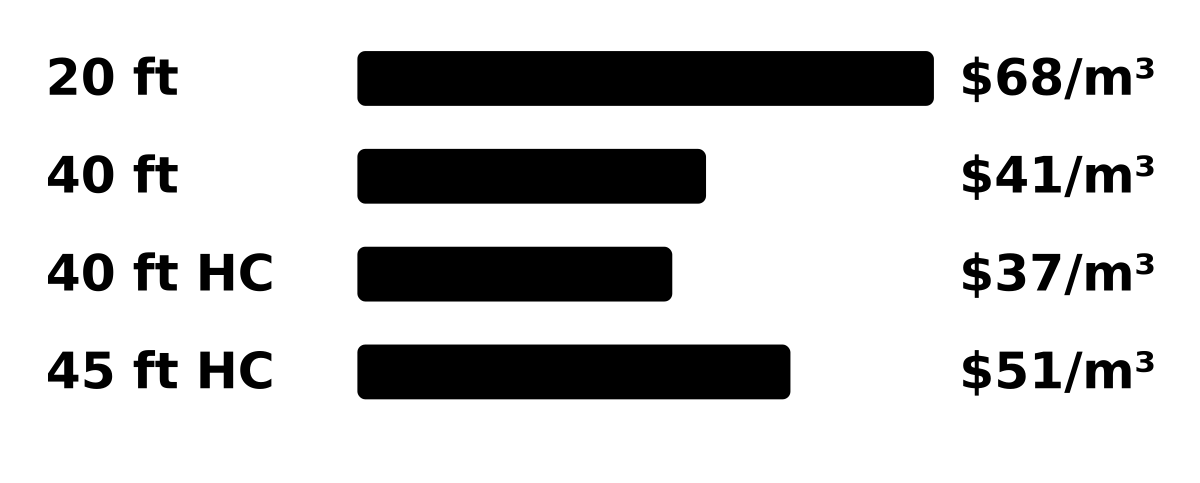
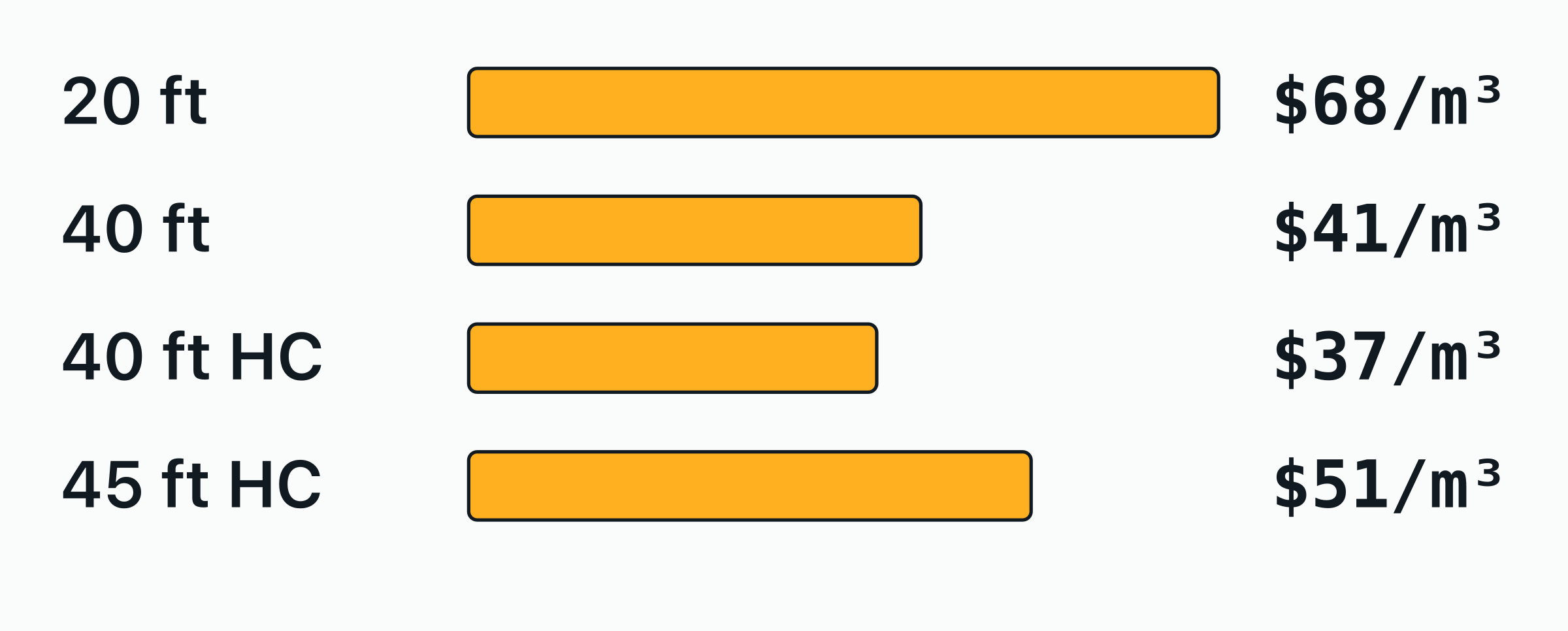
Per cubic metre, used cargo-worthy: 20 ft $68/m³ · 40 ft $41/m³ · 40 ft high cube $37/m³ · 45 ft high cube $51/m³
The middle of the range over the inside volume: the bigger the box, the cheaper its space.
What will my container cost?
The box, the truck and the ground it stands on, from the same ranges as the table above.
Likely total: $2,600–4,600
- Container
- $2,100–3,500
- Delivery
- $400–800
- Foundation
- $100–300
Renting a 40 ft high cube costs as much as buying this one after 11 to 19 months.
US dollars, before sales tax. A dealer’s quote for your address is the fact; this is the range to hold it against.
Check the seller firstNot sure of the size? Plan the loadHow delivery works
| Container | Box | Delivery | Foundation | Total |
|---|---|---|---|---|
| 10 ft | $2,500–3,700 | $400–800 | $100–300 | $3,000–4,800 |
| 20 ft | $1,700–2,800 | $400–800 | $100–300 | $2,200–3,900 |
| 40 ft | $2,100–3,400 | $400–800 | $100–300 | $2,600–4,500 |
| 40 ft high cube | $2,100–3,500 | $400–800 | $100–300 | $2,600–4,600 |
| 45 ft high cube | $3,500–5,300 | $400–800 | $100–300 | $4,000–6,400 |
Most sellers put prices behind a quote form. This page gives the range for each size, type and condition, what delivery and a foundation add, what a box costs city by city, and where each figure comes from — so you can tell a fair offer from a markup, or from a scam, before you pay.
One disclosure up front: we do not sell containers and have no stock to move. Every range is computed from what named companies publish — 8 for the main table, read on 2026-10-05, and 20 more for types, delivery, cities and rent, read on 2026-10-09 — by one rule: the middle of their low prices to the middle of their high ones, with at least two sources for every figure.
Prices by size and condition
A 40 ft high cube is the cheapest space a container sells: about $37 a cubic metre used, against $68 in a 20 ft. Size by size:
- 20 ft. The size most bought for storage and small sites: $1,300–2,300 wind and watertight, $1,700–2,800 cargo-worthy, $2,800–4,400 one-trip.
- 40 ft and 40 ft high cube. A used 40 ft standard is $2,100–3,400, a used high cube $2,100–3,500; one-trip high cubes run $4,000–5,600. The extra foot of height costs little, which is why almost every new 40 ft sold is a high cube.
- 10 ft. A 10 ft is $2,500–3,700 used and $3,500–5,000 new — more than a 20 ft for half the space. Tens are not built in volume, and most are cut down from twenties.
- 45 ft. A used 45 ft high cube is $3,500–5,300.
The 10 ft and 45 ft rows both rest on two sources that disagree widely; treat them as rough.
There is a dash for a new standard-height 40 ft. The pages that price one are mostly not the pages that price a new high cube. Set side by side, their figures put the lower box above the taller one; a range that says that would mislead, so we give none.


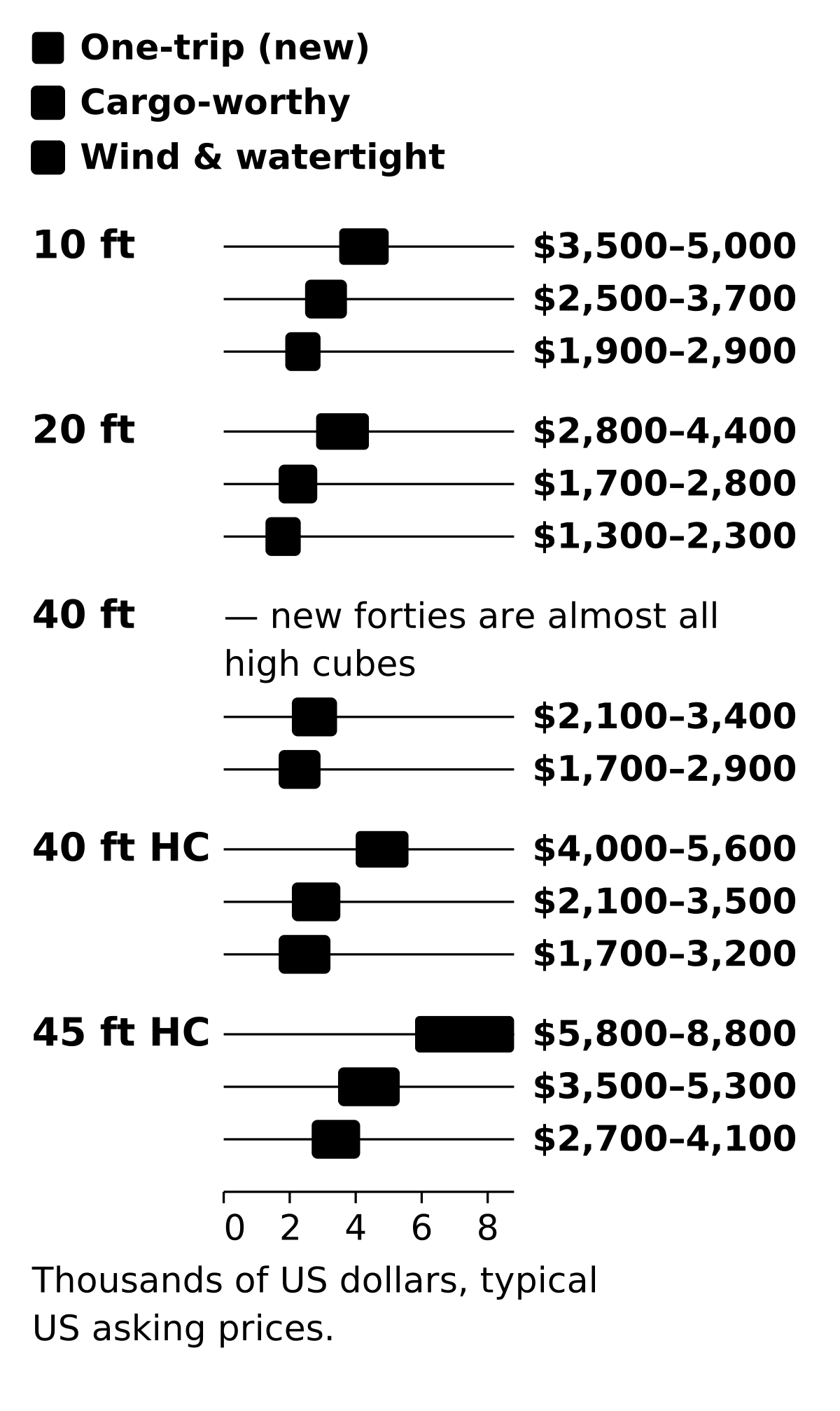
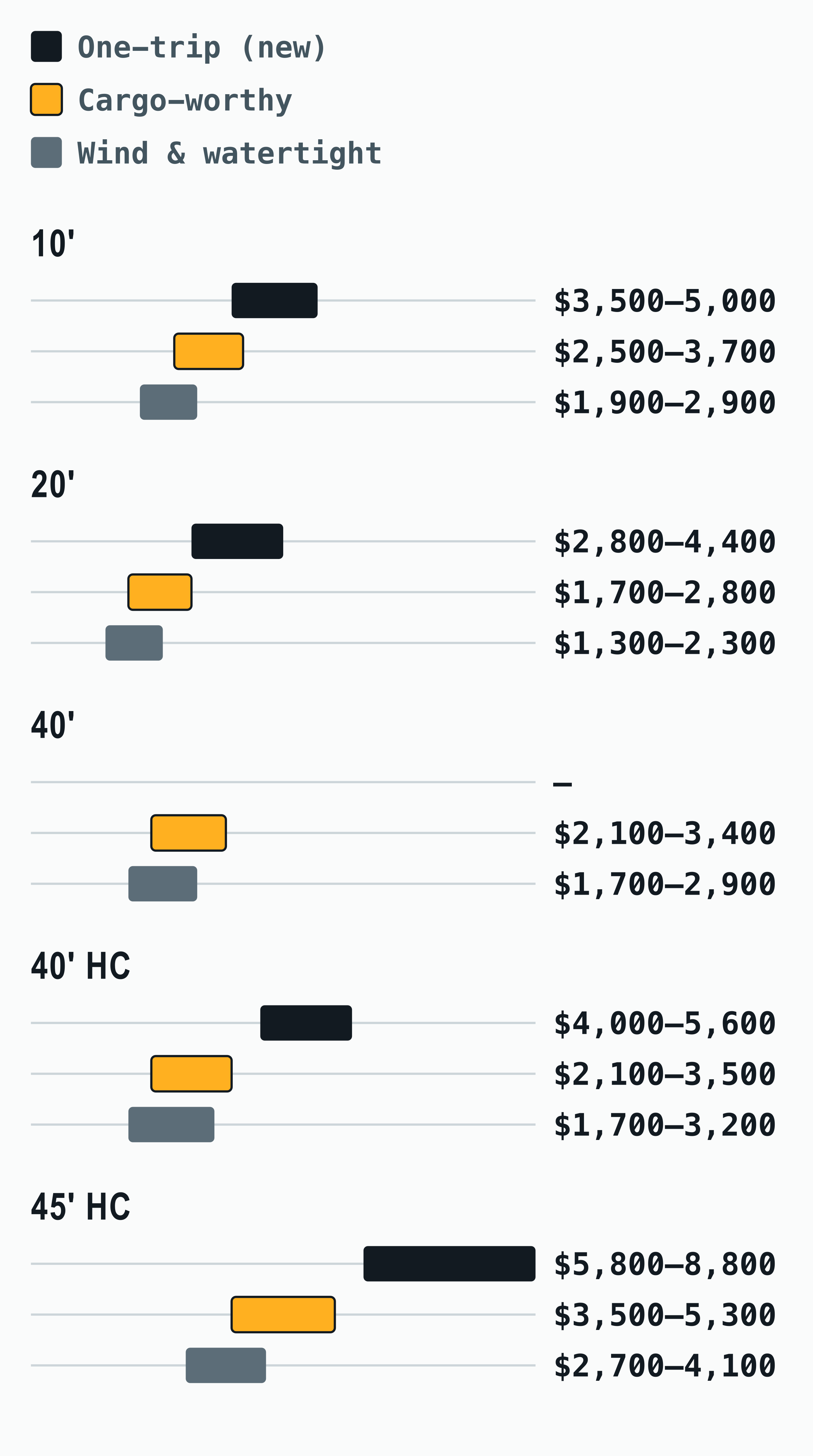
The numbers in this chart
| Size | One-trip (new) | Cargo-worthy | Wind & watertight |
|---|---|---|---|
| 10 ft container | $3,500–5,000 | $2,500–3,700 | $1,900–2,900 |
| 20 ft container | $2,800–4,400 | $1,700–2,800 | $1,300–2,300 |
| 40 ft container | — new forties are almost all high cubes | $2,100–3,400 | $1,700–2,900 |
| 40 ft high cube container | $4,000–5,600 | $2,100–3,500 | $1,700–3,200 |
| 45 ft high cube container | $5,800–8,800 | $3,500–5,300 | $2,700–4,100 |
Special containers: reefer, open side, double door, open top, flat rack
Machinery, extra doors or a missing roof all cost money. These are the prices dealers list for one box collected from the depot. Most special containers sell one at a time, so where the dealers agree, a range comes out as one figure.
| Container | New | Used (unit working, or cargo-worthy) | Used, unit not working |
|---|---|---|---|
| Reefer, 20 ft | $26,800 | $9,000 | $7,300 |
| Reefer, 40 ft high cube | $28,000 | $7,500–8,000 | $5,500 |
| Open side (full side), 20 ft | $5,500–7,500 | — | — |
| Open side (full side), 20 ft high cube | $5,800–7,300 | — | — |
| Open side (full side), 40 ft high cube | $11,500–13,500 | — | — |
| Open side (side doors), 20 ft | $6,400 | — | — |
| Open side (side doors), 40 ft high cube | $6,900–9,400 | — | — |
| Double door, 20 ft | $3,400–4,800 | — | — |
| Double door, 40 ft high cube | $5,000 | — | — |
| Open top, 20 ft | — | $3,500–4,000 | — |
| Open top, 40 ft | — | $5,100–6,800 | — |
| Flat rack, 40 ft | — | $5,400–5,700 | — |
- Reefers are priced by their machine more than their box. A used 20 ft with a working unit is about $9,000, against $7,300 with a dead one — which is then, in effect, an insulated container. New, a 40 ft high cube reefer is about $28,000.
- Open side boxes cost about 1.8 times a new dry box of the same size, more for a 40 ft whose whole side opens.
- A double door adds far less: $3,400–4,800 new for a 20 ft.
- Used open tops run $3,500–4,000 for a 20 ft.
- Used flat racks run $5,400–5,700 for a 40 ft. We found no two sources that price a new flat rack.
What each type is for: reefer, open side, double door, open top, flat rack.

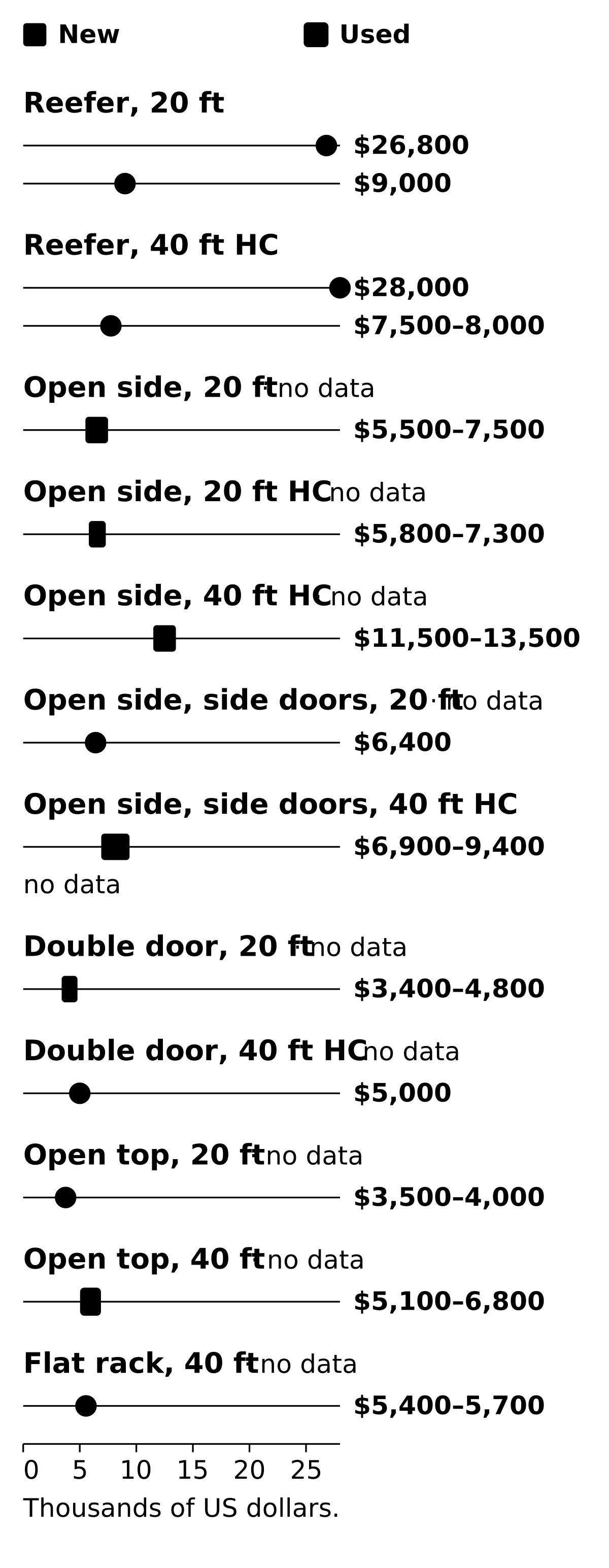
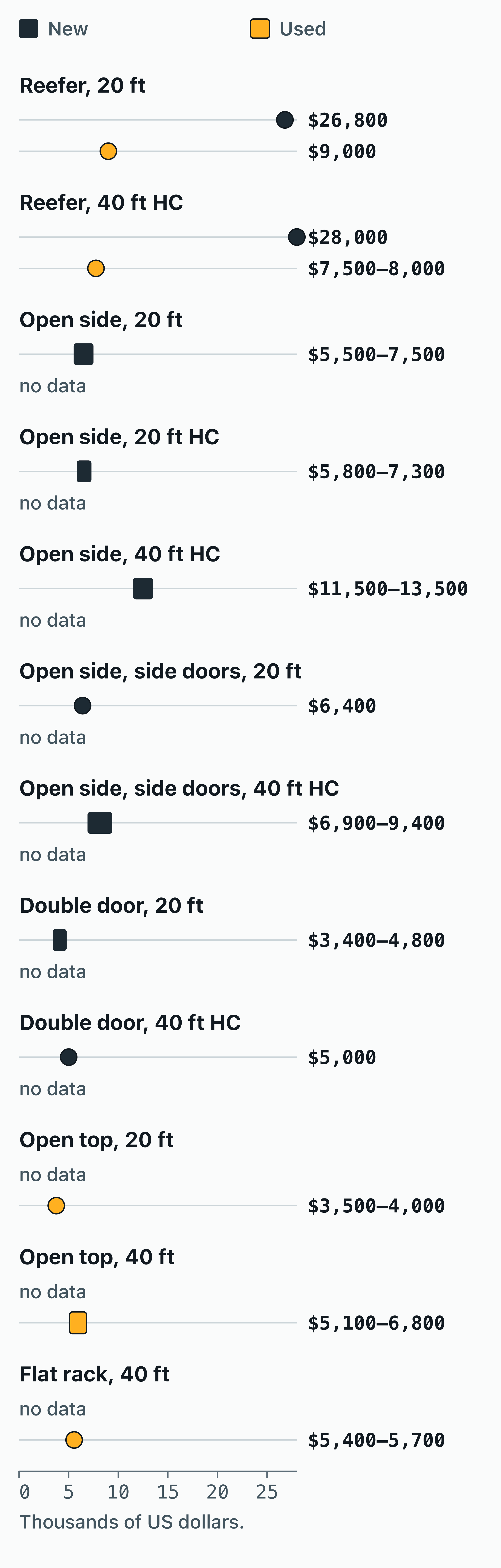
The numbers in this chart
| Type | New | Used |
|---|---|---|
| Reefer, 20 ft | $26,800 | $9,000 |
| Reefer, 40 ft HC | $28,000 | $7,500–8,000 |
| Open side, 20 ft | $5,500–7,500 | — |
| Open side, 20 ft HC | $5,800–7,300 | — |
| Open side, 40 ft HC | $11,500–13,500 | — |
| Open side, side doors, 20 ft | $6,400 | — |
| Open side, side doors, 40 ft HC | $6,900–9,400 | — |
| Double door, 20 ft | $3,400–4,800 | — |
| Double door, 40 ft HC | $5,000 | — |
| Open top, 20 ft | — | $3,500–4,000 |
| Open top, 40 ft | — | $5,100–6,800 |
| Flat rack, 40 ft | — | $5,400–5,700 |
Delivery and foundation: the rest of the cost
Added up, a used cargo-worthy 20 ft delivered within 50 miles and set on ties is about $2,200–3,900, a 40 ft high cube $2,600–4,600. The calculator above adds any other combination.
The price of the box is for one collected from the depot. Most buyers pay a dealer to bring it on a tilt-bed truck that slides it off at the site:
| Distance from the depot | Delivery (USD) |
|---|---|
| Up to 50 miles | $400–800 |
| 50 to 100 miles | $500–800 |
| 100 to 200 miles | $700–1,700 |
On a flatbed instead, a forklift or a crane at your end has to lift the box off. A tilt-bed needs a long straight run of clear access: about 120 ft (36.6 m) for a 40 ft, by two dealers' published site requirements. How the truck sets a box down, and what to prepare, is in moving a shipping container.
Then the ground. A container on soft soil settles unevenly and its doors stop closing, so something goes under the corners:
| Foundation | Cost (USD) |
|---|---|
| Railroad ties or timbers | $100–300 |
| Gravel pad | $300–1,500 |
| Concrete piers | $1,500–6,000 |
| Concrete slab | $3,000–12,000 |
Railroad ties or a gravel pad are enough for storage. Piers and slabs are for a box that becomes an office, a shop or a home; there the price depends more on the builder than on the box (see container homes).
Used container prices by city: ports against inland
A used 20 ft costs about $1,300 in Chicago and $1,400 in Houston, and about $2,550 in Denver, the dearest of the 17 cities we can price. Containers pile up where imports land, and every mile inland adds trucking.
Each figure is the middle of what 2 to 5 companies list for that city: a marketplace's cheapest offer, a depot's price, a dealer's retail price. The spread beside it shows how far apart they are:
| City | Used 20 ft | Used 40 ft high cube |
|---|---|---|
| Atlanta, GA | $1,850 ($1,375–2,199) | $2,350 ($1,700–2,599) |
| Baltimore, MD | $1,550 ($867–1,699) | $2,100 ($1,450–2,225) |
| Charlotte, NC | $2,100 ($1,953–2,300) | $2,600 ($2,600–2,631) |
| Chicago, IL | $1,300 ($625–1,499) | $1,800 ($1,175–2,199) |
| Dallas, TX | $1,700 ($1,025–1,999) | $2,200 ($1,325–2,950) |
| Denver, CO | $2,550 ($2,345–2,799) | $2,900 ($2,829–3,199) |
| Houston, TX | $1,400 ($725–1,799) | $1,950 ($1,200–2,399) |
| Los Angeles / Long Beach, CA | $1,450 ($750–1,699) | $1,650 ($950–2,099) |
| Miami, FL | $1,400 ($900–1,699) | $2,000 ($1,525–2,199) |
| Minneapolis, MN | $1,650 ($1,425–1,999) | $2,300 ($1,725–2,599) |
| Newark, NJ / New York, NY | $1,400 ($750–1,599) | $1,800 ($1,175–2,099) |
| Oakland, CA | $1,700 ($1,345–1,899) | $2,150 ($1,790–2,399) |
| Phoenix, AZ | $2,100 ($1,945–2,284) | $2,950 ($2,790–3,065) |
| Salt Lake City, UT | $2,450 ($2,145–2,799) | $2,900 ($2,075–3,200) |
| Savannah, GA | $1,350 ($725–1,499) | $1,800 ($1,025–2,099) |
| Seattle, WA | $1,850 ($1,425–2,199) | $2,100 ($1,275–2,899) |
| St Louis, MO | $1,600 ($1,290–1,799) | $2,200 ($1,790–2,599) |
Chicago is cheap for an inland city because it is a rail hub: boxes come off the trains and wait there for export. A city missing here is not priced by two sources; the nearest port or rail hub is the guide.

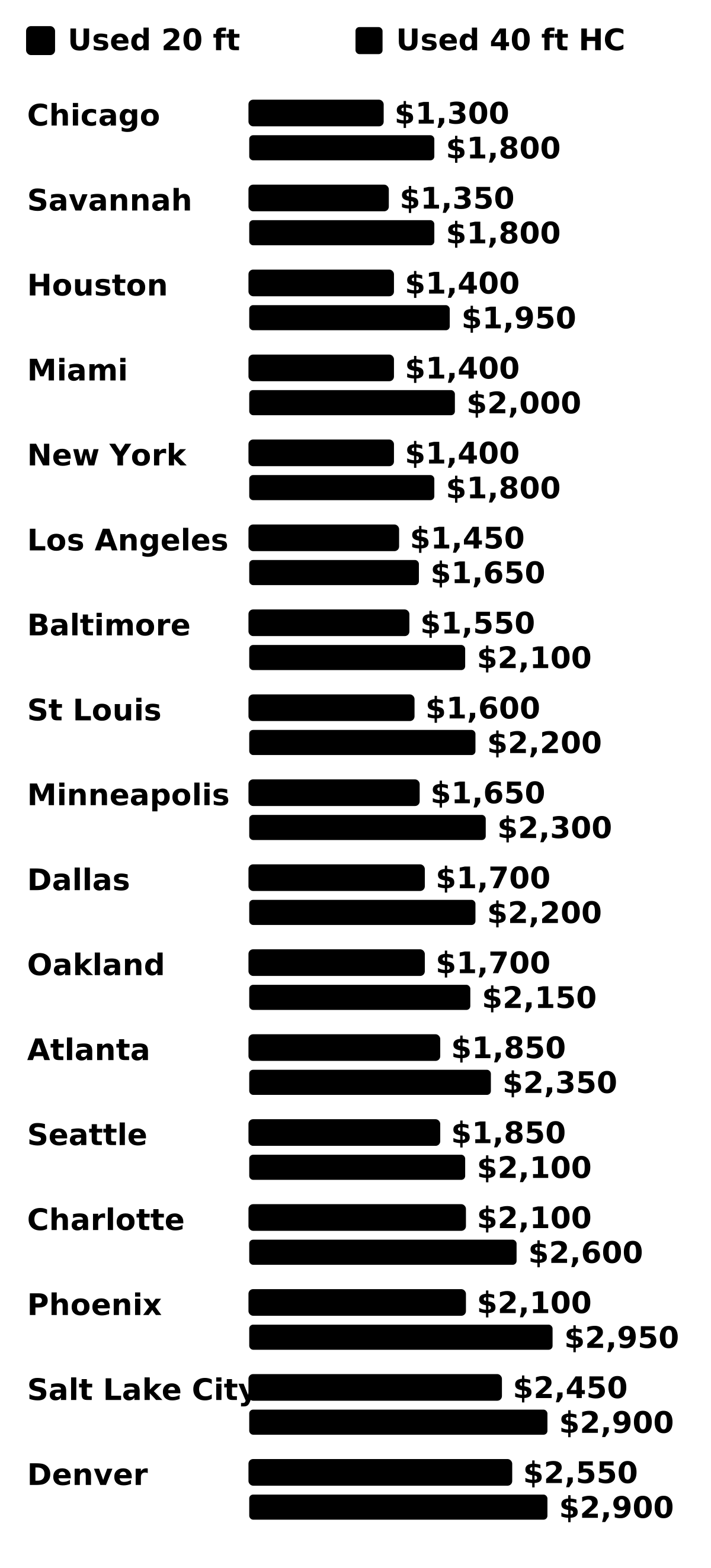
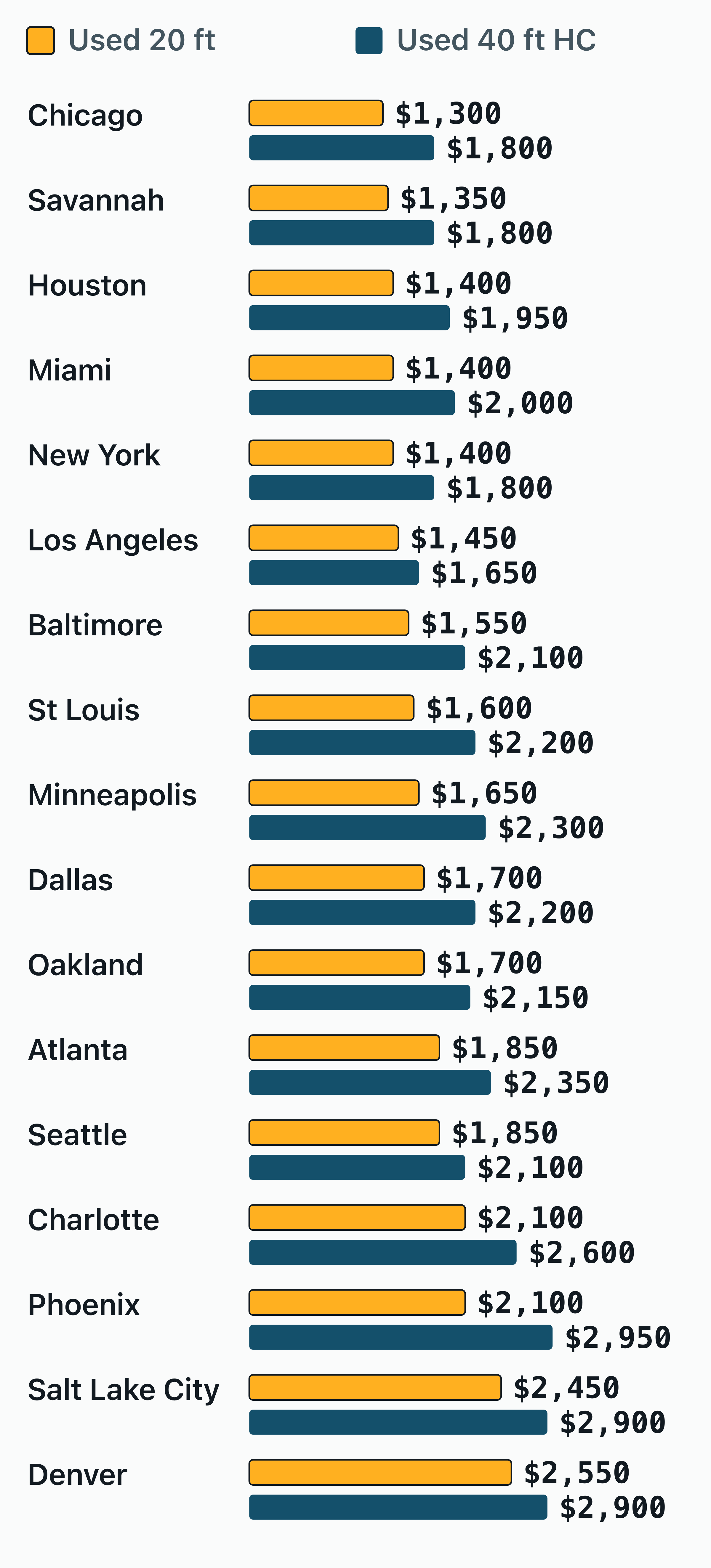
The numbers in this chart
| City | Used 20 ft | Used 40 ft HC |
|---|---|---|
| Chicago, IL | $1,300 | $1,800 |
| Savannah, GA | $1,350 | $1,800 |
| Houston, TX | $1,400 | $1,950 |
| Miami, FL | $1,400 | $2,000 |
| Newark, NJ / New York, NY | $1,400 | $1,800 |
| Los Angeles / Long Beach, CA | $1,450 | $1,650 |
| Baltimore, MD | $1,550 | $2,100 |
| St Louis, MO | $1,600 | $2,200 |
| Minneapolis, MN | $1,650 | $2,300 |
| Dallas, TX | $1,700 | $2,200 |
| Oakland, CA | $1,700 | $2,150 |
| Atlanta, GA | $1,850 | $2,350 |
| Seattle, WA | $1,850 | $2,100 |
| Charlotte, NC | $2,100 | $2,600 |
| Phoenix, AZ | $2,100 | $2,950 |
| Salt Lake City, UT | $2,450 | $2,900 |
| Denver, CO | $2,550 | $2,900 |
Are container prices going up or down?
Down, from the 2021 shortage, and slowly still. Container xChange put the average 40 ft high cube at $4,863 in Long Beach in August 2021 and $5,224 in Savannah in September 2021.
One dealer's weekly national average (Eveon Market Monitor) has a used wind-and-watertight (WWT) 40 ft high cube at $4,421 in March 2022 and $2,251 in the week of 28 September 2026. The same average has a used WWT 20 ft at $2,984 and $1,755.
Container xChange's own reports describe the same shape: a peak in 2021–22, a fall through 2023, a rise in late 2024. But the series in the chart is one company's, and we say so on it.
What moves the price:
- Steel moves one-trip prices: an empty box weighs 1.3 tonnes (10 ft) to 4.7 tonnes (45 ft high cube), most of it Corten steel.
- Freight moves used prices: when ships are short of boxes, fewer are sold off, and depot prices rise.
- The season moves demand: it peaks in spring and early summer, when people build and move. Buyers who can wait do better in late autumn and winter.

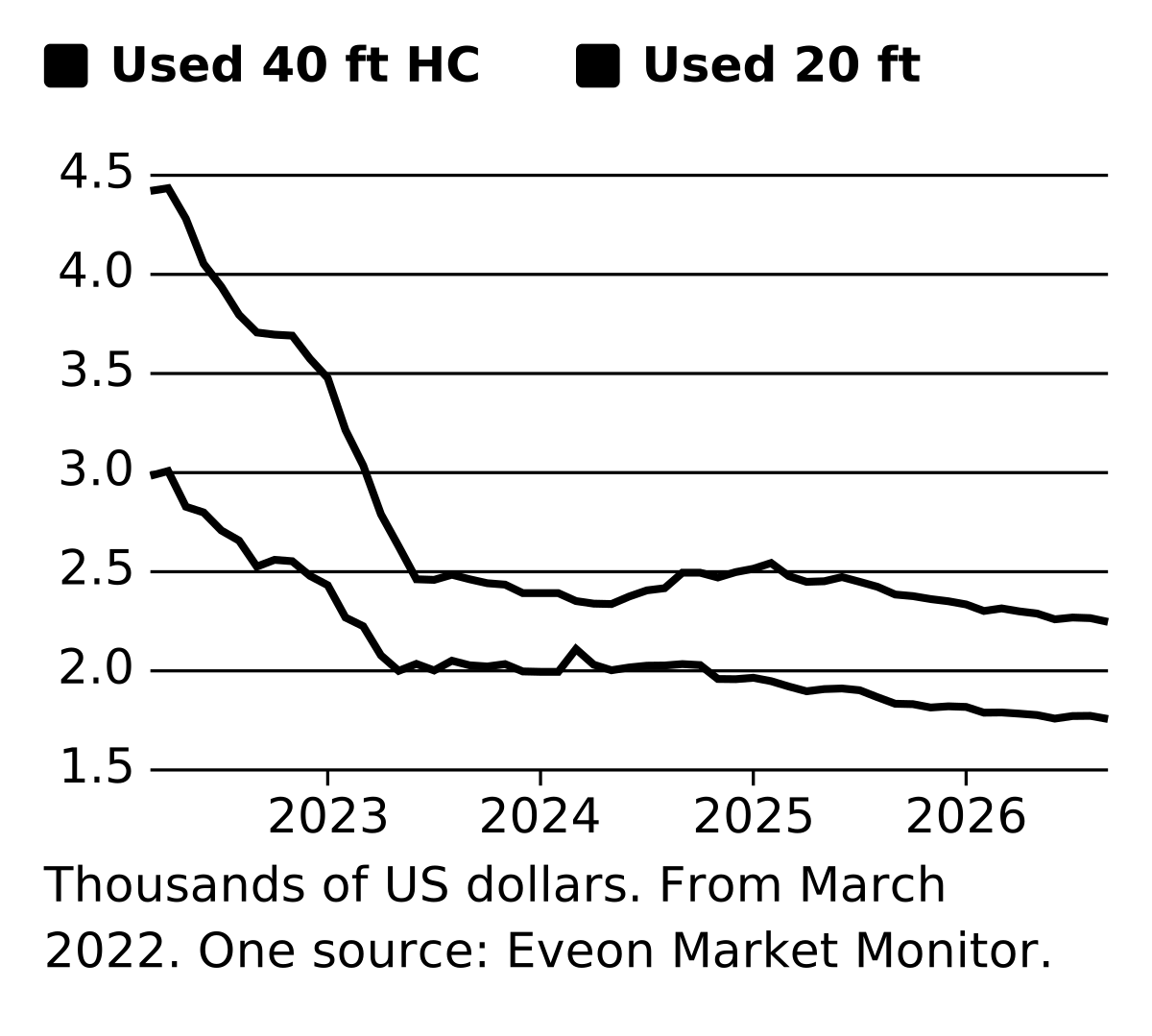
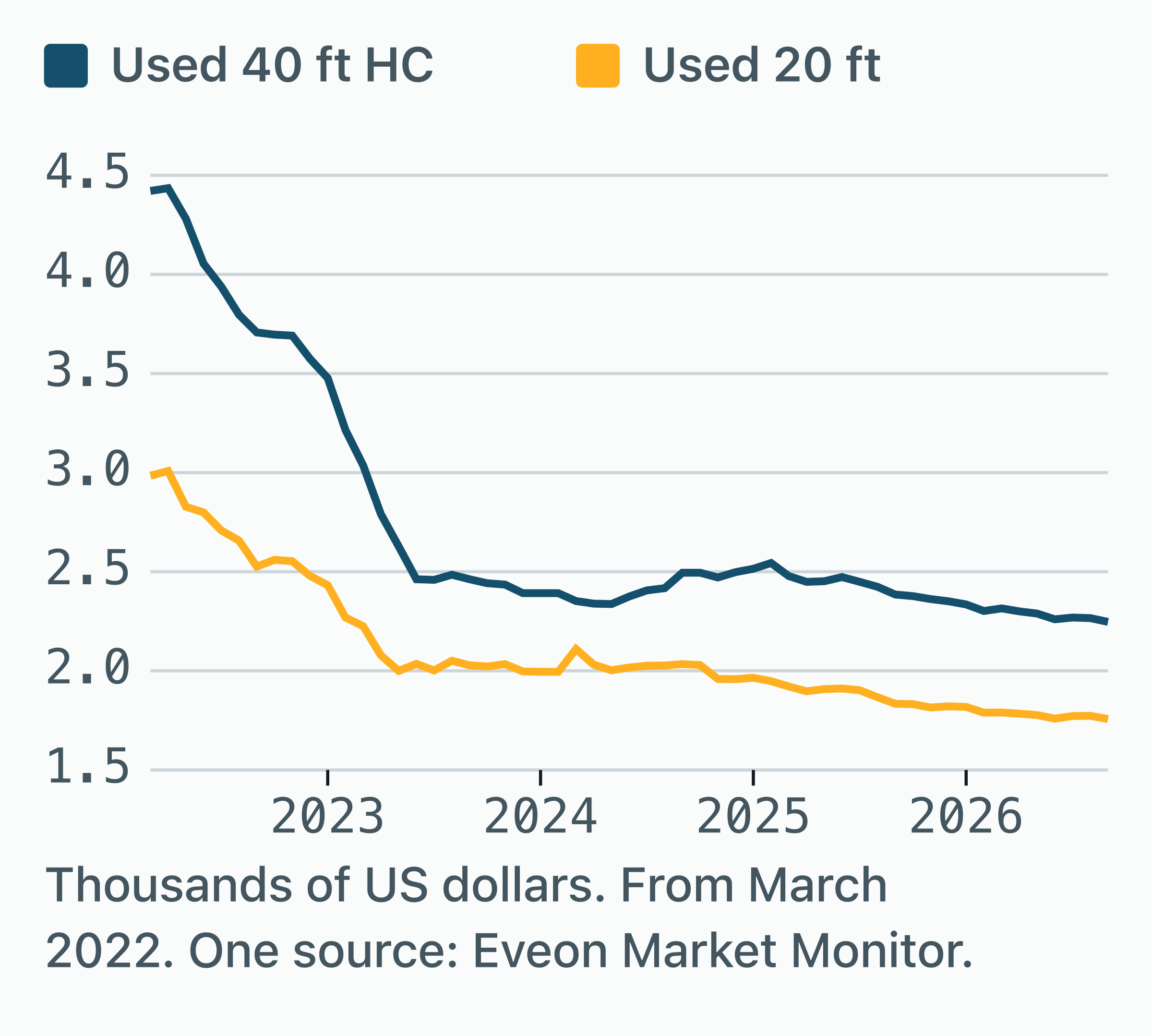
The numbers in this chart
| Month | Used 20 ft | Used 40 ft HC |
|---|---|---|
| 2022-07 | $2,708 | $3,938 |
| 2023-01 | $2,432 | $3,477 |
| 2023-07 | $2,002 | $2,459 |
| 2024-01 | $1,995 | $2,392 |
| 2024-07 | $2,026 | $2,406 |
| 2025-01 | $1,965 | $2,515 |
| 2025-07 | $1,902 | $2,449 |
| 2026-01 | $1,818 | $2,335 |
| 2026-07 | $1,772 | $2,269 |
Renting vs buying: when a purchase pays for itself
| Size | Rent a month (USD) |
|---|---|
| 20 ft | $100–200 |
| 40 ft | $150–250 |
| 40 ft high cube | $180–200 |
| Delivery, each way | $150–200 |
| Pickup at the end | $150–400 |
Against a $1,700–2,800 purchase, renting a 20 ft has cost as much as buying after 9 to 28 months — about 15 at mid-range prices. Rent for a project shorter than that; buy for anything longer.
Buying also leaves you an asset: a container that keeps its roof and door gaskets sound loses value slowly.

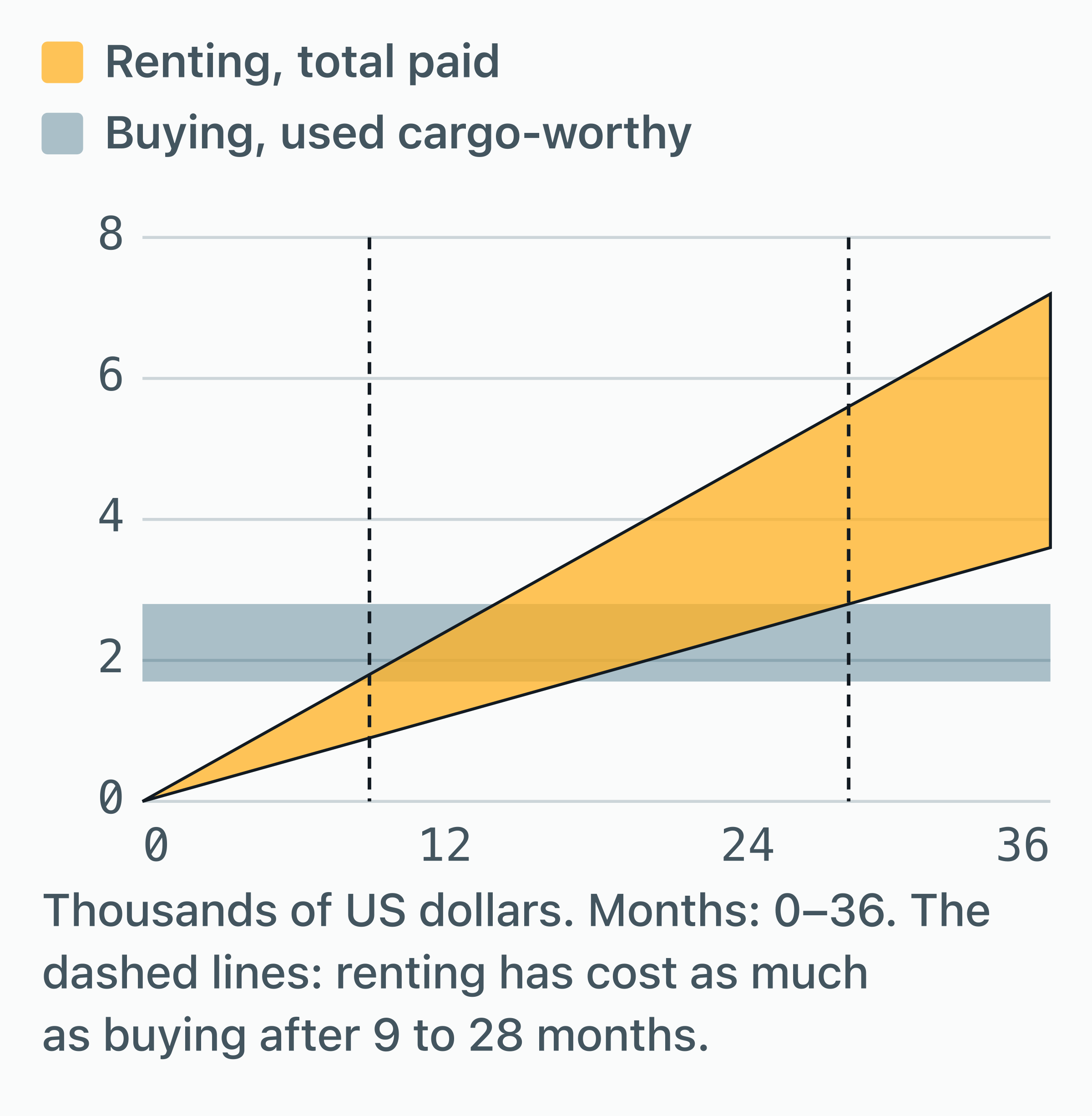
The numbers in this chart
| Months | Rent paid, low | Rent paid, high |
|---|---|---|
| 6 | $600 | $1,200 |
| 12 | $1,200 | $2,400 |
| 18 | $1,800 | $3,600 |
| 24 | $2,400 | $4,800 |
| 36 | $3,600 | $7,200 |
How much does condition change the price?
More than size does. What each grade means:
- One-trip means effectively new.
- Cargo-worthy means graded sound enough to carry cargo by sea. That is a seller’s or surveyor’s word; the certificate is an in-date CSC plate.
- Wind-and-watertight means dry but uncertified. That is enough for static storage, and the best value if the box will never sail again.
What each grade certifies, and what to check before believing it, is in the container grades guide. The inspection itself is covered step by step in buying a shipping container.
How to avoid shipping container scams
Fake container sellers are common enough that Better Business Bureau offices publish warnings about them. The bait is a price no real depot can match — two dealers' warning pages name a 20 ft for $500 — on a website copied from a real dealer. Walk away when you see any of these:
- A price far below the ranges on this page, for the same size and condition.
- Payment only by wire transfer, a payment app, gift cards or crypto — money you cannot get back.
- Full payment before delivery, and no way to see the container or the depot first.
- An address that is a house, an empty lot or another company’s yard.
- A website that copies a known dealer’s name, photos or text, often on a domain registered weeks ago.
- Pressure to pay today, and new fees after you have paid — “customs”, “insurance”, “delivery release”.
- Reviews that all appeared at once, or none anywhere but on the seller’s own site.
Cases a Better Business Bureau office published:
- 2024-06-18 — Springfield, MO (BBB St. Louis): reported lost $3,879
- 2025-11-10 — Council Bluffs, IA (BBB of the Midwest Plains via 10/11 NOW): reported lost $8,000
- 2026-09-10 — Canfield, OH (WKBN reporting BBB of the Mahoning Valley): warning issued, losses not stated
The safe way to buy:
- See the box, or a recent photo with its container number.
- Look the number up: the owner prefix tells you whose box it is (see container tracking).
- Visit or call the depot named on the invoice.
- Pay by card or after delivery wherever the seller allows it.
Where these numbers come from
Each range runs from the median of the sources' low ends to the median of their high ends, rounded to $100. A figure needs at least two sources; where only one company publishes a price, we give none.
Nothing in the tables was chosen by hand. Two sources that print the same table count as one: shipping-containers.com repeats CHS Container Group, and one dealer's city table repeats another's.
Sources: 31 pages, with links
- Angi 2026-10-09
- BBB of the Midwest Plains via 10/11 NOW 2025-11-10
- BBB St. Louis 2024-06-18
- Cascade Container 2026-10-09
- Central Virginia Containers 2026-10-09
- CHS Container Group 2026-10-09
- Conex Depot 2026-10-09
- Conexwest 2026-10-09
- Container Management Inc. dealer, 2026-08-25
- Container xChange marketplace, 2025-03-16
- ContainerCompass price guide, 2026
- ContainerPricer 2026-10-09
- ContainersX 2026-10-09
- Dry Box 2026-10-09
- Eveon Containers dealer, 2026-06-16
- Get Simple Box dealer, 2026-09-03
- GiantLockBox 2026-10-09
- Interport 2026-10-09
- Kwote Advisor 2026-10-09
- metal-buildings.org 2026-10-09
- Midstate Containers 2026-10-09
- On-Site Storage Solutions 2026-10-09
- Pelican Containers dealer, 2026-02-21
- RentalHawk 2026-10-09
- shipping-containers.com price guide, 2026-06-17
- SiteBox Storage 2026-10-09
- STOMO Storage 2026-10-09
- Western Container Sales 2026-10-09
- WKBN reporting BBB of the Mahoning Valley 2026-09-10
- Worthy Container 2026-10-09
- YES Containers dealer, 2026-06-05
What is left out, and why. Prices that include delivery are a different quantity and are not mixed in. A "from" price is not a range.
Prices move, and a page read on a given day describes that day. When a dealer's quote disagrees with this page, the quote is the fact and the page is the context. The ranges and every observation behind them are in the open price data.
Frequently asked questions
How much does a shipping container cost?
A used cargo-worthy 20 ft costs $1,700–2,800 in the US in October 2026 and a one-trip $2,800–4,400; a used 40 ft high cube $2,100–3,500 and one-trip $4,000–5,600. A wind-and-watertight 20 ft, dry but not certified to sail, costs $1,300–2,300. Delivery within 50 miles adds $400–800.
How much is a 20 ft shipping container?
A used 20 ft costs $1,700–2,800 cargo-worthy or $1,300–2,300 wind and watertight, and a new one-trip 20 ft $2,800–4,400. Delivered within 50 miles and set on railroad ties, a used one comes to about $2,200–3,900.
How much is a 40 ft container?
A used cargo-worthy 40 ft standard costs $2,100–3,400; the more common 40 ft high cube $2,100–3,500 used and $4,000–5,600 one-trip. Near major import ports and rail hubs expect the bottom of those ranges; inland, the top.
How much is a 10 ft shipping container?
A 10 ft costs $2,500–3,700 used and $3,500–5,000 new — more than a 20 ft for half the space, because tens are built in small numbers or cut down from twenties. For most storage a used 20 ft is the better buy.
How much does a refrigerated (reefer) container cost?
A used 20 ft reefer with a working unit costs about $9,000 and a used 40 ft high cube reefer $7,500–8,000; new, a 40 ft high cube reefer is about $28,000. A reefer whose unit does not work sells for less — about $7,300 for a 20 ft.
How much does it cost to deliver a shipping container?
Delivery costs $400–800 within 50 miles of the depot, $500–800 for 50 to 100 miles and $700–1,700 for 100 to 200 miles, on a tilt-bed truck. A flatbed needs a forklift or crane at your end to lift the box off.
Can you buy a shipping container for under $1,000?
Rarely, and an advert that offers one is the commonest bait of container scams: the cheapest used 20 ft we see is $1,300–2,300 wind and watertight, and two dealers' warnings name a 20 ft for $500 as a scam price. A damaged box sold as-is can go lower — see it before you pay.
How much do 12 shipping containers cost?
Twelve used 20 ft boxes cost about $20,400–33,600 and twelve used 40 ft high cubes $25,200–42,000, before delivery — the same per-box range times twelve. A dealer may discount a batch, and delivery is charged per box or per truck.
Is it cheaper to build a shed or buy a shipping container?
For secure storage, a container usually wins: a used 20 ft at $1,700–2,800 plus $400–800 of delivery gives 13.9 m² (149 ft²) of floor in a steel box that needs no building permit in many places. A shed is cheaper to make pretty and to insulate; see container sheds.
Is it cheaper to rent or buy a shipping container?
Renting a 20 ft costs $100–200 a month, so buying at $1,700–2,800 pays for itself in 9 to 28 months. Rent for short projects; buy for anything longer than that — and the box keeps resale value afterwards.
Are container prices going up or down?
Down from the 2021 shortage: one dealer's national average for a used wind-and-watertight (WWT) 40 ft high cube fell from $4,421 in March 2022 to $2,251 in September 2026, and today's used WWT range is $1,700–3,200. Prices follow steel, freight rates and local supply, and are lowest near ports.
Why are containers cheaper near ports?
Because that is where the empty boxes are: a used 20 ft costs about $1,400 in Houston and about $2,550 in Denver. Import-heavy ports and rail hubs accumulate containers that carriers would rather sell than ship back empty, and every mile inland adds trucking.