ISO 45G1 · 2 TEU
40 ft High Cube Container Dimensions
 Yuri Kan Checked against 20 of 88 published sheets Updated
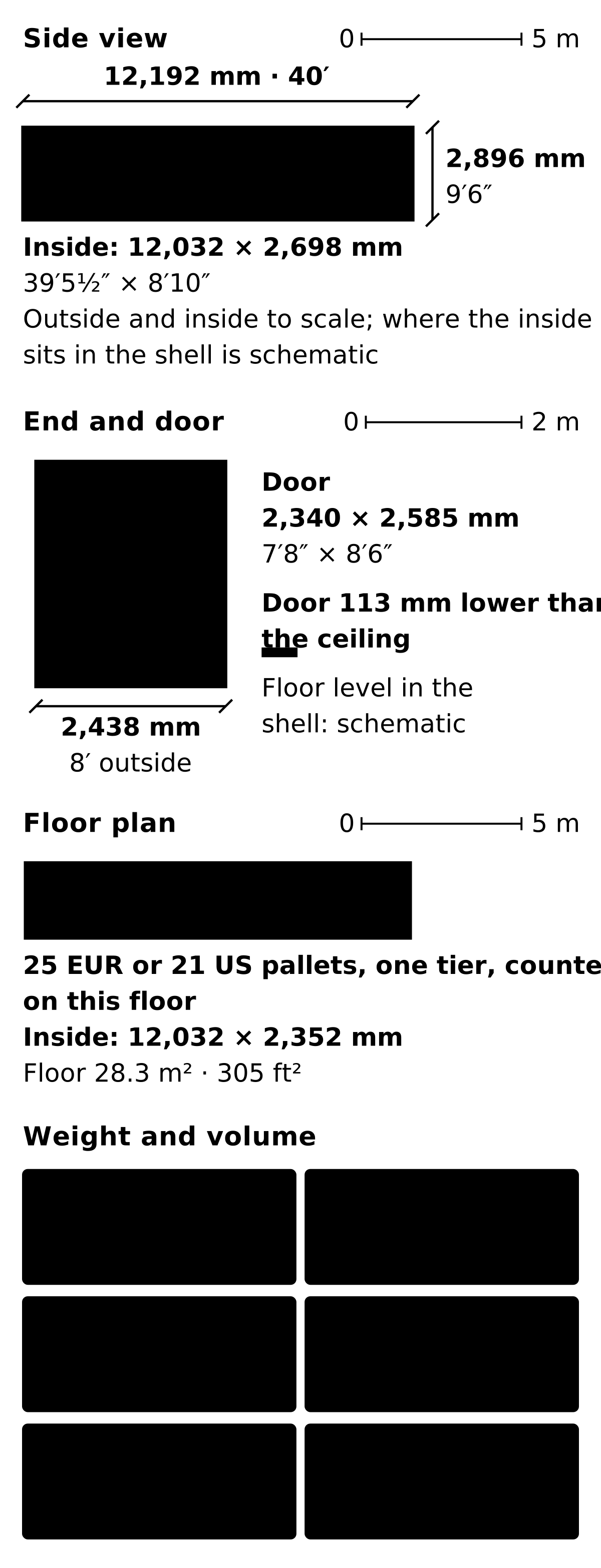
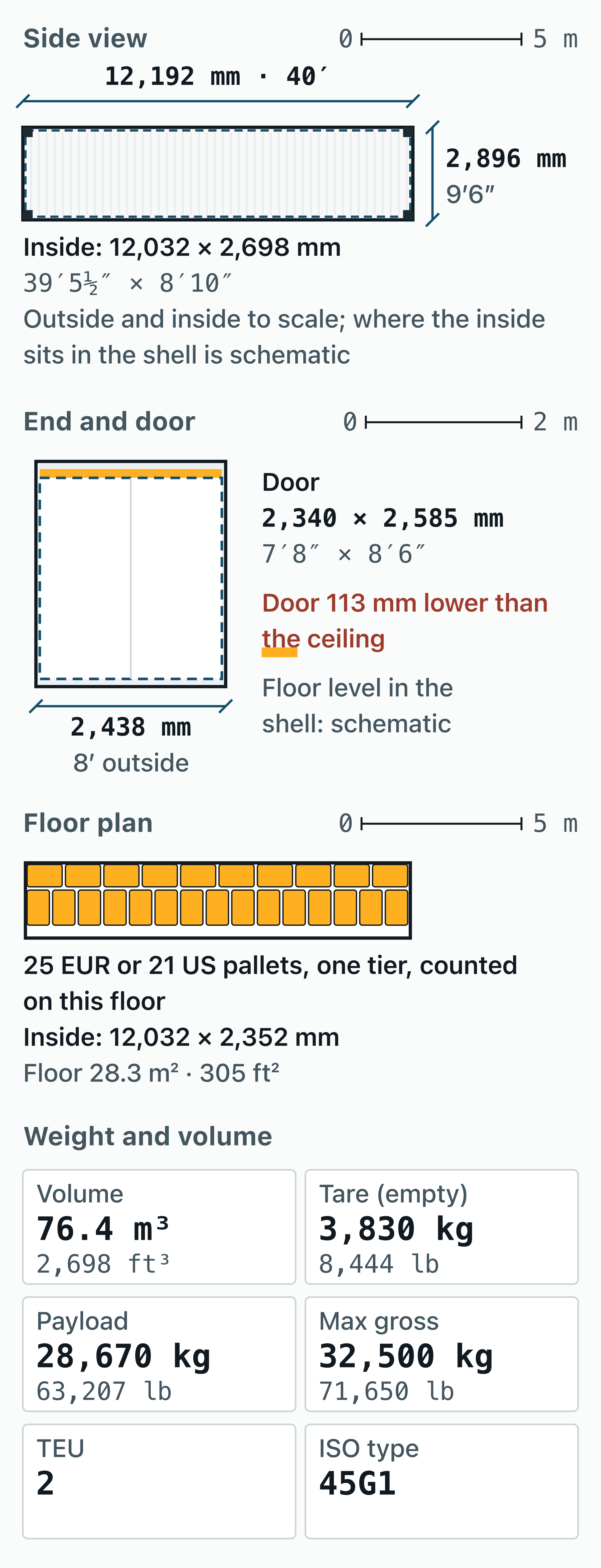
A 40 ft high cube container is 40′ × 8′ × 9′6″ outside (12.192 × 2.438 × 2.896 m), 39′5½″ × 7′8½″ × 8′10″ inside (12.032 × 2.352 × 2.698 m), door 7′8″ × 8′6″ (2.340 × 2.585 m): 76.4 m³ (2,698 ft³), tare 3,830 kg (CMA CGM prints 3,900), max gross 32,500 kg, payload 28,670 kg. ContSize, 2026: sizes per ISO 668; inside, per 13 of 19 sheets; tare: per 10 of 19 sheets.
The numbers in this chart
| Measure | Metric | Imperial |
|---|---|---|
| Length outside | 12,192 mm | 40′ |
| Width outside | 2,438 mm | 8′ |
| Height outside | 2,896 mm | 9′6″ |
| Length inside | 12,032 mm | 39′5½″ |
| Width inside | 2,352 mm | 7′8½″ |
| Height inside | 2,698 mm | 8′10″ |
| Door width | 2,340 mm | 7′8″ |
| Door height | 2,585 mm | 8′6″ |
| Floor area | 28.3 m² | 305 ft² |
| Volume | 76.4 m³ | 2,698 ft³ |
| Tare (empty) | 3,830 kg | 8,444 lb |
| Payload | 28,670 kg | 63,207 lb |
| Max gross | 32,500 kg | 71,650 lb |
| TEU | 2 | — |
| ISO type | 45G1 | — |
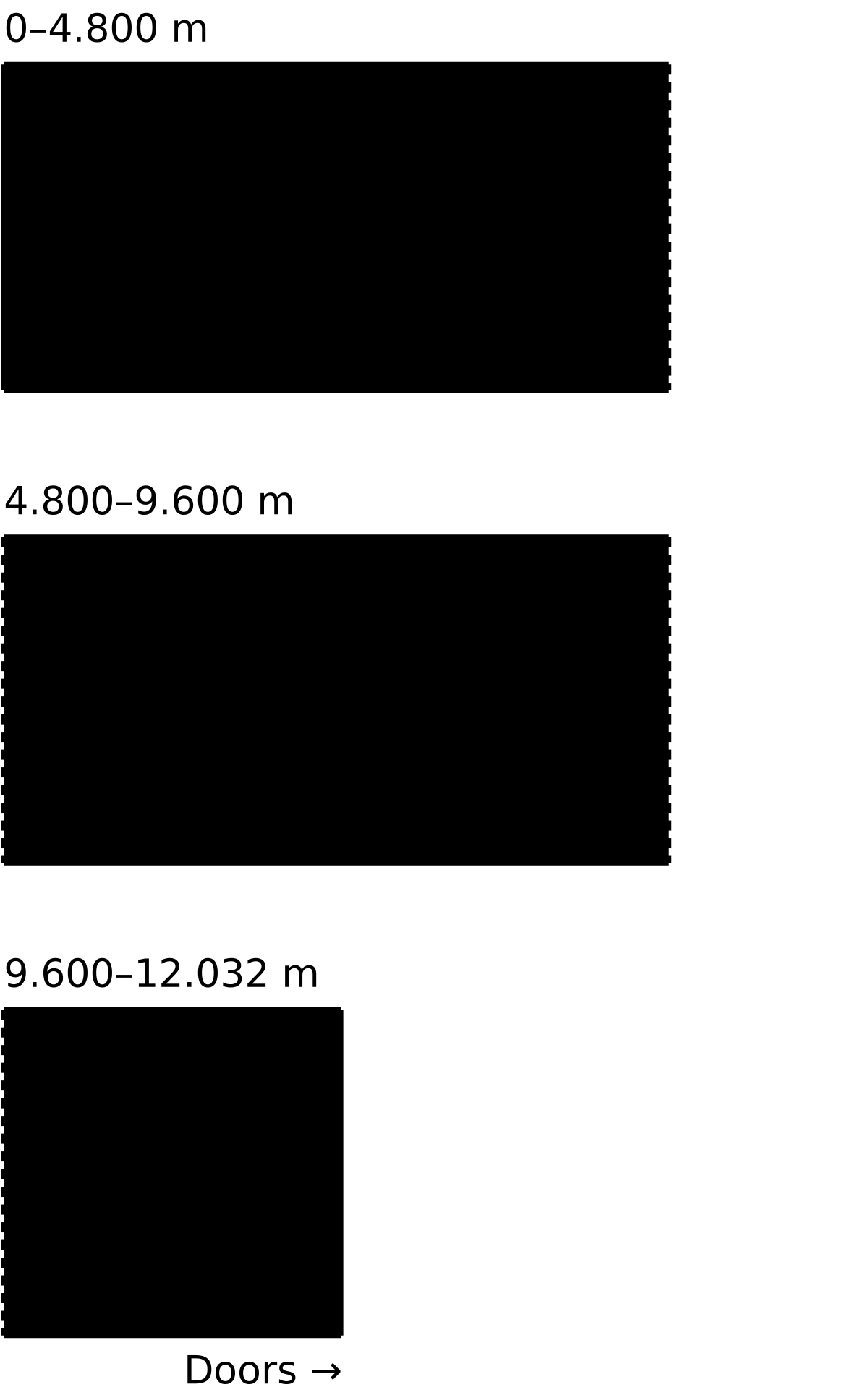
| EUR pallets, one tier (counted) | 25 | — |
| US pallets, one tier (counted) | 21 | — |
Checked : outside sizes set by ISO 668, read in IS 6566:2001, GOST R 51876-2008 and GOST R 53350-2009; every other figure against 20 published sheets of 20 lines, lessors and makers. A sheet agrees within ±5 mm, or ±2 % for a mass and ±1 % for a volume; a maximum gross is a rating and must be the same. Every figure and its sources
40 ft high cube container: dimensions and weight
| Metric | Imperial | |
|---|---|---|
| External dimensions | ||
| Length | 12.192 m 40 ft high cube container · Outside length 12,192 mm Set by the standard | 40′ |
| Width | 2.438 m 40 ft high cube container · Outside width 2,438 mm Set by the standard | 8′ |
| Height | 2.896 m 40 ft high cube container · Outside height 2,896 mm Set by the standard | 9′6″ |
| Internal dimensions | ||
| Length | 12.032 m | 39′5½″ |
| Width | 2.352 m | 7′8½″ |
| Height | 2.698 m | 8′10″ |
| Door opening | ||
| Width | 2.340 m | 7′8″ |
| Height | 2.585 m | 8′6″ |
| Specification | ||
| Tare weight | 3,830 kg | 8,444 lb |
| Max gross weight | 32,500 kg | 71,650 lb |
| Max payload | 28,670 kg | 63,207 lb |
| Capacity (volume) | 76.4 m³ | 2,698 ft³ |
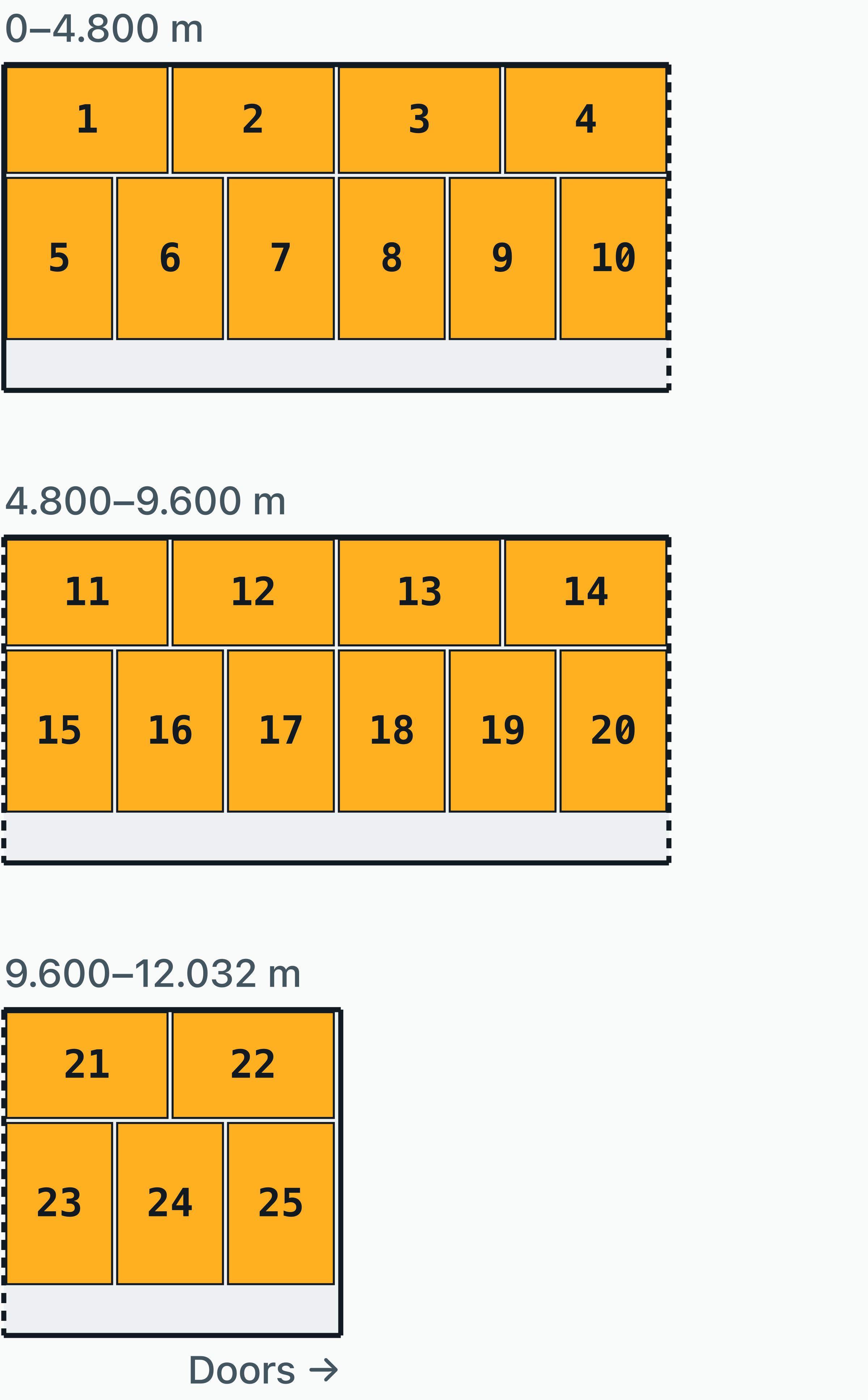
| Pallets (one tier, counted on the floor) | 25 EUR · 21 US | |
| TEU | 2 | |
Beside each figure, its evidence: ISO set by the standard · ✓ 16 sheets that agree, counted · range the sheets disagree · 1 sheet one source. A mark opens the sheets behind the figure.
Checked : outside sizes set by ISO 668, read in IS 6566:2001, GOST R 51876-2008 and GOST R 53350-2009; every other figure against 20 published sheets of 20 lines, lessors and makers. A sheet agrees within ±5 mm, or ±2 % for a mass and ±1 % for a volume; a maximum gross is a rating and must be the same. Every figure and its sources
Machine-readable: /data/containers.json · closest published sheet: CMA CGM, 9 of 9 figures
Data: ISO 668 (1995 text, read in IS 6566:2001) · CMA CGM Equipment Guide · Evergreen Container Specifications · Hapag-Lloyd Container Specifications · Maersk Container Specifications · ONE Container Specifications · Singamas product range · COSCO, Crowley, HMM, Matson, MSC, OOCL, Seaco, SeaCube, Textainer, TOTE, Trailer Bridge, Triton, Yang Ming, ZIM
A 40 ft high cube is one foot taller than a standard forty, which adds 8.7 m³ on the same 28.3 m² (305 ft²) floor and the same slot on the ship. It holds 25 EUR or 21 US pallets per tier, as the standard forty does, and counts as 2 TEU — the box for light, voluminous cargo, racking and conversions.


The numbers in this chart
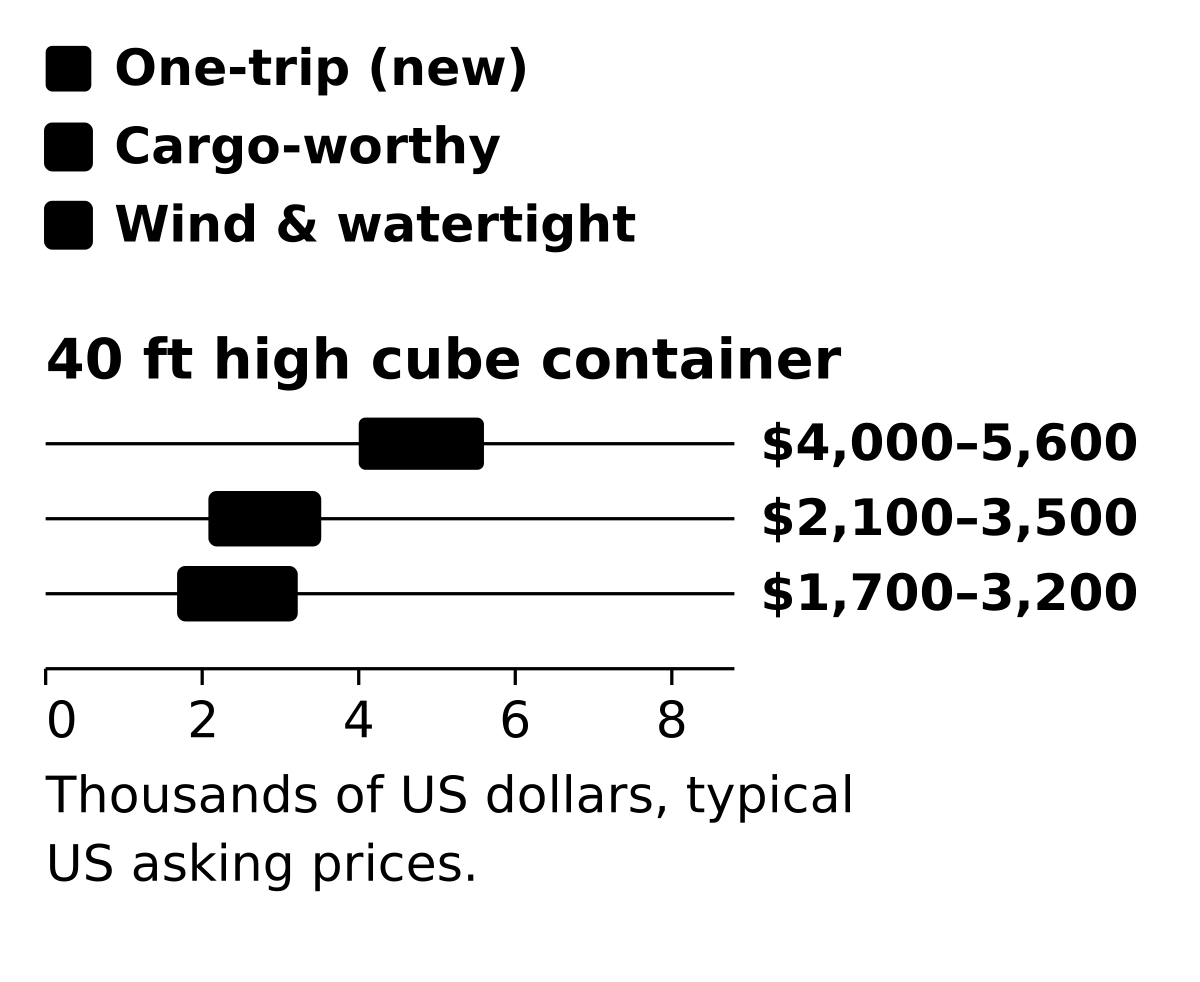
| Size | One-trip (new) | Cargo-worthy | Wind & watertight |
|---|---|---|---|
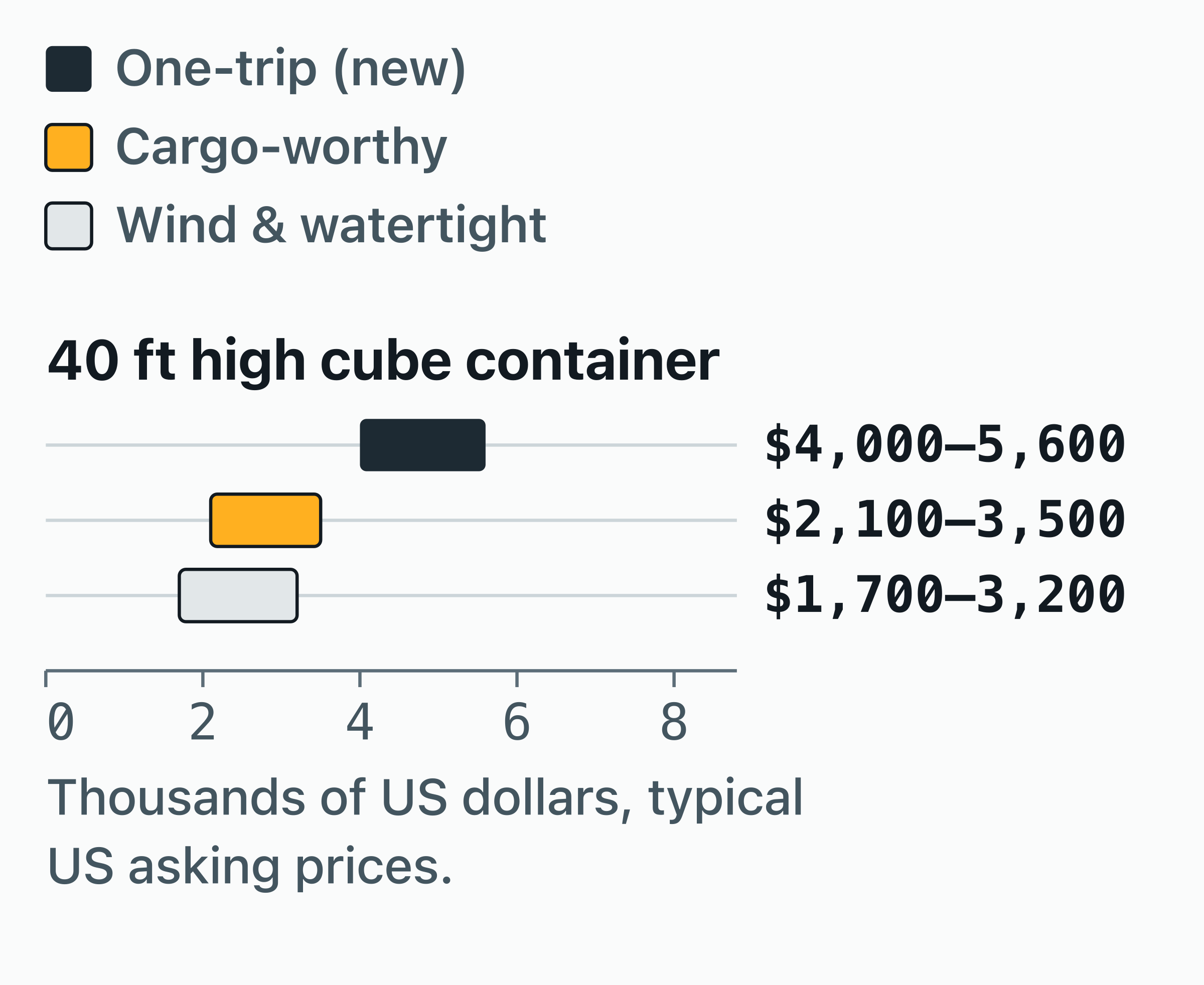
| 40 ft high cube container | $4,000–5,600 | $2,100–3,500 | $1,700–3,200 |

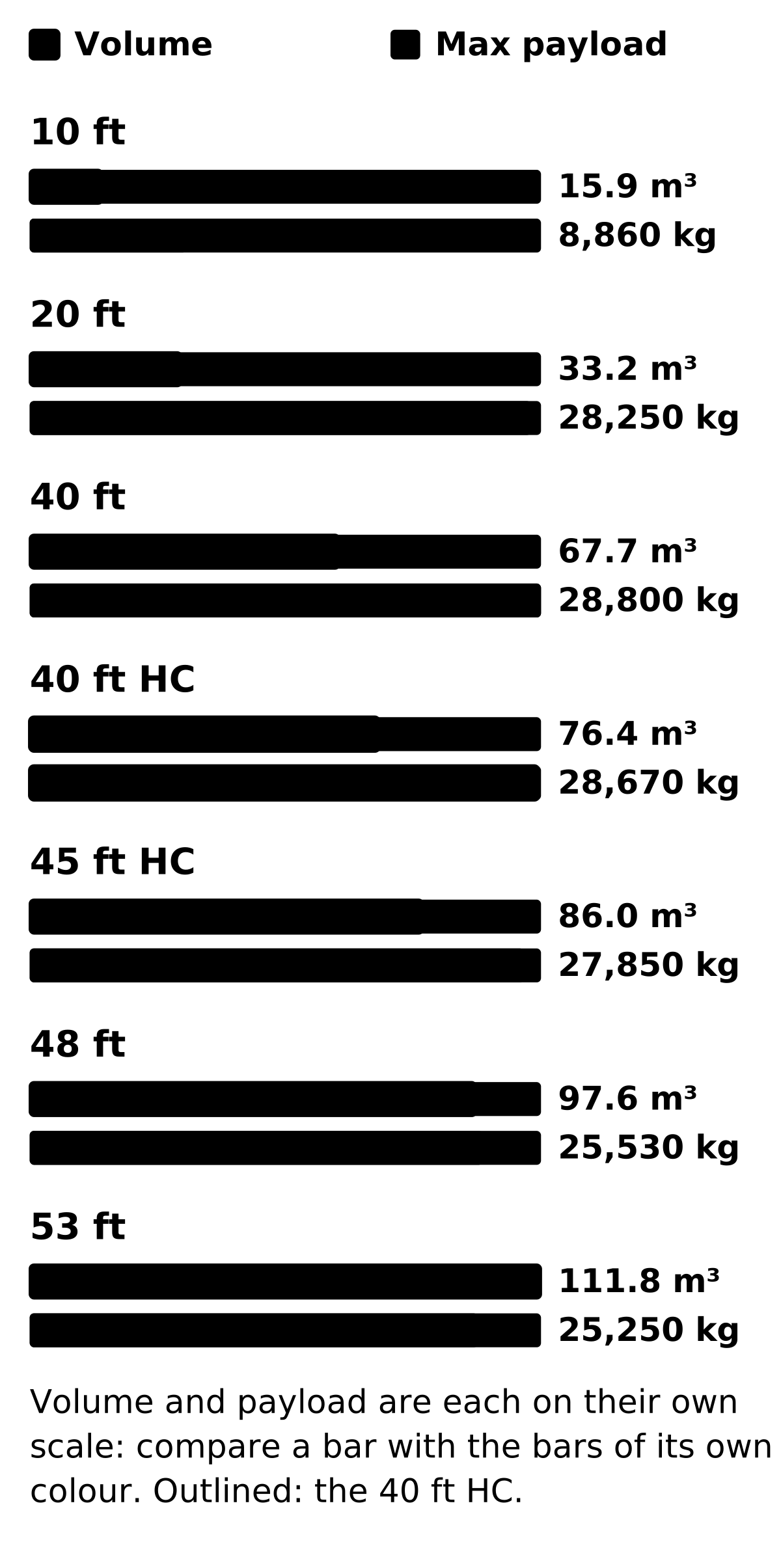
The numbers in this chart
| Size | Volume | Max payload |
|---|---|---|
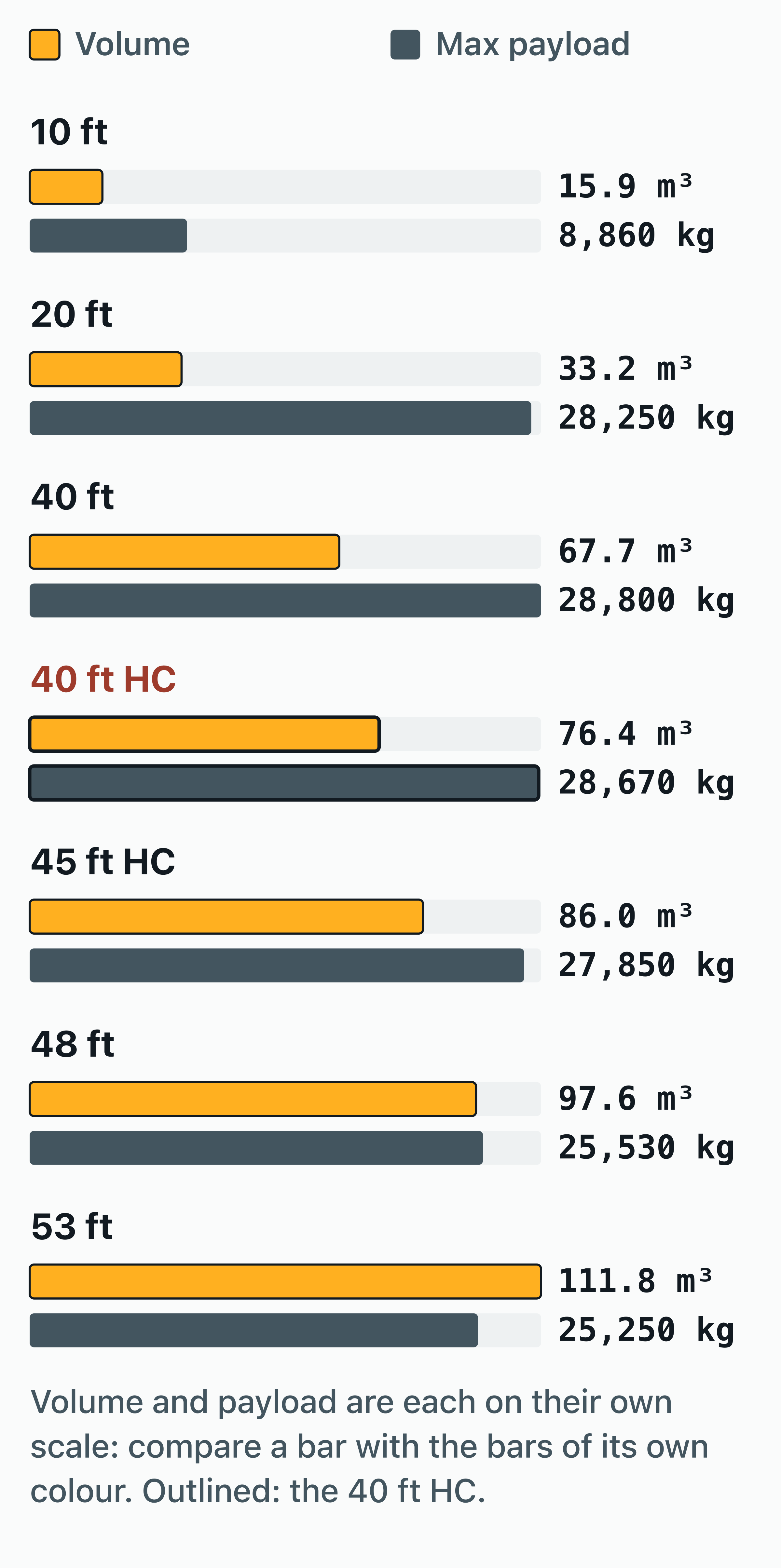
| 10 ft container | 15.9 m³ · 562 ft³ | 8,860 kg · 19,533 lb |
| 20 ft container | 33.2 m³ · 1,172 ft³ | 28,250 kg · 62,281 lb |
| 40 ft container | 67.7 m³ · 2,391 ft³ | 28,800 kg · 63,493 lb |
| 40 ft high cube container | 76.4 m³ · 2,698 ft³ | 28,670 kg · 63,207 lb |
| 45 ft high cube container | 86.0 m³ · 3,037 ft³ | 27,850 kg · 61,399 lb |
| 48 ft container | 97.6 m³ · 3,447 ft³ | 25,530 kg · 56,284 lb |
| 53 ft container | 111.8 m³ · 3,948 ft³ | 25,250 kg · 55,667 lb |
Checked : the figures in this chart against 42 of 88 published sheets from 27 lines, lessors, makers and rail and road operators: those that print these figures. A sheet agrees within ±5 mm, or ±2 % for a mass and ±1 % for a volume; a maximum gross is a rating and must be the same. Every figure and its sources
What a 40 ft high cube container is used for
The 40 ft high cube (ISO type 45G1) is a standard 40 ft container with one extra foot of height: 2.896 m (9′6″) externally against 2.591 m (8′6″). That foot adds 8.7 m³, taking capacity from 67.7 to 76.4 m³ — for essentially the same slot on the ship.
An internal height of 2.698 m makes the high cube the minimum choice for cargo, racking or conversions needing more than 2.393 m of clearance.
The extra height carries through to the doors: the opening is 2.340 m wide × 2.585 m high, against 2.280 m on a standard box (per 13 of 19 sheets). Those extra 305 mm of door clearance matter for tall crates, racked garments and machinery on skids.
The trade-offs are minor. Tare rises slightly to about 3,830 kg, and on the same 32,500 kg gross rating the payload stays close to a standard forty’s, at around 28,670 kg. The only real caution is overall height on the road, covered in the FAQ below.
The 40 ft high cube container on one page, plus the whole pack
Every dimension in millimetres, metres and feet, the door opening, tare, payload and volume, and the floor drawn to scale with EUR and US pallets on it. In the same email, the container pack: all 17 containers by the job, 17 sheets like this one, the 85 owner prefixes, an A3 wall chart and an Excel workbook.
- 17 containers, by the job
- 17 container sheets
- 85 owner prefixes
The bot check did not finish, so nothing was sent. Send the form again; if it stops again, allow challenges.cloudflare.com in your blocker or write to info@contsize.com from the address the file should go to.
Nothing was sent: the address could not be read, or a required box was not ticked. Check them and send the form again.
What fits in a 40 ft high cube
The floor plan is identical to the standard 40 ft — 25 EUR pallets or 21 US pallets per tier. The gain is all vertical: 305 mm more stacking height, which for double-stacked pallets or tall crates decides whether the load fits at all. The volume on one page, the figure first: how many CBM a 40 ft high cube is.
76.4 m³ of volume with a payload around 28,670 kg makes the high cube the usual pick for light, bulky cargo, and the standard pick for container homes and offices thanks to the extra ceiling height after insulation.
The arithmetic is easy to picture: two pallet loads stacked before loading pass the 2.585 m door when each stands no more than half of it, pallet included: 2,585 ÷ 2 ≈ 1,290 mm (4′3″), or 2,280 ÷ 2 = 1,140 mm (3′9″) in a standard forty; pallets stacked inside the box need only half the inside height: 2,698 ÷ 2 ≈ 1,340 mm (4′5″), or 2,393 ÷ 2 ≈ 1,190 mm (3′11″) in a standard forty (each rounded down to the centimetre). Many carton sizes gain a whole extra tier, which a container load calculator shows for your own carton. For light, cube-out cargo — furniture, garments, toys, insulation — the 8.7 m³ bonus translates directly into fewer containers per shipment.
For conversions, floor build-up and roof insulation come off the 2.698 m raw ceiling; a standard-height box starts 305 mm lower, at 2.393 m, before any of that is taken. How much headroom is left depends on the build-up and on the building code where the box will stand, which is why most container-home plans start from a high cube.
40 ft high cube vs standard
| 40 ft high cube container | 40 ft container | |
|---|---|---|
| ISO type code | 45G1 | 42G1 |
| External dimensions — Length | 12.192 m40′ | 12.192 m40′ |
| External dimensions — Width | 2.438 m8′ | 2.438 m8′ |
| External dimensions — Height | 2.896 m9′6″ | 2.591 m8′6″ |
| Internal dimensions — Length | 12.032 m39′5½″ | 12.032 m39′5½″ |
| Internal dimensions — Width | 2.352 m7′8½″ | 2.352 m7′8½″ |
| Internal dimensions — Height | 2.698 m8′10″ | 2.393 m7′10″ |
| Tare weight | 3,830 kg8,444 lb | 3,700 kg8,157 lb |
| Max gross weight | 32,500 kg71,650 lb | 32,500 kg71,650 lb |
| Max payload | 28,670 kg63,207 lb | 28,800 kg63,493 lb |
| Capacity (volume) | 76.4 m³2,698 ft³ | 67.7 m³2,391 ft³ |
| EUR pallets | 25 | 25 |
| TEU | 2 | 2 |
Every figure checked: ISO 668 + 25 published sheets · · Every figure and its sources
Data: ISO 668 (1995 text, read in IS 6566:2001) · CMA CGM Equipment Guide · Evergreen Container Specifications · Hapag-Lloyd Container Specifications · Maersk Container Specifications · ONE Container Specifications · Singamas product range · COSCO, Crowley, HMM, Matson, MSC, OOCL, Seaco, SeaCube, Textainer, TOTE, Trailer Bridge, Triton, Yang Ming, ZIM
Frequently asked questions
What are the dimensions of a 40 ft high cube container?
A 40 ft high cube is 12.032 × 2.352 × 2.698 m inside (39′5½″ × 7′8½″ × 8′10″) and 12.192 × 2.438 × 2.896 m outside (40′ × 8′ × 9′6″) — per ISO 668; inside, per 13 of 19 sheets. The door is 2.340 × 2.585 m (per 13 of 19 sheets), and the capacity 76.4 m³ (2,698 ft³).
How tall is a high cube container?
A high cube is 2.896 m (9′6″) tall outside, per ISO 668 — exactly one foot more than a standard container. Its internal height is 2.698 m (8′10″), per 13 of 19 sheets, against 2.393 m (7′10″) in a standard unit.
How many cubic metres (cubic feet) is a 40 ft high cube?
A 40 ft high cube holds 76.4 m³ (2,698 ft³) inside — per all 19 sheets, within 76.0–76.5 m³. That is 8.7 m³ more than a standard forty (67.7 m³); cartons and pallets never fill every corner, so plan cargo on about 64.9 m³, roughly 85% of it.
How much does a 40 ft high cube container cost?
In October 2026, used cargo-worthy 40 ft high cubes typically sell for $2,100–3,500 in the US and one-trip units for $4,000–5,600, against $2,100–3,400 for a used standard-height forty. Prices vary by market and location; supply is best near major ports.
How many square meters (square feet) is a 40 ft high cube?
A 40 ft high cube has the same floor as a standard 40 ft: about 28.3 m² (305 ft²), from an internal footprint of 12.032 × 2.352 m (39′5½″ × 7′8½″), per 15 of 19 sheets. The gain over a standard forty is height, not floor area.
How tall is a high cube container on a truck?
A 9′6″ (2.896 m) high cube stands 2.896 + 1.219 = 4.115 m (13′6″) overall on a US gooseneck chassis with a 48 in (1,219 mm) deck, as 2 independent documents print it (THACO Industries), and 2.896 + 1.075 = 3.971 m (13′0½″) on a European low-bed chassis with a 1,075 mm laden deck, as 3 independent documents print it (Schmitz Cargobull). The US figure sits at the low end of the limits most States set, 13′6″ to 14′ (4.110–4.270 m), per U.S. Federal Highway Administration, Office of Freight Management and Operations; the European one keeps under the EU’s 4.0 m, per Directive 96/53/EC. Canada’s interprovincial limit is 4.15 m (per Council of Ministers Responsible for Transportation and Highway Safety (Canada), Task Force on Vehicle Weights and Dimensions Policy); Japan’s is 3.8 m, or 4.1 m on roads designated for it (per Ministry of Land, Infrastructure, Transport and Tourism (Japan), Road Bureau), so there a high cube keeps to designated roads.
Do high cube containers cost more to ship?
Often not: both take 2 TEU on the ship, and lines often quote a high cube at the standard 40 ft’s rate, so ask for both. On the road, the taller box can require a lowered chassis in countries with strict overall height limits.
How do I recognise a high cube container?
By the ISO size-type code on the door, whose second character gives the height: a 9′6″ (2.896 m) box reads 45G1 on a 40 ft, 25G1 on a 20 ft and L5G1 on a 45 ft, against 42G1 and 22G1 for an 8′6″ box. Some owners also paint a yellow-and-black stripe along the top rail of 9′6″ units, but the code is the sure sign.