10 tools
Container Calculators
 Yuri Kan Updated
Enter the size, weight and quantity of one piece and see at once how many go into a 20 ft, a 40 ft, a 40 ft high cube and a 45 ft high cube container, which runs out first — space or weight — and which containers carry it all. A 60 × 40 × 40 cm carton: about 590 in a 40 ft and 660 in a high cube. Below, 10 free tools, no sign-up.
How much fits in a container?
This is the 3D load planner’s first plan for your piece, in all four containers at once. Open it in the planner to mix pieces, see the loading order and check the balance.
Counted by the planner from the inside dimensions, door and payload of each container; no count is copied from a sheet.
The 10 tools
Start from the question, not from the name of the tool.
- Is this container number real, and where do I track it?Container tracking ↓
- How many cubic metres is my cargo?CBM calculator ↓
- Will I be charged by weight or by volume?CBM calculator ↓
- How many pallets fit, and how do they go in?Pallet calculator ↓
- How do my cartons and pallets go in, and is the load safe?Container load calculator ↓
- What is 40 ft in metres?Unit converter ↓
- 20 ft or 40 ft? Standard or high cube?Container comparison ↓
- What is the check digit of this number?Container check digit calculator ↓
- Is LCL or FCL cheaper for my cargo?LCL vs FCL calculator ↓
- What is my container’s VGM?VGM calculator ↓
- What will a container cost me, delivered?Container cost calculator ↓
Container tracking
You have a container number and want to know whether it is valid, whose box it is and where to follow it.
Example and limits
- You enter
- The 11 characters from the door or your paperwork: four letters and seven digits.
- You get
- The check-digit verdict, the registered owner, and that line’s tracker with what it accepts.
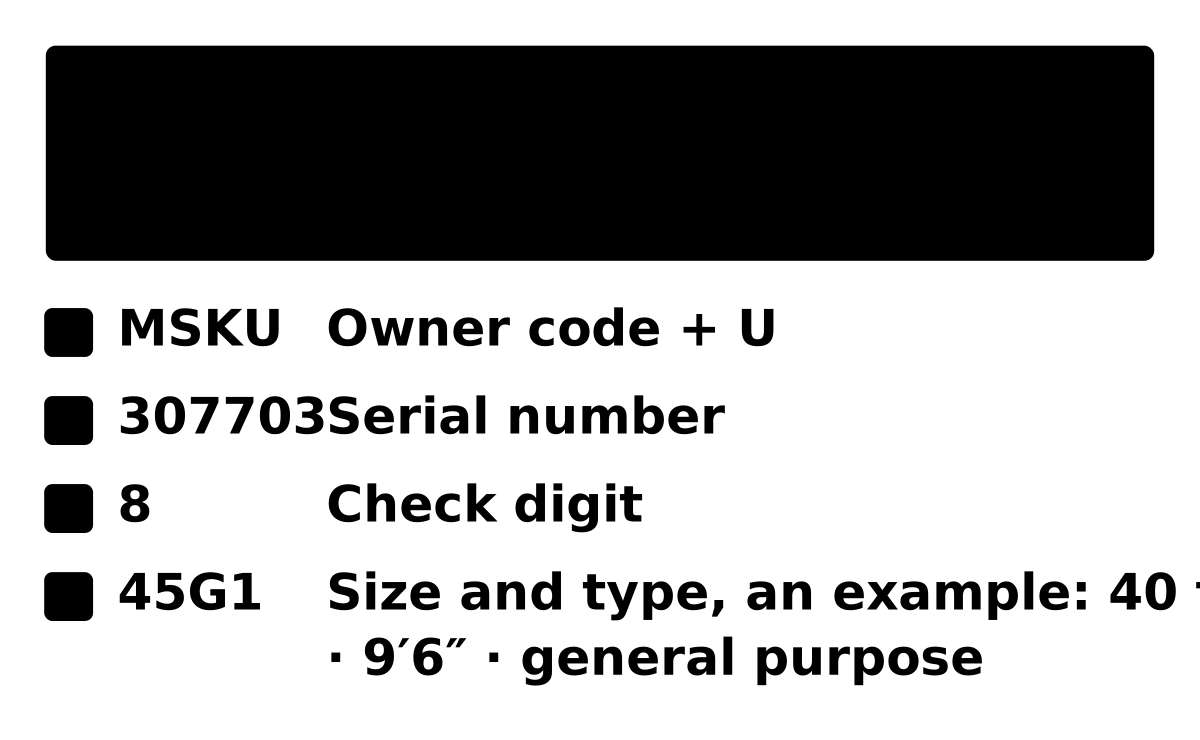
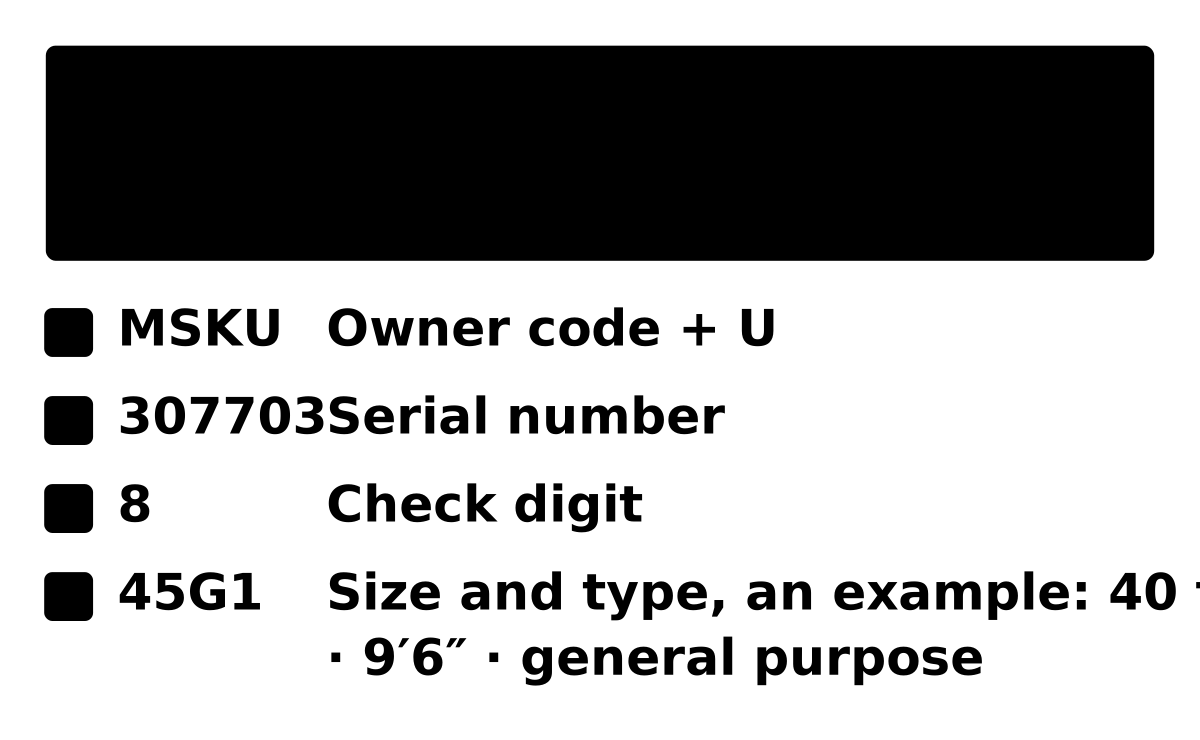
Worked exampleMSKU 307703-8: the computed check digit is 8 and it matches, the MSKU prefix belongs to Maersk, and its tracker takes the number inside the link.
What it does not tell youThe shipment’s status. We show no live tracking: the line publishes that, and this tool only validates the number and sends you to the right site.
To understand the result: ISO container standards · Container glossary
CBM calculator
You know the size of your packages and want to know how much space they take and how they will be charged.
Example and limits
- You enter
- Length, width and height of one package, the quantity and, if you know it, the weight.
- You get
- Total volume in m³, how much of each standard container it fills, and chargeable weight by mode of transport.
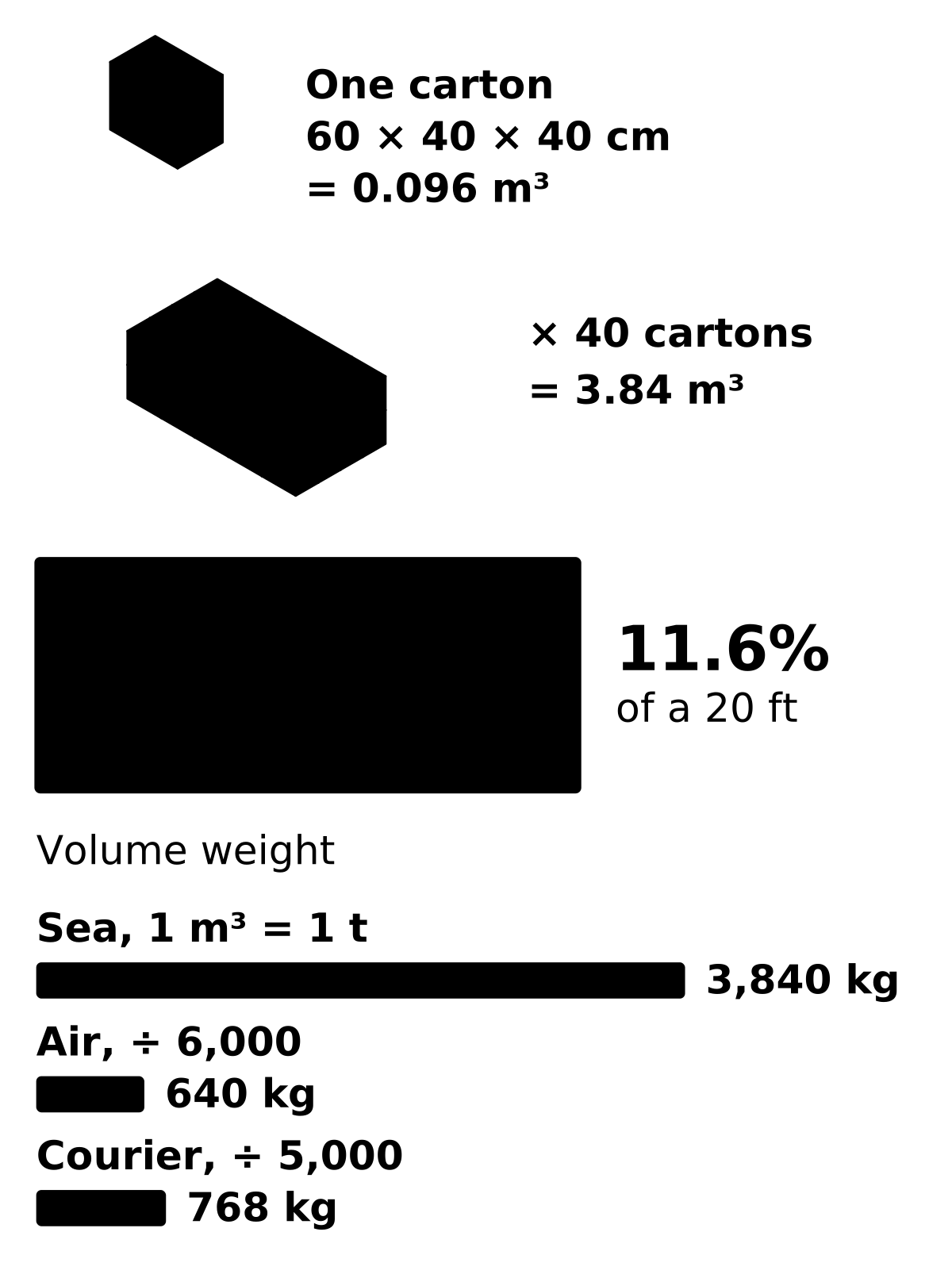
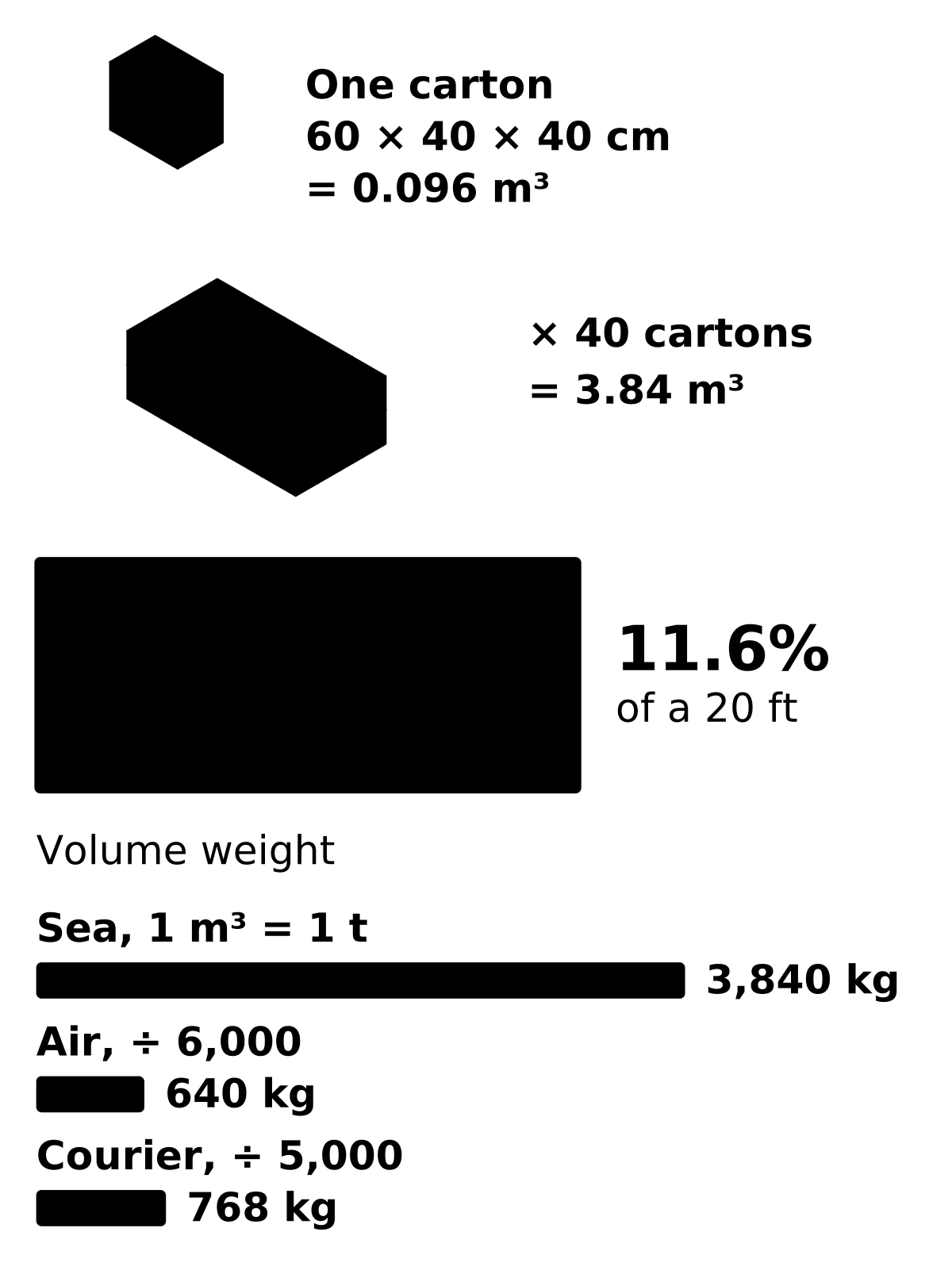
Worked example40 cartons of 60 × 40 × 40 cm come to 3.84 m³, which is 11.6% of a 20 ft container. By air they are charged as 640 kg; by courier, as 768 kg.
What it does not tell youHow much space stowage wastes. The result is geometric volume: cartons do not tile without gaps, and a real load takes more room than it measures.
To understand the result: Container CBM guide · Container size chart (all 17)
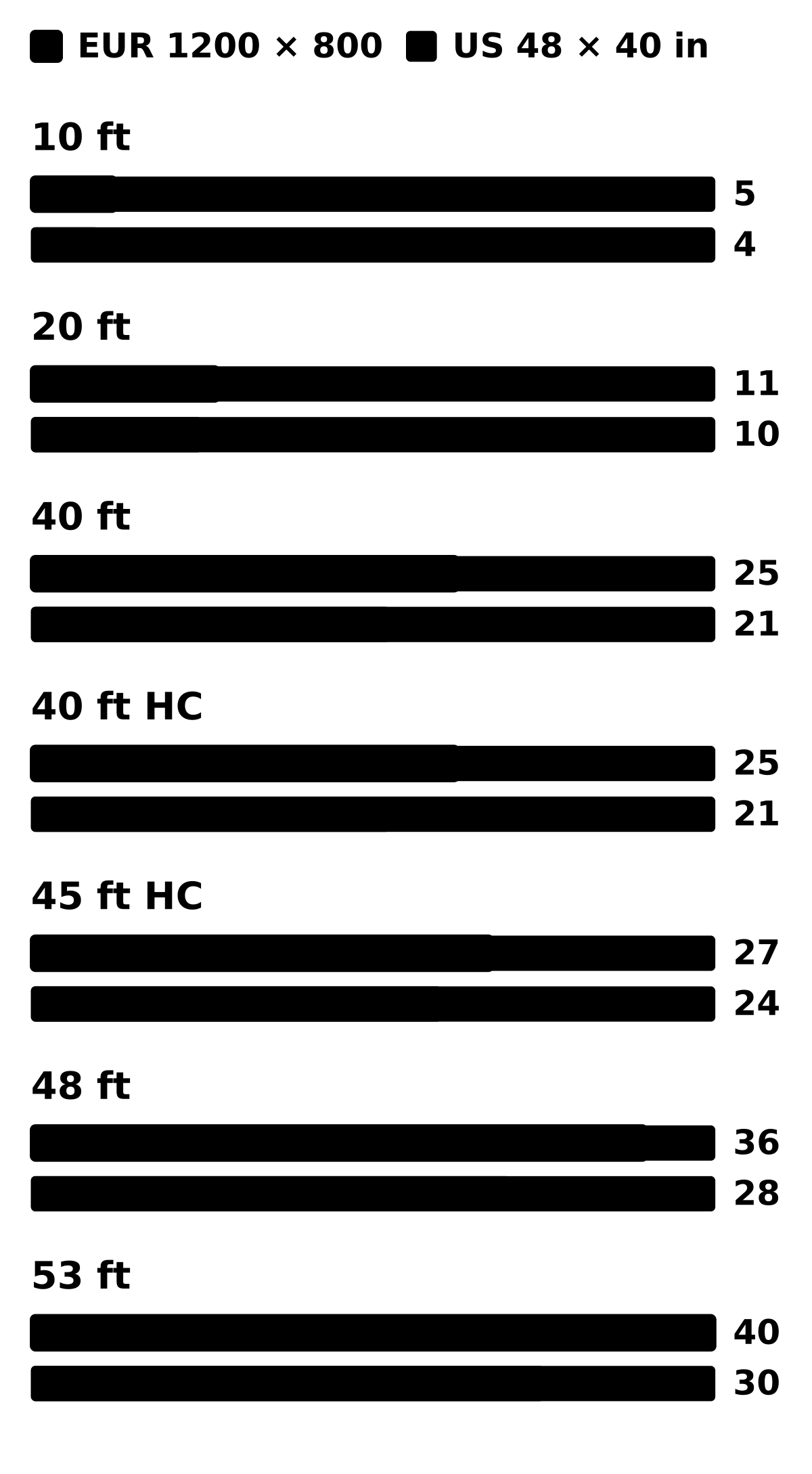
Pallet calculator
Your cargo is palletised and you want to know how many go in and in what pattern.
Example and limits
- You enter
- The pallet type (EUR 1,200 × 800 mm, US 48 × 40 in, or your own size), the container, and the height of the load.
- You get
- Pallets per tier, the number of tiers the height allows, and a diagram of the floor.
Worked exampleWith a load 1.3 m tall, a standard 40 ft takes 1 tier (25 EUR pallets) and a high cube takes 2 (50). At 1.1 m both take 2 tiers: 50.
What it does not tell youWhether the cargo can be stacked, and whether the total weight exceeds the payload. The count is geometry: floor and height.
To understand the result: Pallets in a 20 ft container · Pallets in a 40 ft container · Pallet sizes & dimensions
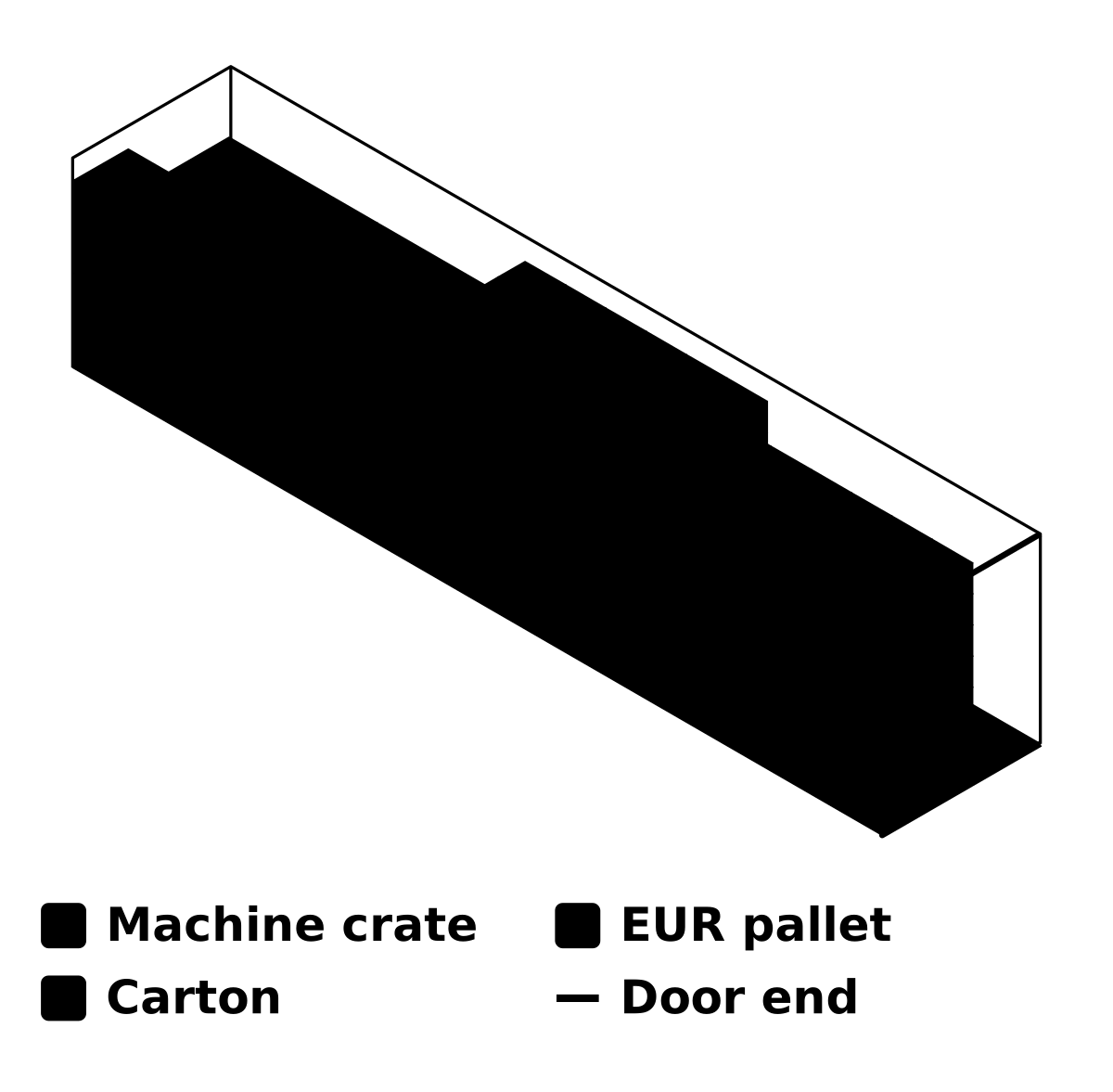
Container load calculator
You have cartons, pallets or crates to pack and want to see how they stand in the container and whether the load is safe.
Example and limits
- You enter
- One line per kind of piece: its size, weight and quantity, whether it may turn or carry weight on top, and its delivery stop; then a container, or let the planner choose.
- You get
- A side, top and 3D plan, loading steps wall by wall, what was left out and why, CTU Code checks (centre of gravity, floor load per metre, gross mass, road), and a PDF and a CSV.
Worked exampleA 40 ft high cube is 2,698 mm high inside but 2,585 mm at the door. A crate 2,640 mm tall that must stay upright fits under the roof, so a volume count says it loads; the planner leaves it out and names the door as the reason.
What it does not tell youWhether the load is properly secured. The checks warn rather than refuse: the planner cannot see lashing, bearers or permits, and its gross mass is arithmetic, not a weighed VGM.
To understand the result: Shipping container weight · Container door dimensions · Pallets in a 40 ft container
Unit converter
You have a measurement in one system and need it in another.
Example and limits
- You enter
- A length in millimetres, centimetres, metres, inches or feet.
- You get
- The same length in all five units at once.
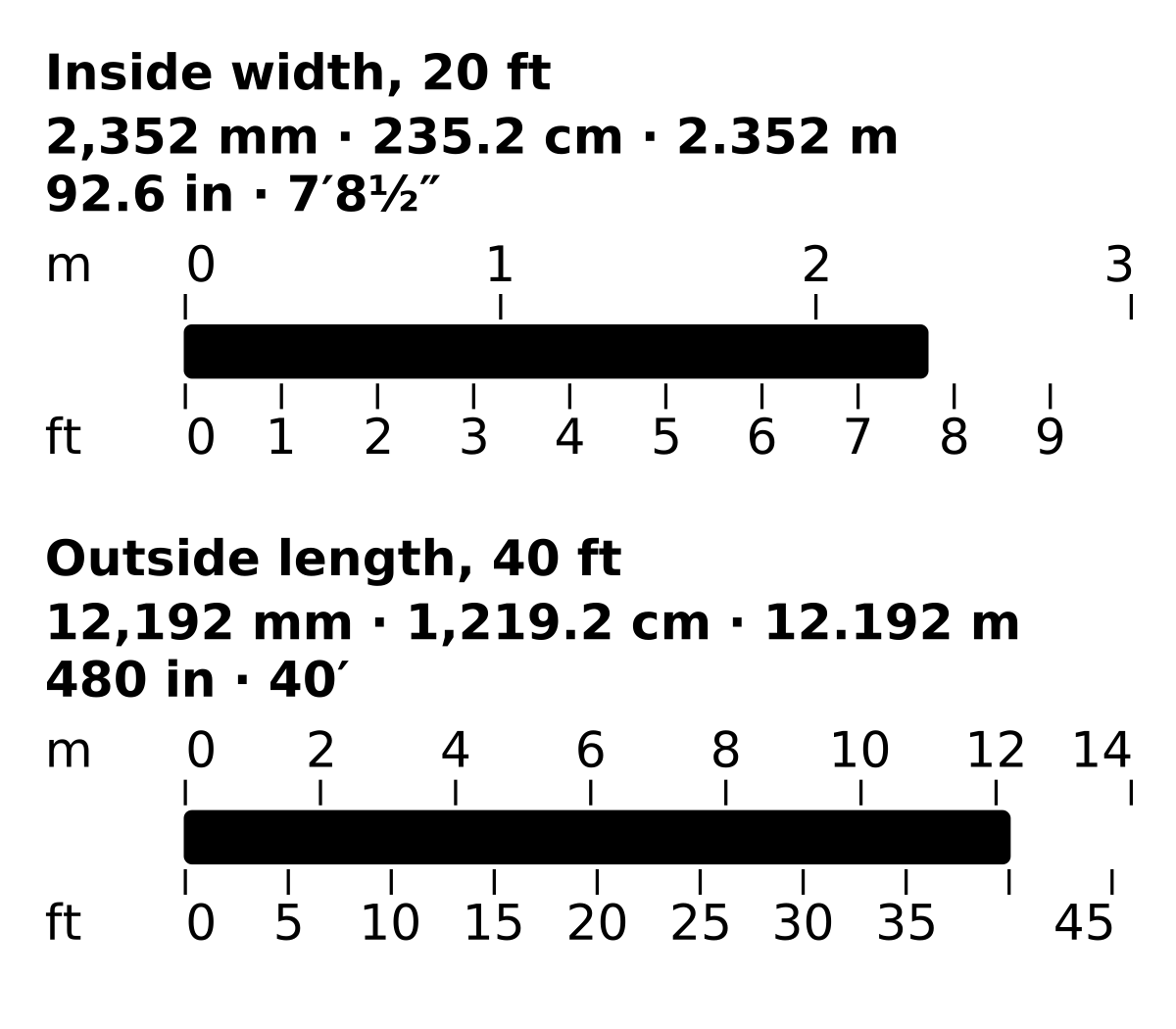
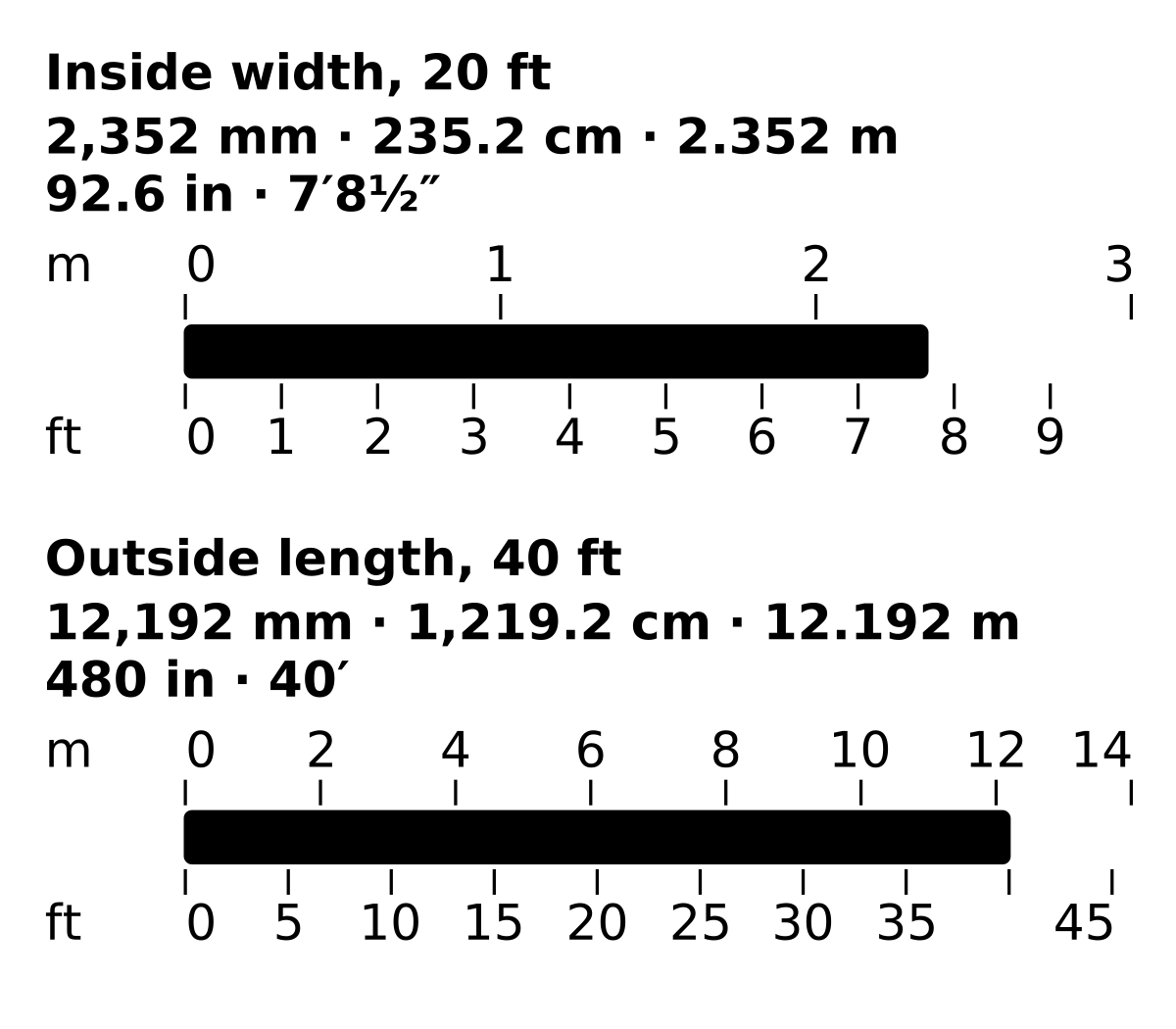
Worked example40 ft is 12.192 m. The internal width of a container, 2,352 mm, is 7′8½″.
What it does not tell youAnything about weight or volume: it converts lengths. For m³ and cubic feet, the table below already gives both.
To understand the result: Container dimensions in meters · Container dimensions in feet & inches
Container comparison
You are choosing between two containers and want to see exactly where they differ.
Example and limits
- You enter
- Any two containers from the fleet: dry sizes or special types.
- You get
- Twelve specifications side by side and both silhouettes drawn to one scale.
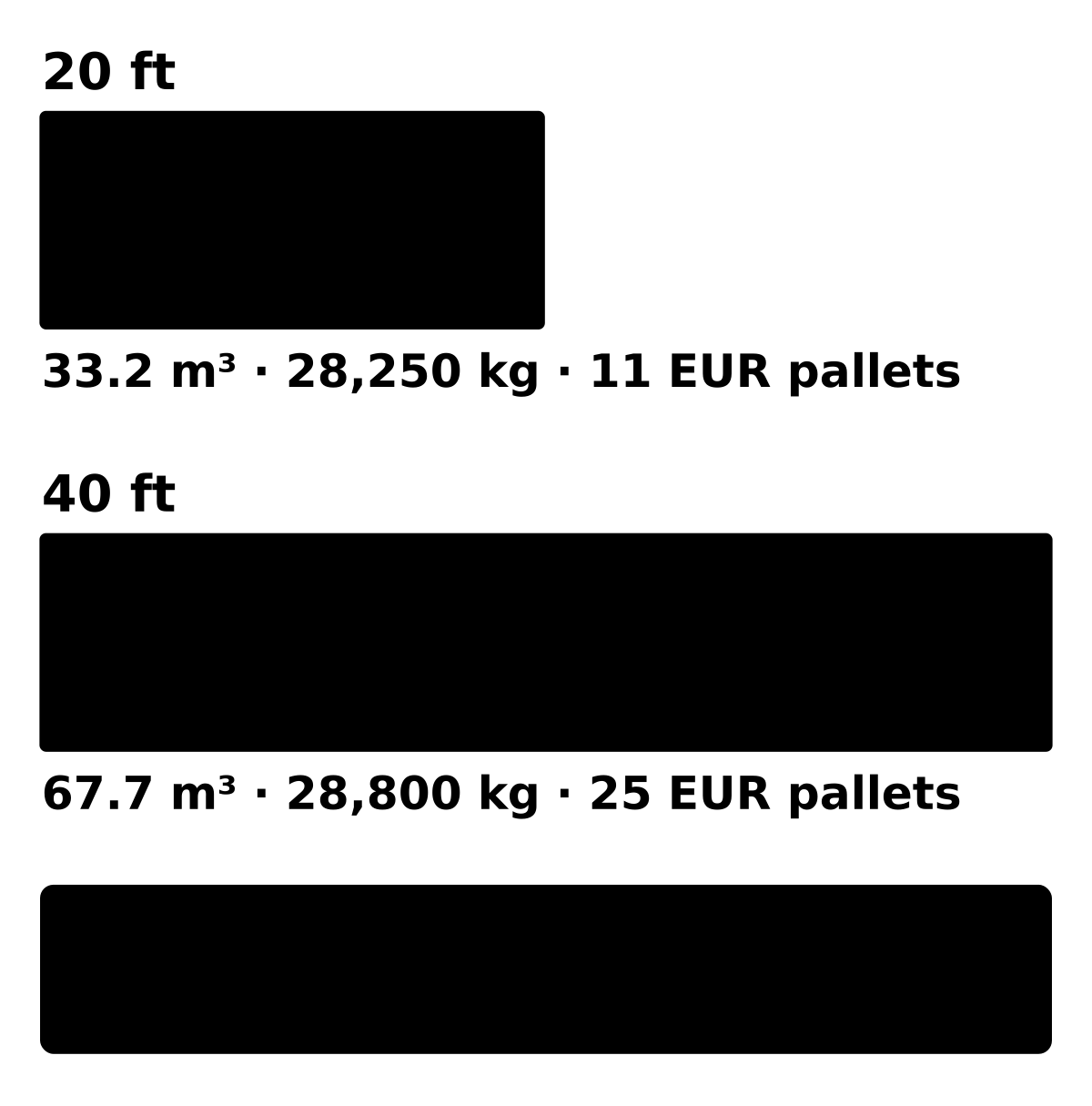
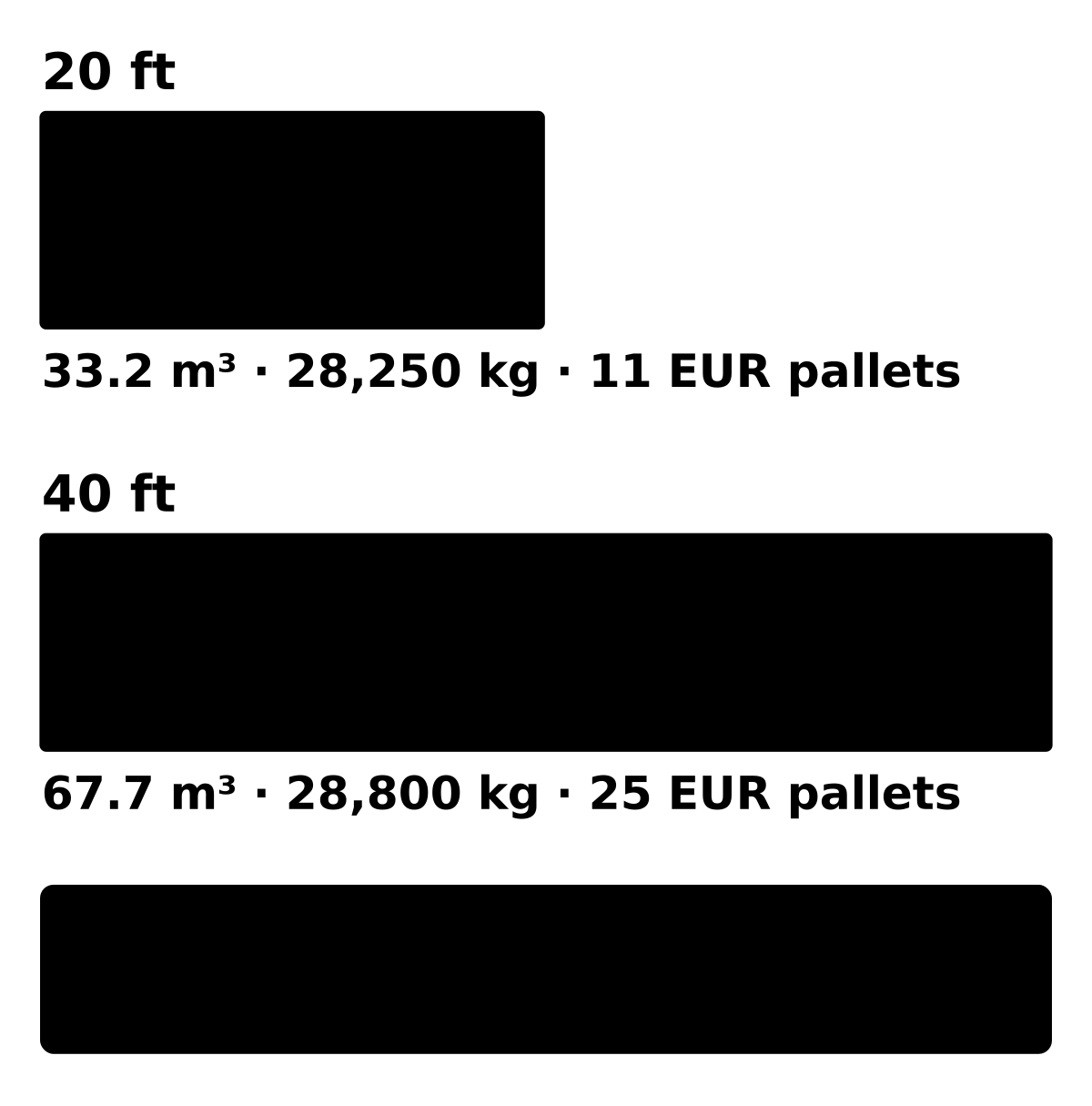
Worked exampleA 40 ft has 2.04 times the volume of a 20 ft but carries only 550 kg (1,213 lb) more cargo: it is longer, not stronger.
What it does not tell youThe price. The comparison is of dimensions and weights; cost per cubic metre depends on the freight rate of the day.
To understand the result: 20 ft vs 40 ft container · Shipping container weight
Container check digit calculator
You have the first ten characters of a container number and need the check digit, or want to know whether a number is right.
Example and limits
- You enter
- The first 10 characters to get the digit, or all 11 to check it; separately, the size and type code painted under it.
- You get
- The check digit with the working shown a character at a time, as ISO 6346 sets it out, and the size and type code read.
Worked exampleMSKU 307703: the values multiplied by 1, 2, 4 … 512 add up to a sum whose remainder after dividing by 11 is 8, so the full number is MSKU 307703-8.
What it does not tell youWhether the box exists or where it is. A number that passes is well-formed; the owner and the tracker are in the number checker.
To understand the result: ISO container standards · Conex box & container names
LCL vs FCL calculator
You were quoted for sharing a container (LCL) and for a whole one (FCL) and want to know which is cheaper.
Example and limits
- You enter
- The volume and weight of the cargo, and the rates you were given: per revenue ton for LCL, per container for FCL.
- You get
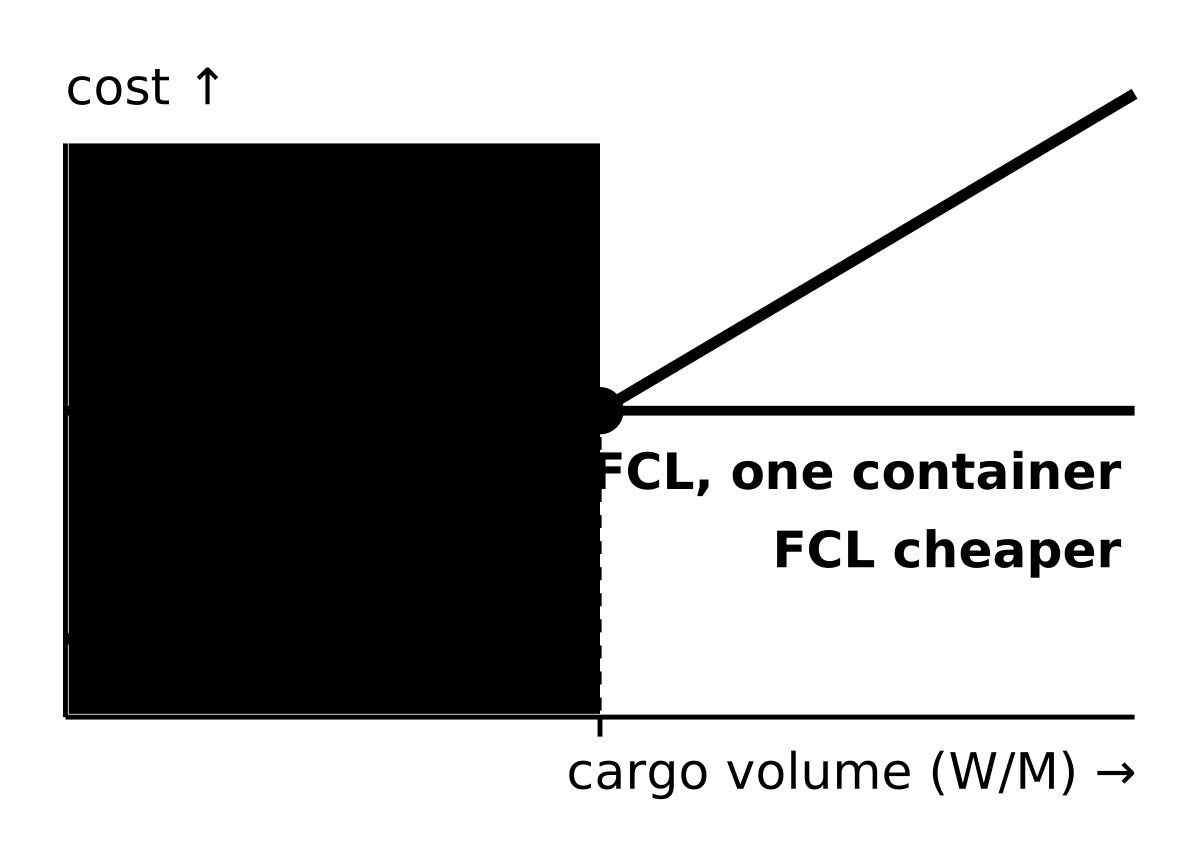
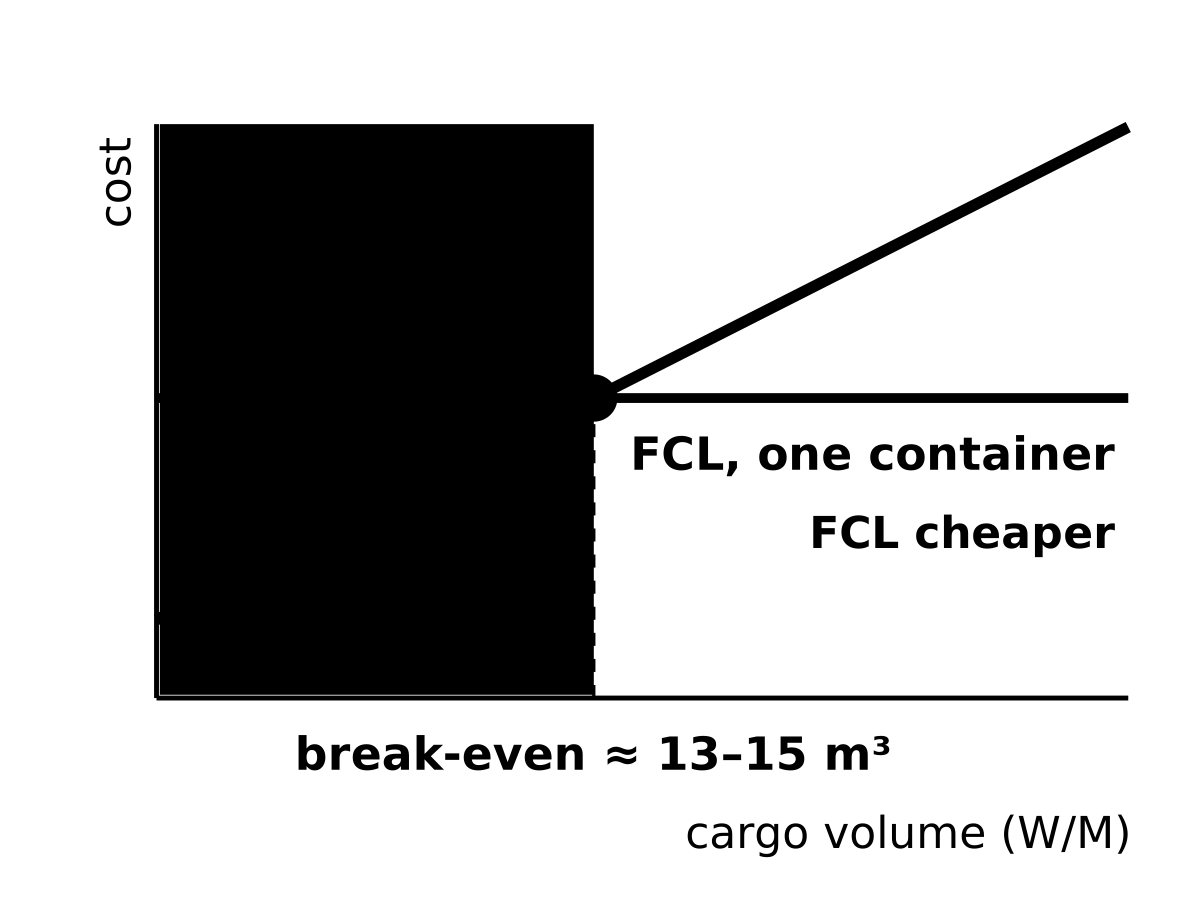
- Revenue tons, the cost of each, the difference, the cost per piece, and the volume from which FCL pays.
Worked example2 m³ weighing 3,100 kg is charged in LCL as 3.1 revenue tons: it is heavier than it is bulky, so it pays by weight.
What it does not tell youThe rates. None are filled in: they move weekly and by lane, so the answer is as good as your quotes.
To understand the result: Container CBM guide · Demurrage vs detention
VGM calculator
You have to declare a container’s verified gross mass (VGM) by method 2.
Example and limits
- You enter
- The weighed packages, the pallets under them, the dunnage and the container; the tare from the door, if you have it.
- You get
- The VGM in kg and lb, checked against the box’s maximum gross, and the declaration ready to print.
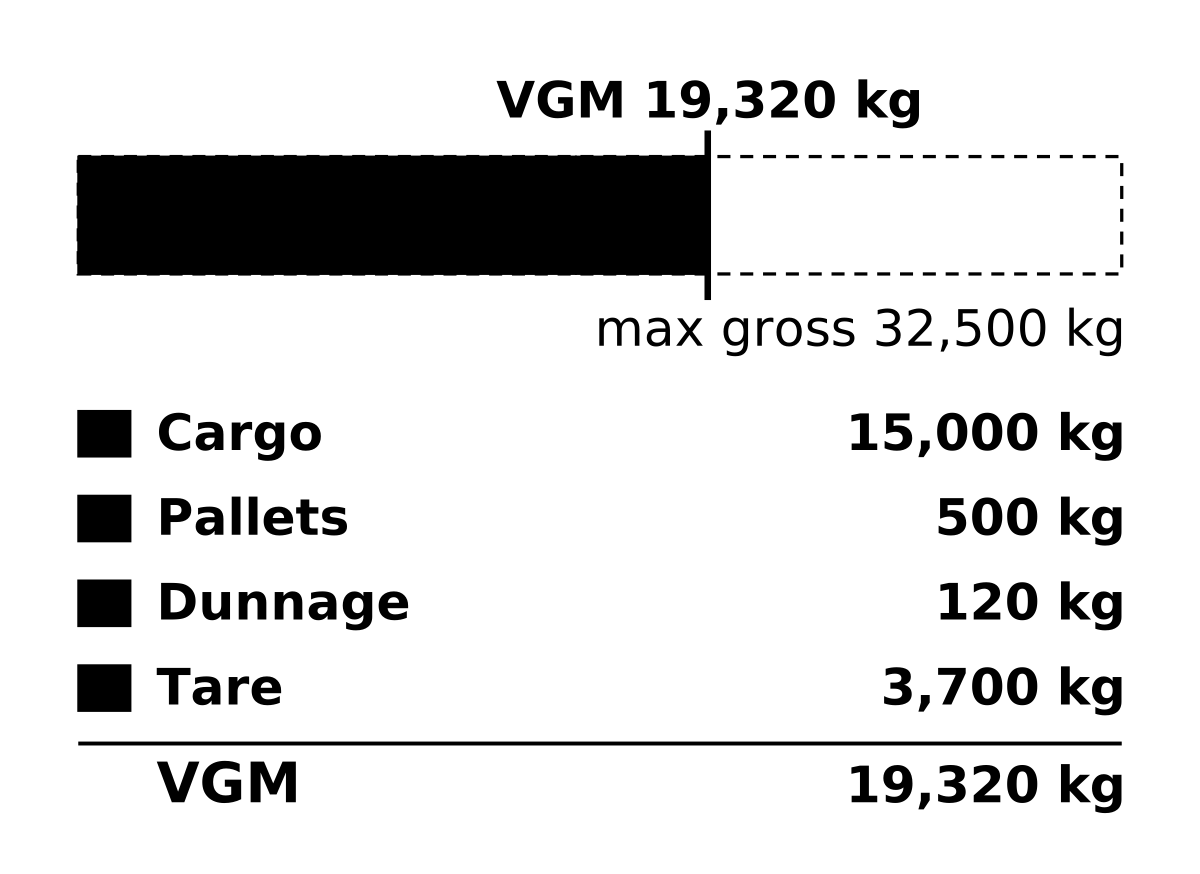
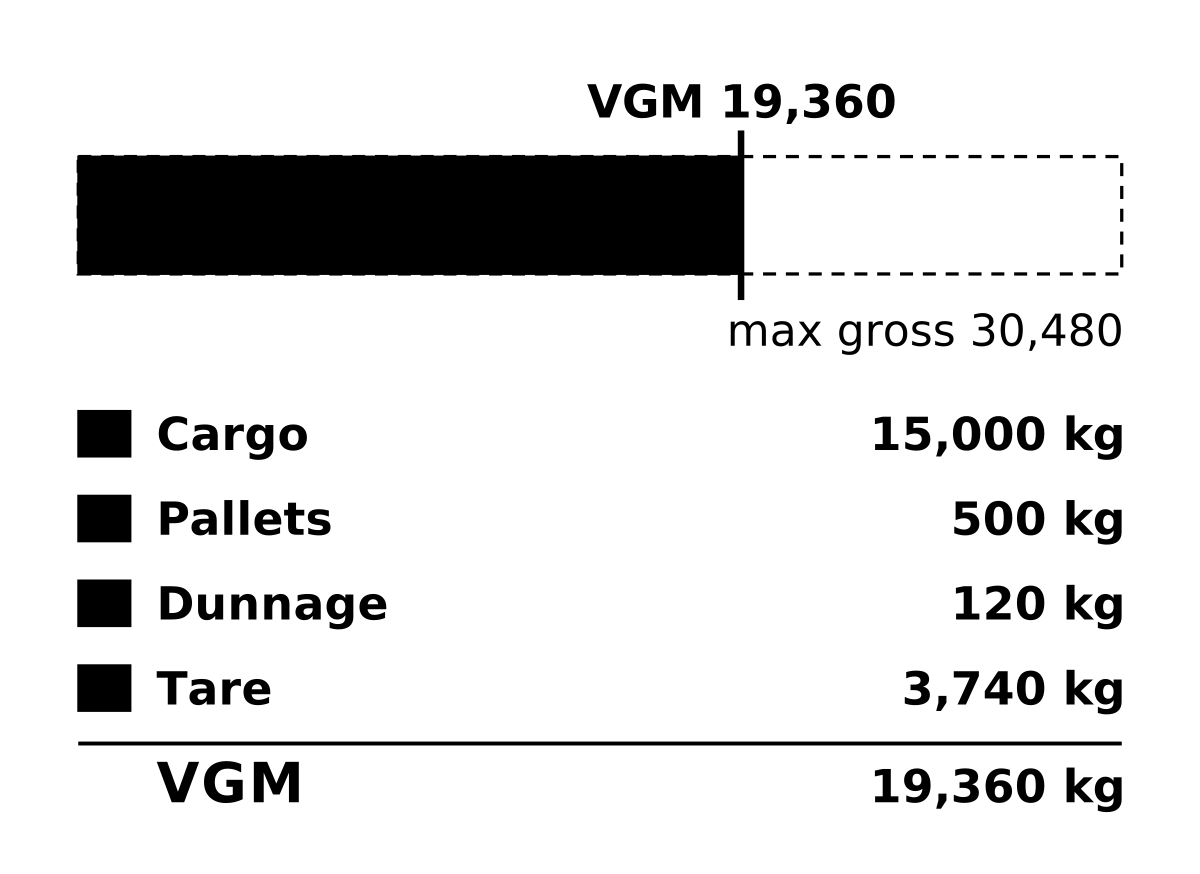
Worked example20 EUR pallets of 750 kg in a 40 ft: 15,000 kg of cargo, 500 kg of empty pallets and 120 kg of dunnage (15,620 kg of contents) plus the 3,700 kg tare make a VGM of 19,320 kg.
What it does not tell youThe weighing. The calculator adds up what you weighed; the figures must come from calibrated scales, not the invoice.
To understand the result: Shipping container weight
Container cost calculator
You are buying a container and want to know what it will cost on your site.
Example and limits
- You enter
- Type and size, condition (new, cargo-worthy, wind and water tight), delivery distance and foundation.
- You get
- The likely price of the box, the delivery and the foundation separately and in total, and when buying beats renting.
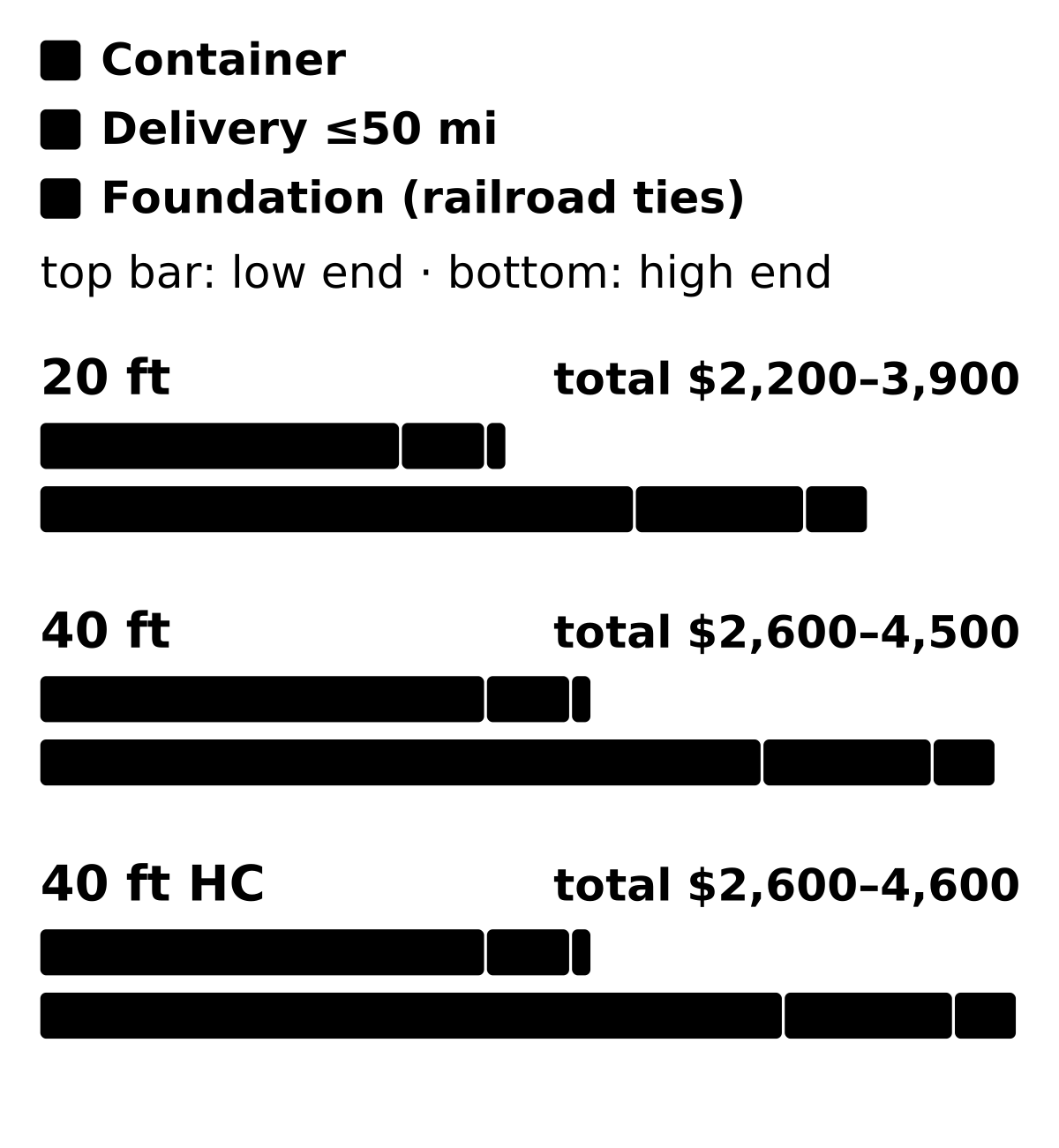
Worked exampleA used cargo-worthy 40 ft high cube delivered within 50 miles onto railroad ties: $2,600–4,600 in all.
What it does not tell youYour local quote. It is the US market in dollars, from dealers’ published prices; the dealer near you sets the final figure.
The figures every tool runs on
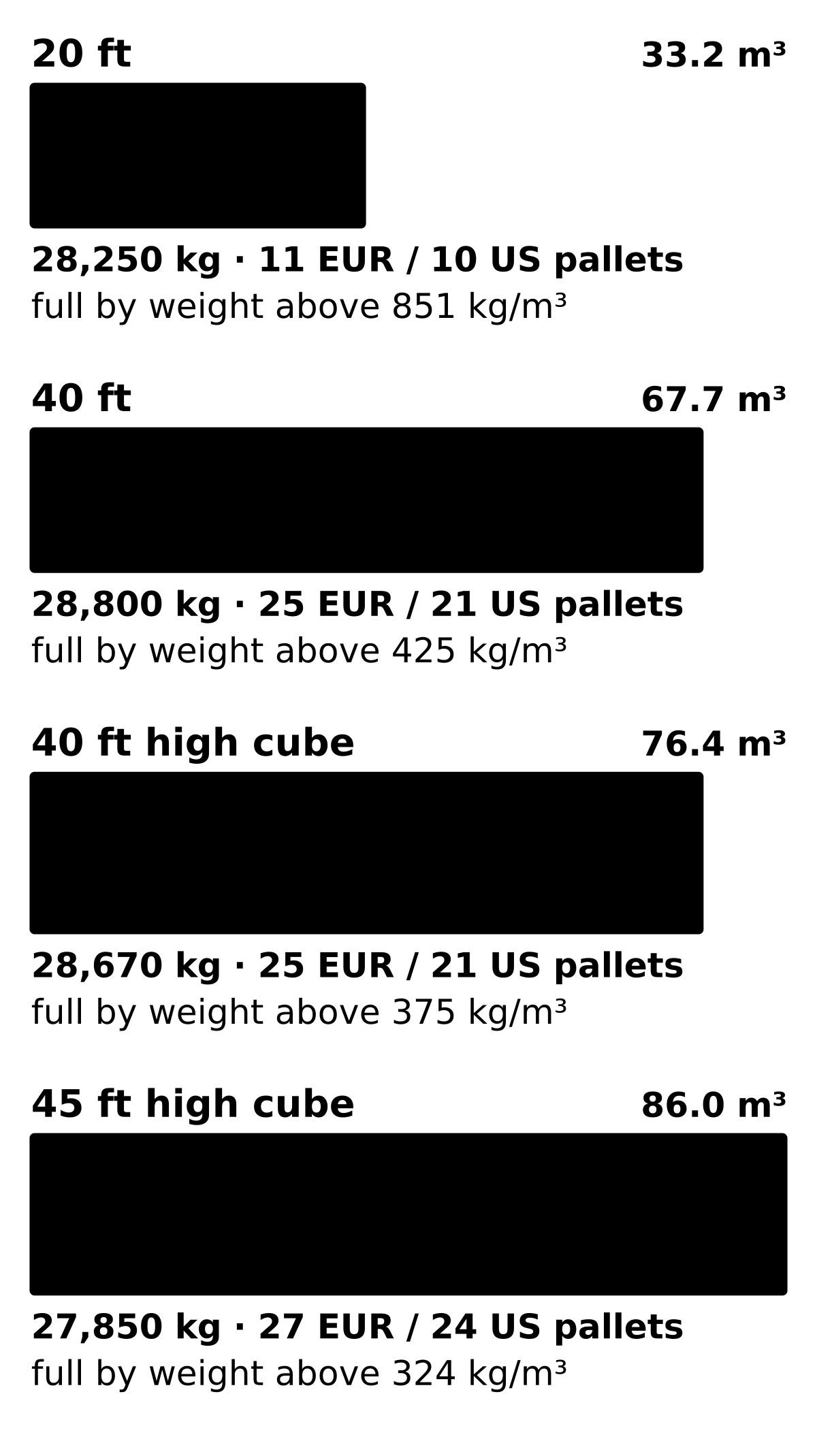
The calculators have no numbers of their own: they read the same dataset as the tables on this site. These are the four boxes your cargo is measured against; their 48 figures are checked against ISO 668 and 32 published sheets of 20 lines, lessors and makers.

The numbers in this chart
| Container | Inside, m | Volume | Payload | Pallets EUR / US | Weight-limited above |
|---|---|---|---|---|---|
| 20 ft | 5.898 × 2.352 × 2.393 | 33.2 m³ (1,172 ft³) | 28,250 kg (62,281 lb) | 11 / 10 | 851 kg/m³ (53 lb/ft³) |
| 40 ft | 12.032 × 2.352 × 2.393 | 67.7 m³ (2,391 ft³) | 28,800 kg (63,493 lb) | 25 / 21 | 425 kg/m³ (27 lb/ft³) |
| 40 ft high cube | 12.032 × 2.352 × 2.698 | 76.4 m³ (2,698 ft³) | 28,670 kg (63,207 lb) | 25 / 21 | 375 kg/m³ (23 lb/ft³) |
| 45 ft high cube | 13.556 × 2.352 × 2.698 | 86.0 m³ (3,037 ft³) | 27,850 kg (61,399 lb) | 27 / 24 | 324 kg/m³ (20 lb/ft³) |
Checked : outside sizes set by ISO 668, read in IS 6566:2001, GOST R 51876-2008 and GOST R 53350-2009; every other figure against 32 published sheets of 20 lines, lessors and makers. A sheet agrees within ±5 mm, or ±2 % for a mass and ±1 % for a volume; a maximum gross is a rating and must be the same. Every figure and its sources
Data: ISO 668 (1995 text, read in IS 6566:2001) · Hapag-Lloyd Container Specifications · Maersk Container Specifications · EPAL Euro pallet 800 × 1,200 mm product data sheet (PB 05/2025)
35 of the 48 figures agree, within 2 % for a weight and 1 % for a volume, with most of the published sheets (the 20 ft payload with 15 of 16), 12 are set by ISO 668, and the sheets spread on 1 (the 20 ft tare: 8 of 18 sheets print the same figure, and they range from 2,080 to 2,570 kg). Payload varies with maker and year of build: the sheets print 21,640 to 30,250 kg for a 20 ft and 26,480 to 28,970 kg for a 40 ft. Pallets are counted in a single tier on the floor.
Pallets counted by the pallet calculator from the inside length and width, one tier on the floor; no count is copied from a sheet.
Weight or volume: which limit you reach first
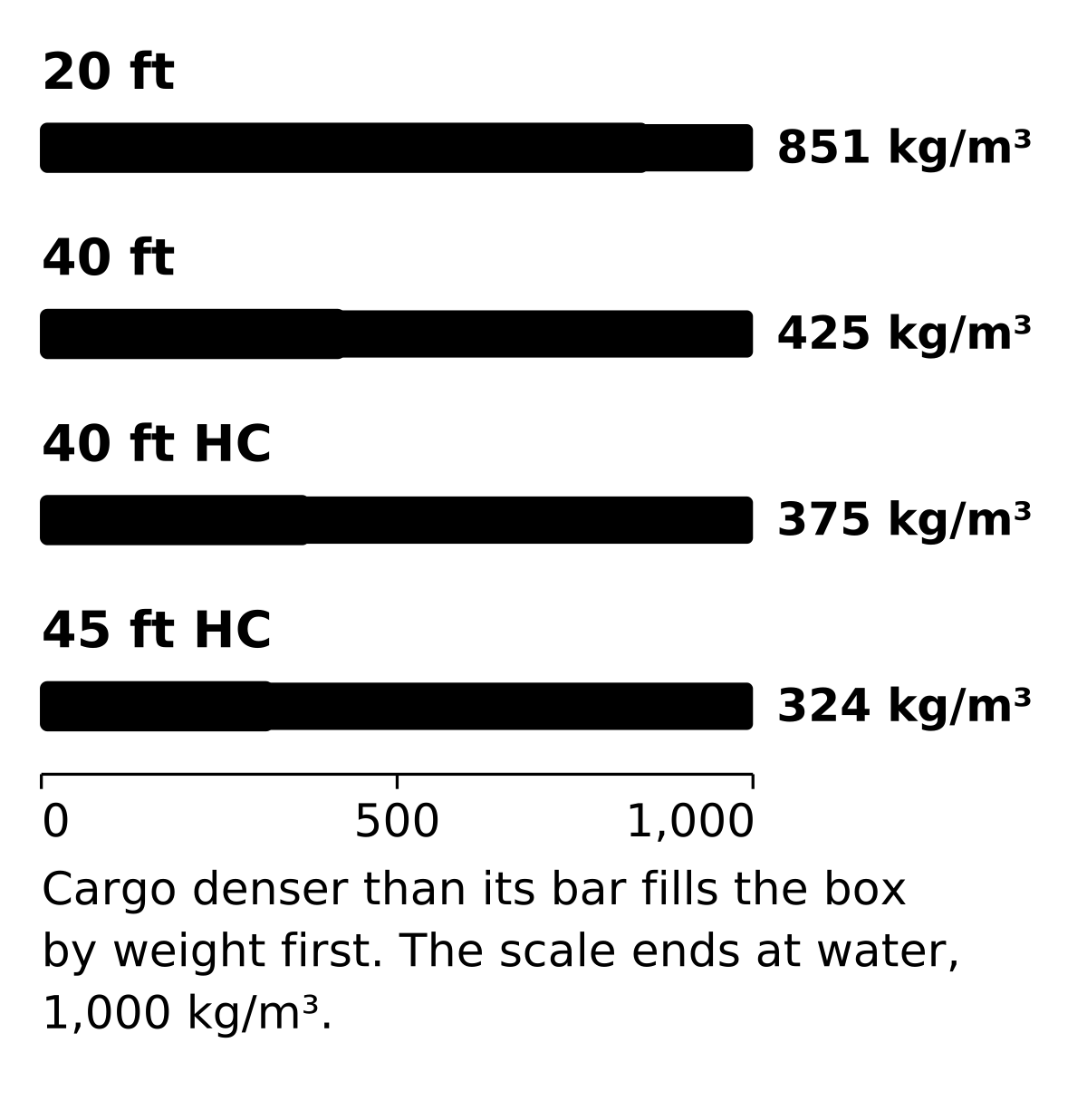
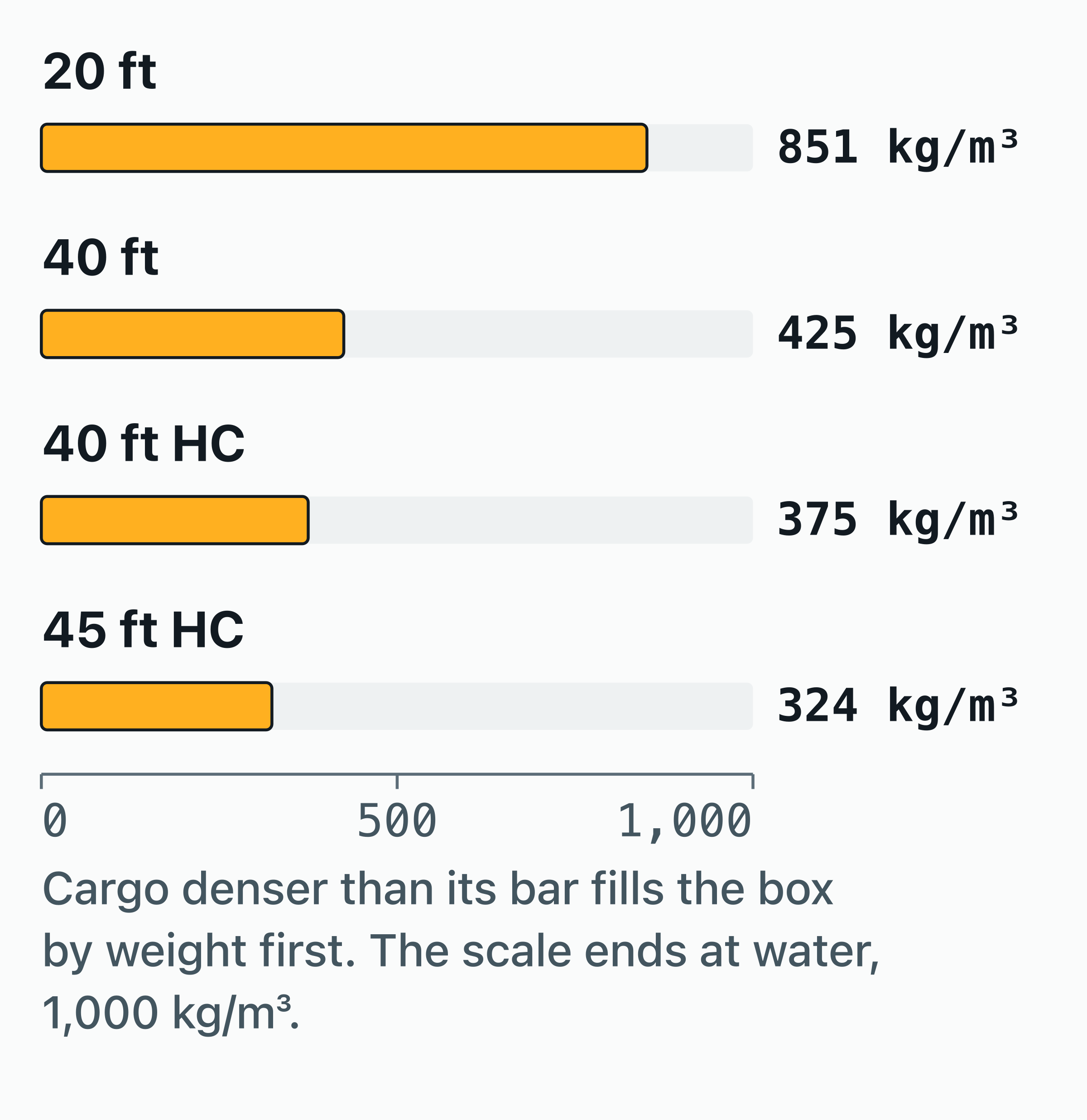
Every container has two limits, and cargo reaches one before the other. Dividing payload by volume gives the density at which they coincide: 851 kg/m³ (53 lb/cu ft) for a 20 ft and only 425 kg/m³ (27 lb/cu ft) for a 40 ft. Above it the box reaches its weight limit with room to spare; below it the box fills before it is heavy.
That is why a 20 ft is the box for dense cargo. Cargo as dense as water, 1,000 kg/m³, reaches the payload of a 20 ft with 85% of the volume used, and the payload of a 40 ft with 43%: more than half of the longer container travels empty.

The numbers in this chart
| Container | kg/m³ |
|---|---|
| 20 ft container | 851 |
| 40 ft container | 425 |
| 40 ft high cube container | 375 |
| 45 ft high cube container | 324 |
Every figure checked: ISO 668 + 32 published sheets · · Every figure and its sources
How each result is worked out
None of the tools is a black box. These are the rules, so you can repeat any result by hand.
- Volume (CBM)
- Length × width × height in metres, times the number of packages. Dimensions in centimetres are divided by 1,000,000.
- Fill percentage
- Cargo volume divided by the internal volume of the container: 33.2 m³ for a 20 ft, 67.7 m³ for a 40 ft.
- Chargeable weight by sea
- One cubic metre counts as 1,000 kg. You pay on the greater of actual weight and that volume weight.
- Chargeable weight by air
- Volume in cm³ divided by 6,000, the divisor airlines usually apply (the carrier’s tariff decides): one cubic metre counts as about 167 kg. Couriers usually divide by 5,000.
- Pallets per tier
- Lengthwise, crosswise and mixed patterns are tried on the internal floor, and the one that takes the most pallets is kept.
- Pallet tiers
- Internal height divided by the height of the load including the pallet, rounded down.
- Check digit
- Each of the first 10 characters becomes a value, is multiplied by 1, 2, 4, 8… and the sum is divided by 11; the remainder is the digit, and a remainder of 10 is written 0.
What the calculators leave to you
The results are geometry and arithmetic. Four things sit outside them, and they are worth holding in mind before you book. The load calculator checks the door, the gaps between pieces and the road weight for you; the other tools do not.
- The door is smaller than the inside. The door opening is 2,340 × 2,280 mm, 113 mm lower than the interior (2,393 mm). A piece that fits inside may not pass through the door.
- Stowage loses space. Fill percentage treats cargo as if it moulded to the container. Gaps are left between cartons, pallets and walls, and a real load takes more than its volume.
- The road limits you before the box does. Payload is what the container itself can carry. The weight allowed on the road is set by each country and is usually lower.
- The number does not say where the cargo is. The checker verifies the number and names the owner. The shipment’s status is published by the line, and that is where it sends you.
Frequently asked questions
What is a container calculator?
A container calculator tells you how much of a shipping container your cargo fills: the one on this page counts how many of your pieces go into a 20 ft (33.2 m³, 1,172 cu ft), a 40 ft (67.7 m³, 2,391 cu ft), a 40 ft high cube or a 45 ft high cube, and which limit — space or weight — stops them first. To mix pieces and see the plan in 3D, the load planner does the same for a whole packing list.
How many boxes fit in a 40 ft container?
About 590 cartons of 60 × 40 × 40 cm (23.6 × 15.7 × 15.7 in) fit in a 40 ft container and about 660 in a 40 ft high cube, by the 3D planner’s first plan; a 20 ft takes about 270. The count changes with the carton’s size and whether it may be turned, and heavy cartons use up the payload before the space.
Are the calculators free?
All 10 tools on this page are free, with no account and no limit on use. They run in your browser, so there is nothing to install and nothing to sign up for.
How many cubic metres fit in a 20 ft and a 40 ft container?
A 20 ft container has 33.2 m³ (1,172 cu ft) of internal volume and a 40 ft has 67.7 m³ (2,391 cu ft), figures which 18 of 18 and 15 of 16 published sheets of lines, lessors and makers agree with to within 1 %. A 40 ft high cube reaches 76.4 m³ (2,698 cu ft) thanks to its extra foot of height.
How many pallets fit in a container?
11 EUR pallets (1,200 × 800 mm) or 10 US pallets (48 × 40 in) fit on the floor of a 20 ft container, and 25 or 21 on the floor of a 40 ft. Those are single-tier figures with no overhang: if the cargo can be stacked, the calculator multiplies by the tiers the height allows.
When do you hit the weight limit before the volume limit?
Cargo denser than 851 kg/m³ (53 lb/cu ft) reaches the weight limit of a 20 ft container before it fills it; for a 40 ft the threshold is 425 kg/m³ (27 lb/cu ft). Below that density the container is full before it reaches payload.
What is chargeable weight?
Chargeable weight is the greater of actual and volumetric weight: by sea 1 m³ counts as 1,000 kg, and by air as about 167 kg (volume in cm³ divided by the usual 6,000; the carrier’s tariff decides). The CBM calculator shows all three modes at once, so you can see which one applies.
Is anything I type sent anywhere?
No: all 10 tools do their arithmetic in your browser and send nothing you type. The number checker never sends the container number; it only counts, anonymously, how often it is used.
Can the number checker tell me where my container is?
No: it checks the 11 characters, names the owner and opens the line’s tracker, but it shows no live status. Tracking data belongs to the line, which is why it sends you to the line’s own site.