ISO 22G1 · double door
Double Door & Side Door Containers
 Yuri Kan Checked against 4 of 88 published sheets
A double door (tunnel) container has the outside of a standard box, 6.058 × 2.438 × 2.591 m (19′10½″ × 8′ × 8′6″) for a 20 ft, per ISO 668, and a second set of doors in the far end, each opening 2.340 m (7′8″) wide, per all 2 sheets. The second door frame takes inside length: a 20 ft is 5.844 m (19′2″) long inside against 5.898 m in a standard box, as both makers’ sheets we read print it (Triton and Sea Box); for the 40 ft high cube Triton prints 11.978 m and Sea Box 12.033 m, a standard high cube’s length. Both plate the 40 ft HC tunnel at 30,480 kg gross rather than 32,500 kg, which trims its payload to 26,430–26,730 kg; an open-side container, with bi-fold doors down one long wall, has a page of its own.
| Metric | Imperial | |
|---|---|---|
| External dimensions | 6.058 × 2.438 × 2.591 m | 19′10½″ × 8′ × 8′6″ |
| Internal dimensions | 5.844 × 2.352 × 2.393 m | 19′2″ × 7′8½″ × 7′10″ |
| Door opening | 2.340 × 2.280 m | 7′8″ × 7′6″ |
| Capacity (volume) | 32.9 m³ | 1,162 ft³ |
| Tare weight | 2,200 kg | 4,850 lb |
| Max payload | 28,280 kg | 62,347 lb |
A double door (“tunnel”) container has standard doors at both ends; an open-side container adds full-length bi-fold doors along one wall. Base dimensions match the standard 20 ft or 40 ft high cube box — what changes is access.
The numbers in this chart
| Figure | Value |
|---|---|
| Outside, L × W × H | 6.058 × 2.438 × 2.591 m |
| Volume | 32.9 m³ |
| Payload | 28,280 kg |
Checked : outside sizes set by ISO 668, read in IS 6566:2001, GOST R 51876-2008 and GOST R 53350-2009; every other figure against 2 published sheets of 2 lessors and makers. A sheet agrees within ±5 mm, or ±2 % for a mass and ±1 % for a volume; a maximum gross is a rating and must be the same. Every figure and its sources
Tunnel units shine for self-storage partitioning, vehicle loading and drive-through workflows. Open-siders let a forklift reach any pallet directly, which turns a container into workable warehouse space.
On the 40 ft high cube tunnel, both openings measure 2.340 × 2.585 m, and inside the box is 2.352 m wide and 2.698 m high. Its inside length is 11.978 m on Triton’s sheet, 54 mm shorter than a standard high cube, and 12.033 m on Sea Box’s. Tare is 3,750–4,050 kg on the two sheets, and both plate it at 30,480 kg max gross, which leaves 26,430–26,730 kg of payload — about 1,900–2,200 kg less than a standard high cube carries, which matters only for dense loads.
Most double door and open-side units are new-build “one-trip” boxes from Chinese factories rather than retired ocean stock, because carriers themselves rarely order them. That keeps condition high but prices above comparable standard containers, and makes availability lumpy — dealers stock them in batches.

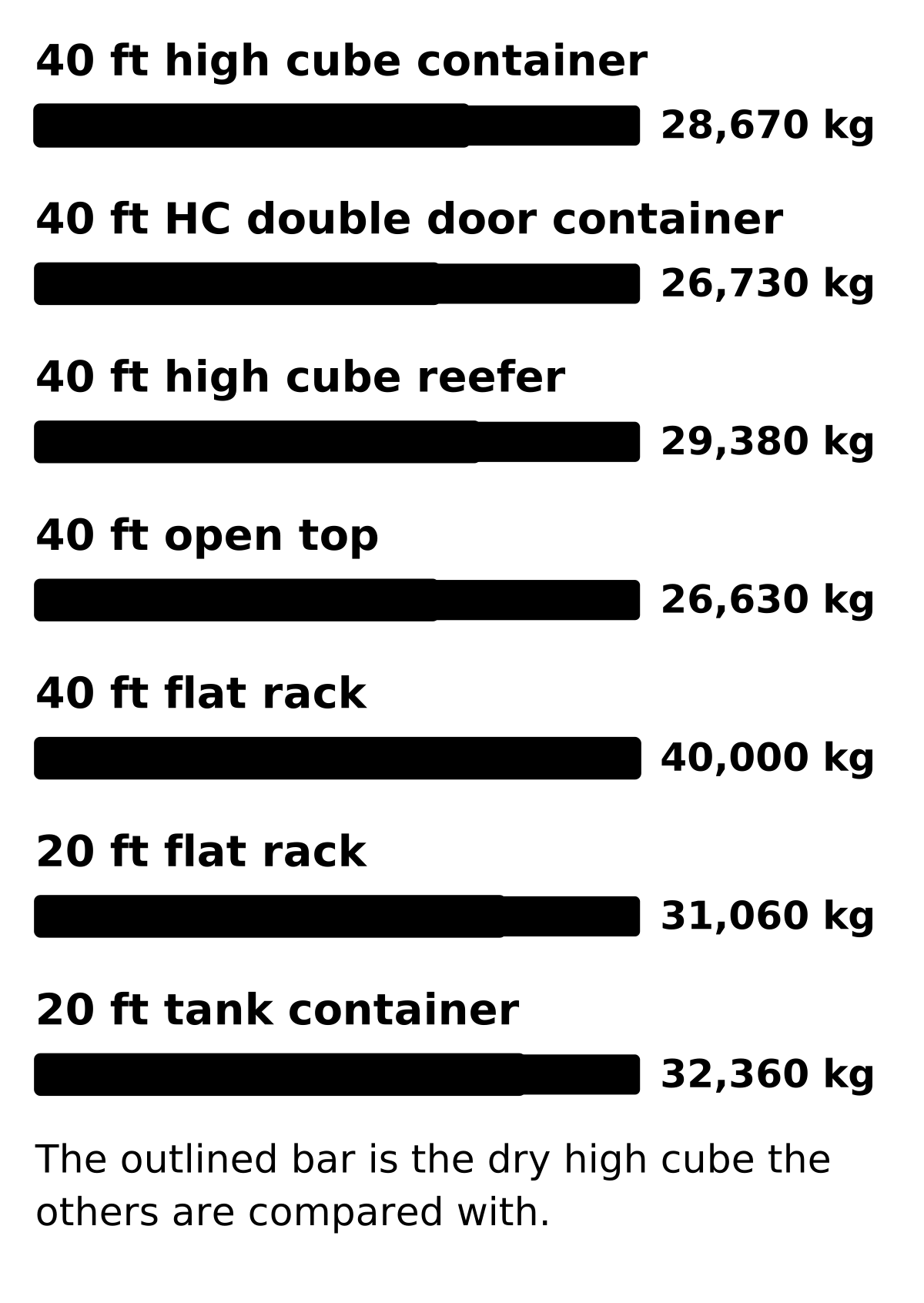
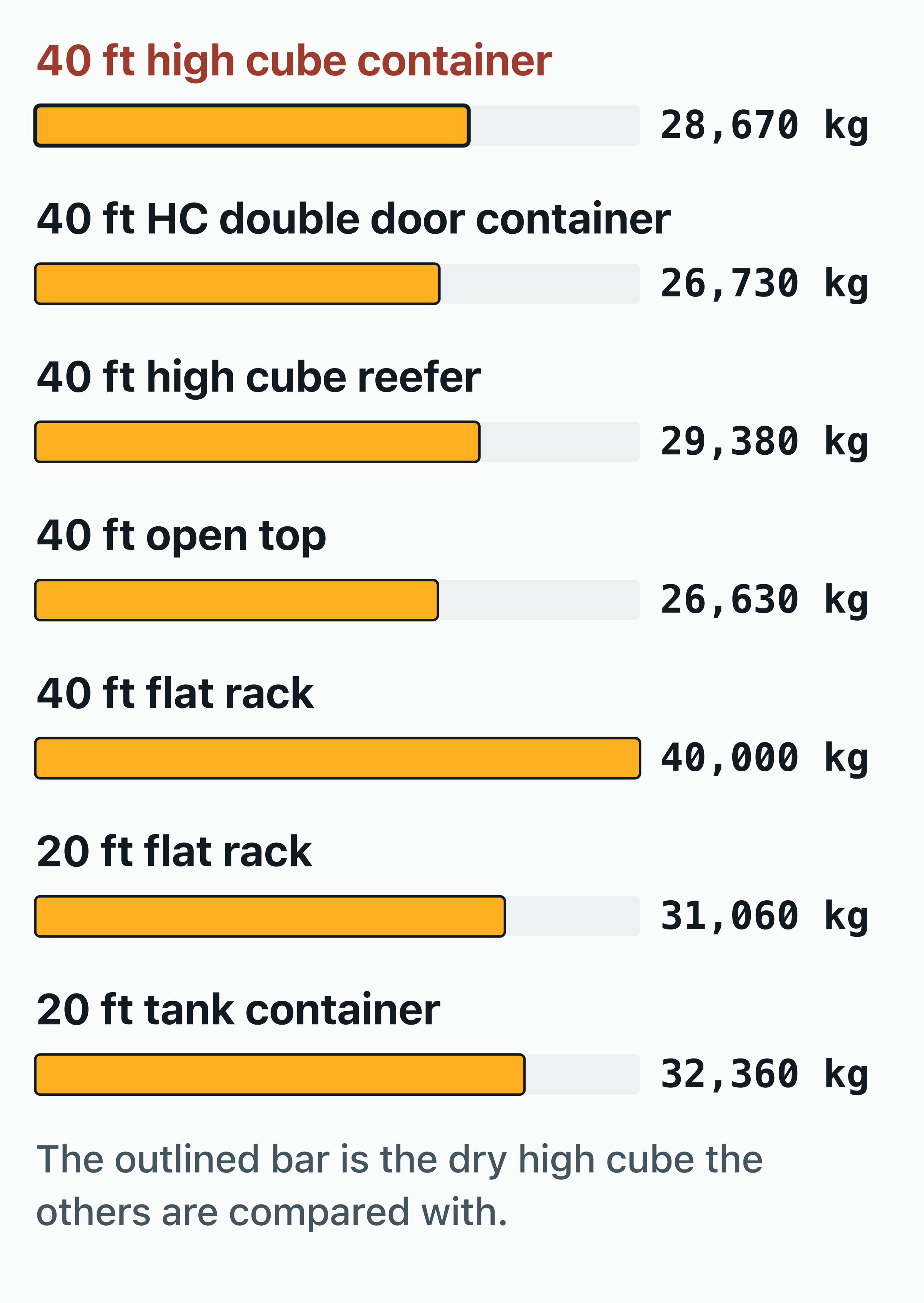
The numbers in this chart
| Container | kg | lb |
|---|---|---|
| 40 ft high cube container | 28,670 | 63,207 |
| 40 ft HC double door container | 26,730 | 58,930 |
| 40 ft high cube reefer | 29,380 | 64,772 |
| 40 ft open top | 26,630 | 58,709 |
| 40 ft flat rack | 40,000 | 88,185 |
| 20 ft flat rack | 31,060 | 68,476 |
| 20 ft tank container | 32,360 | 71,342 |
Checked : the figures in this chart against 44 of 88 published sheets from 20 lines, lessors and makers: those that print these figures. A sheet agrees within ±5 mm, or ±2 % for a mass and ±1 % for a volume; a maximum gross is a rating and must be the same. Every figure and its sources
Double door container: dimensions and weight
| Metric | Imperial | |
|---|---|---|
| External dimensions | ||
| Length | 6.058 m 20 ft double door container · Outside length 6,058 mm Set by the standard | 19′10½″ |
| Width | 2.438 m 20 ft double door container · Outside width 2,438 mm Set by the standard | 8′ |
| Height | 2.591 m 20 ft double door container · Outside height 2,591 mm Set by the standard | 8′6″ |
| Internal dimensions | ||
| Length | 5.844 m | 19′2″ |
| Width | 2.352 m | 7′8½″ |
| Height | 2.393 m | 7′10″ |
| Door opening | ||
| Width | 2.340 m | 7′8″ |
| Height | 2.280 m 20 ft double door container · Door height 2,280 mm Sheets disagree | 7′6″ |
| Specification | ||
| Tare weight | 2,200 kg | 4,850 lb |
| Max gross weight | 30,480 kg | 67,197 lb |
| Max payload | 28,280 kg | 62,347 lb |
| Capacity (volume) | 32.9 m³ | 1,162 ft³ |
| Pallets (one tier, counted on the floor) | 11 EUR · 10 US | |
| TEU | 1 | |
Beside each figure, its evidence: ISO set by the standard · ✓ 16 sheets that agree, counted · range the sheets disagree · 1 sheet one source. A mark opens the sheets behind the figure.
Checked : outside sizes set by ISO 668, read in IS 6566:2001, GOST R 51876-2008 and GOST R 53350-2009; every other figure against 2 published sheets of 2 lessors and makers. A sheet agrees within ±5 mm, or ±2 % for a mass and ±1 % for a volume; a maximum gross is a rating and must be the same. Every figure and its sources
Data: ISO 668 (1995 text, read in IS 6566:2001) · Sea Box, Triton
| Metric | Imperial | |
|---|---|---|
| External dimensions | ||
| Length | 12.192 m 40 ft HC double door container · Outside length 12,192 mm Set by the standard | 40′ |
| Width | 2.438 m 40 ft HC double door container · Outside width 2,438 mm Set by the standard | 8′ |
| Height | 2.896 m 40 ft HC double door container · Outside height 2,896 mm Set by the standard | 9′6″ |
| Internal dimensions | ||
| Length | 11.978 m 40 ft HC double door container · Inside length 11,978 mm Sheets disagree | 39′3½″ |
| Width | 2.352 m | 7′8½″ |
| Height | 2.698 m 40 ft HC double door container · Inside height 2,698 mm Confirmed | 8′10″ |
| Door opening | ||
| Width | 2.340 m | 7′8″ |
| Height | 2.585 m | 8′6″ |
| Specification | ||
| Tare weight | 3,750 kg | 8,267 lb |
| Max gross weight | 30,480 kg | 67,197 lb |
| Max payload | 26,730 kg | 58,930 lb |
| Capacity (volume) | 76.1 m³ | 2,687 ft³ |
| Pallets (one tier, counted on the floor) | 24 EUR · 21 US | |
| TEU | 2 | |
Checked : outside sizes set by ISO 668, read in IS 6566:2001, GOST R 51876-2008 and GOST R 53350-2009; every other figure against 2 published sheets of 2 lessors and makers. A sheet agrees within ±5 mm, or ±2 % for a mass and ±1 % for a volume; a maximum gross is a rating and must be the same. Every figure and its sources
Data: ISO 668 (1995 text, read in IS 6566:2001) · Sea Box, Triton
What changes against a standard box
The second door frame costs inside length rather than weight — a 20 ft tunnel unit is 5.844 m long inside against 5.898 m standard, tares 2,200–2,277 kg on the two makers’ sheets and carries 28,203–28,280 kg. Each door opening is the standard 2.340 m wide. On open-side units the side opening is 5.702 × 2.189 m (18′8½″ × 7′2″) on Bullbox’s sheet and 5.834 × 2.162 m (19′1½″ × 7′1″) on Sea Box’s.
Both variants are conversion favourites: pop-up shops, site offices, workshops — anywhere access matters more than absolute weight capacity.
Check certification before shipping one: many open-side units are built primarily for static use, and their side-wall structure earns a lower stacking rating than a standard box. For storage that is irrelevant; for ocean freight, confirm the CSC plate covers your intended stow.
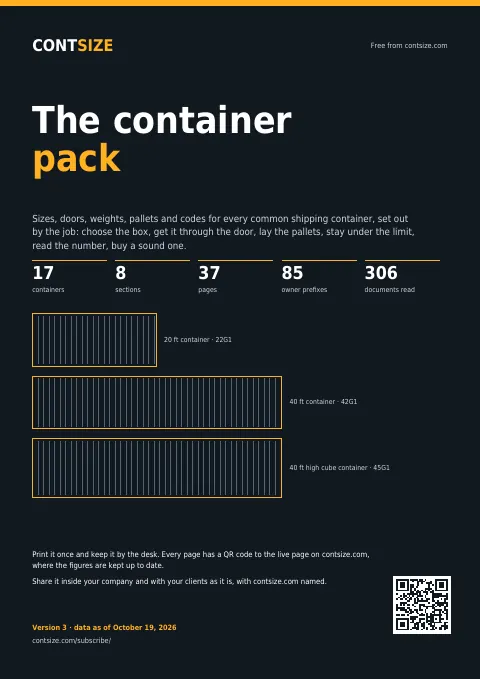
The Double door container on one page, plus the whole pack
Every dimension in millimetres, metres and feet, the door opening, tare, payload and volume, and the floor drawn to scale with EUR and US pallets on it. In the same email, the container pack: all 17 containers by the job, 17 sheets like this one, the 85 owner prefixes, an A3 wall chart and an Excel workbook.
- 17 containers, by the job
- 17 container sheets
- 85 owner prefixes
The bot check did not finish, so nothing was sent. Send the form again; if it stops again, allow challenges.cloudflare.com in your blocker or write to info@contsize.com from the address the file should go to.
Nothing was sent: the address could not be read, or a required box was not ticked. Check them and send the form again.
Which variant for which job
Choose the tunnel when flow matters: vehicles drive through instead of reversing out, self-storage operators wall the middle to rent two units per box, and long items load from whichever end the site allows. Choose the open-side when reach matters: a forklift accesses every pallet position directly through the side, and a shop or bar opens its whole frontage in one gesture.
The two solve different problems and are priced similarly, so let the site layout decide — a box against a wall wants a tunnel, a box facing a yard or street usually wants the open side.
Frequently asked questions
Are double door containers the same size as standard ones?
Outside yes — 6.058 × 2.438 × 2.591 m (19′10½″ × 8′ × 8′6″) for a 20 ft, per ISO 668 — and inside a 20 ft is 54 mm shorter, 5.844 m (19′2″) against 5.898 m (19′4″), per all 2 sheets. For a 40 ft HC, Triton’s sheet gives 11.978 m inside against 12.032 m standard and Sea Box’s 12.033 m; width and height match the standard container.
What are the side opening dimensions of an open-side container?
On a 20 ft open-side unit the bi-fold doors open 5.702 × 2.189 m (18′8½″ × 7′2″) on Bullbox’s sheet and 5.834 × 2.162 m (19′1½″ × 7′1″) on Sea Box’s, nearly the full 5.898 m internal length. A forklift can reach any pallet position directly.
What are the dimensions of a 40 ft double door container?
A 40 ft HC double door measures 12.192 × 2.438 × 2.896 m (40′ × 8′ × 9′6″) outside, like a standard high cube, per ISO 668, and 2.352 m (7′8½″) wide by 2.698 m (8′10″) high inside with a 2.340 × 2.585 m (7′8″ × 8′6″) opening at each end, per all 2 sheets. Its inside length is 11.978 m on Triton’s sheet and 12.033 m on Sea Box’s; tare is 3,750–4,050 kg and payload 26,430–26,730 kg at 30,480 kg max gross.
How much does a double door container cost?
In October 2026, the middle of the US dealer and marketplace listings we read puts a new (one-trip) 20 ft double door container at $3,400–4,800 and a 40 ft high cube one at about $5,000; a new 20 ft with a full open side is $5,500–7,500. That is above a standard one-trip 20 ft at $2,800–4,400, because most are purpose-built in small batches rather than retired ocean stock; prices vary by market and location.
How much more does a double door container weigh?
Little or nothing: the two makers’ sheets we read give 2,200–2,277 kg for an empty 20 ft tunnel unit against about 2,230 kg for a standard 20 ft (its published sheets range 2,080–2,570 kg), and 3,750–4,050 kg for a 40 ft HC against 3,830 kg. What changes is the rating: both plate the 40 ft HC tunnel at 30,480 kg gross, so it carries 26,430–26,730 kg against 28,670 kg in a standard high cube.
What is a side opening container called?
Usually “open-side” or “full side access” container. It has bi-fold doors running the length of one wall in addition to the normal end doors.