ISO 22G1 · 1 TEU
20 ft Container Dimensions
 Yuri Kan Checked against 19 of 88 published sheets Updated
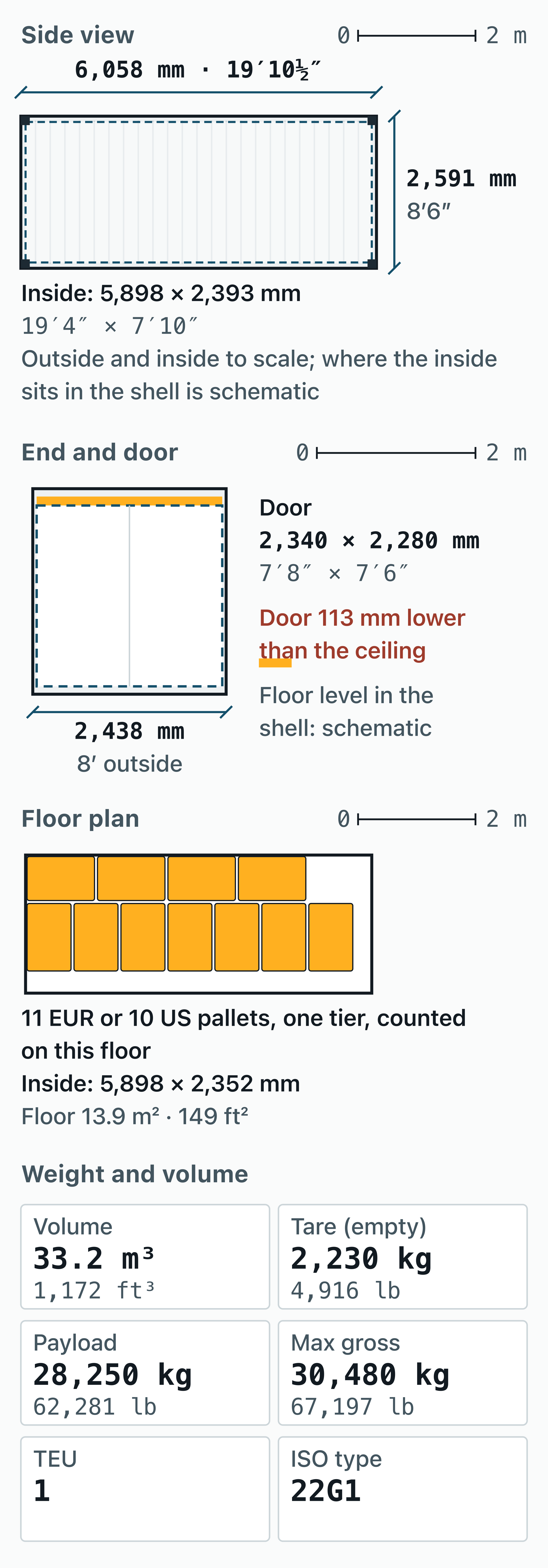
A 20 ft container is 19′10½″ × 8′ × 8′6″ outside (6.058 × 2.438 × 2.591 m), 19′4″ × 7′8½″ × 7′10″ inside (5.898 × 2.352 × 2.393 m), door 7′8″ × 7′6″ (2.340 × 2.280 m): 33.2 m³ (1,172 ft³), tare 2,230 kg (ZIM prints 2,250), max gross 30,480 kg, payload 28,250 kg. ContSize, 2026: sizes per ISO 668; inside, per 15 of 18 sheets; tare: sheets print 2,080–2,570 kg.
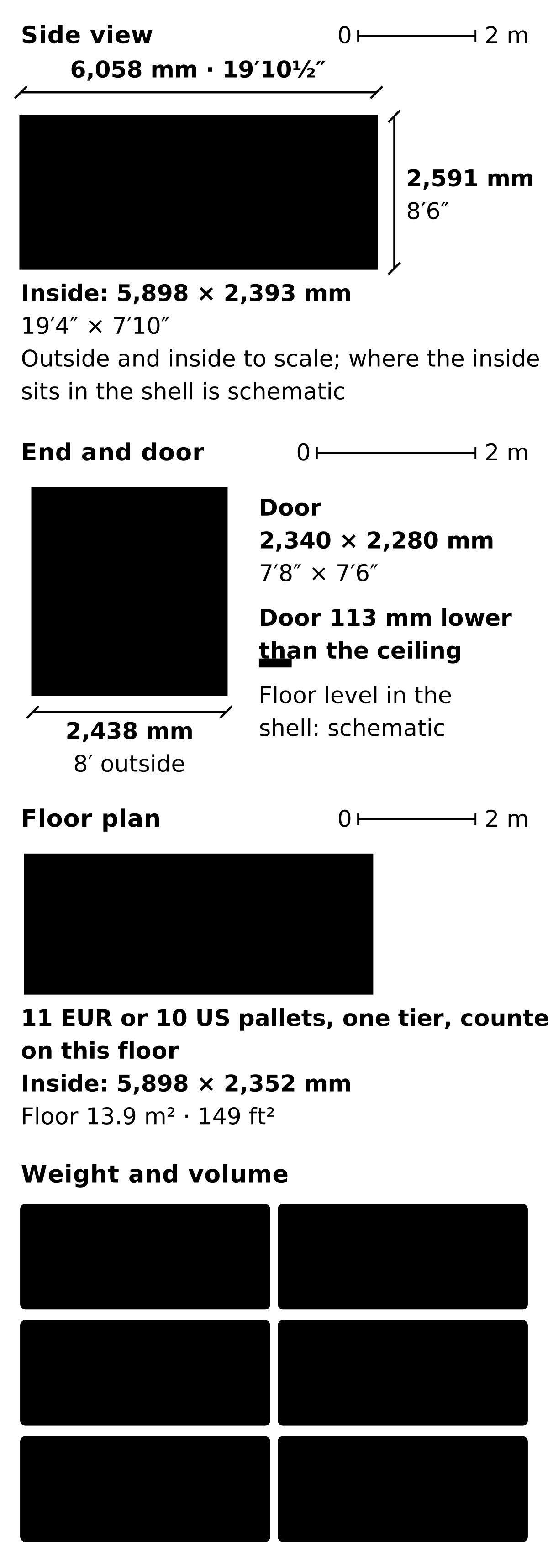
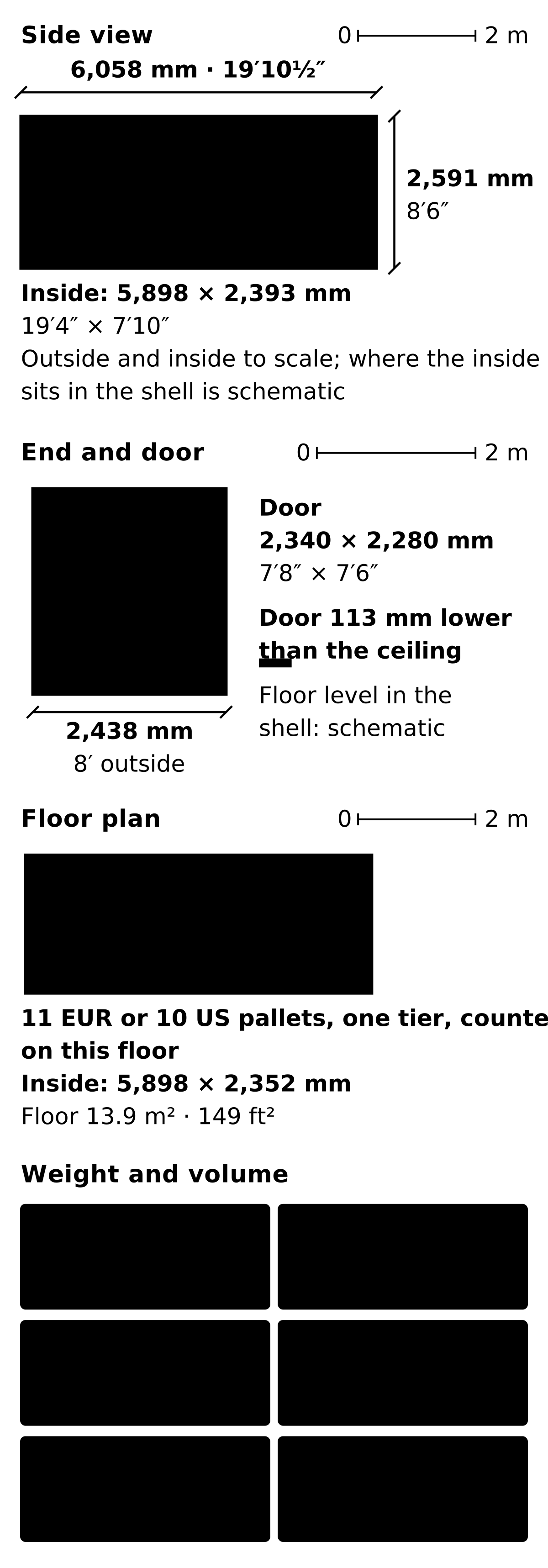
The numbers in this chart
| Measure | Metric | Imperial |
|---|---|---|
| Length outside | 6,058 mm | 19′10½″ |
| Width outside | 2,438 mm | 8′ |
| Height outside | 2,591 mm | 8′6″ |
| Length inside | 5,898 mm | 19′4″ |
| Width inside | 2,352 mm | 7′8½″ |
| Height inside | 2,393 mm | 7′10″ |
| Door width | 2,340 mm | 7′8″ |
| Door height | 2,280 mm | 7′6″ |
| Floor area | 13.9 m² | 149 ft² |
| Volume | 33.2 m³ | 1,172 ft³ |
| Tare (empty) | 2,230 kg | 4,916 lb |
| Payload | 28,250 kg | 62,281 lb |
| Max gross | 30,480 kg | 67,197 lb |
| TEU | 1 | — |
| ISO type | 22G1 | — |
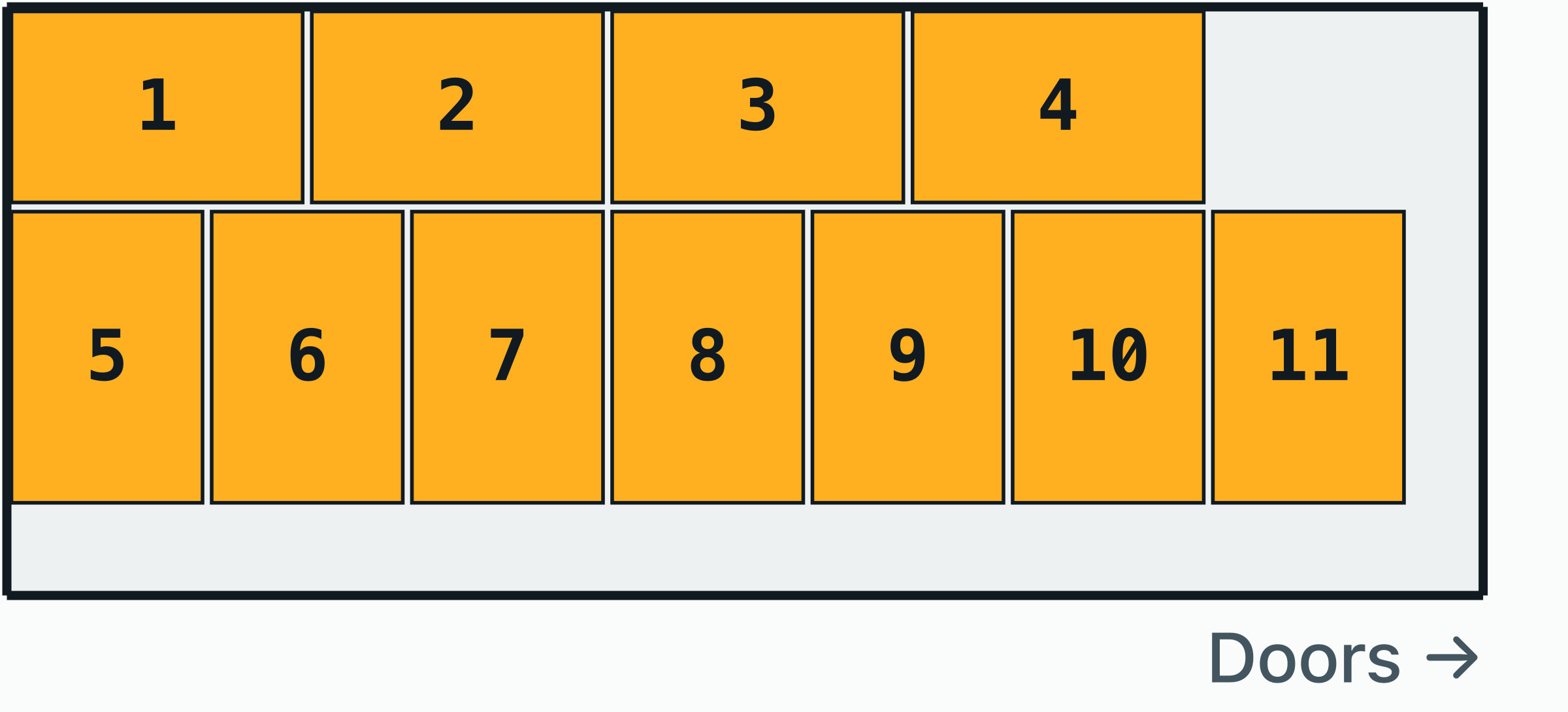
| EUR pallets, one tier (counted) | 11 | — |
| US pallets, one tier (counted) | 10 | — |
Checked : outside sizes set by ISO 668, read in IS 6566:2001, GOST R 51876-2008 and GOST R 53350-2009; every other figure against 19 published sheets of 19 lines, lessors and makers. A sheet agrees within ±5 mm, or ±2 % for a mass and ±1 % for a volume; a maximum gross is a rating and must be the same. Every figure and its sources
20 ft container: dimensions and weight
| Metric | Imperial | |
|---|---|---|
| External dimensions | ||
| Length | 6.058 m | 19′10½″ |
| Width | 2.438 m | 8′ |
| Height | 2.591 m | 8′6″ |
| Internal dimensions | ||
| Length | 5.898 m | 19′4″ |
| Width | 2.352 m | 7′8½″ |
| Height | 2.393 m | 7′10″ |
| Door opening | ||
| Width | 2.340 m | 7′8″ |
| Height | 2.280 m | 7′6″ |
| Specification | ||
| Tare weight | 2,230 kg | 4,916 lb |
| Max gross weight | 30,480 kg | 67,197 lb |
| Max payload | 28,250 kg | 62,281 lb |
| Capacity (volume) | 33.2 m³ | 1,172 ft³ |
| Pallets (one tier, counted on the floor) | 11 EUR · 10 US | |
| TEU | 1 | |
Beside each figure, its evidence: ISO set by the standard · ✓ 16 sheets that agree, counted · range the sheets disagree · 1 sheet one source. A mark opens the sheets behind the figure.
Checked : outside sizes set by ISO 668, read in IS 6566:2001, GOST R 51876-2008 and GOST R 53350-2009; every other figure against 19 published sheets of 19 lines, lessors and makers. A sheet agrees within ±5 mm, or ±2 % for a mass and ±1 % for a volume; a maximum gross is a rating and must be the same. Every figure and its sources
Machine-readable: /data/containers.json · closest published sheet: ZIM, 9 of 12 figures
Data: ISO 668 (1995 text, read in IS 6566:2001) · CMA CGM Equipment Guide · Evergreen Container Specifications · Hapag-Lloyd Container Specifications · Maersk Container Specifications · ONE Container Specifications · Singamas product range · COSCO, Crowley, HMM, Matson, MSC, OOCL, Seaco, SeaCube, Textainer, TOTE, Triton, Yang Ming, ZIM
A 20 ft container stands on 13.9 m² (149 ft²) of floor and holds 11 EUR or 10 US pallets per tier. It defines the TEU, the base unit of shipping capacity — in practice a two-bedroom apartment’s contents, or about 270 medium moving boxes of 60 × 40 × 40 cm by our load planner’s first plan.

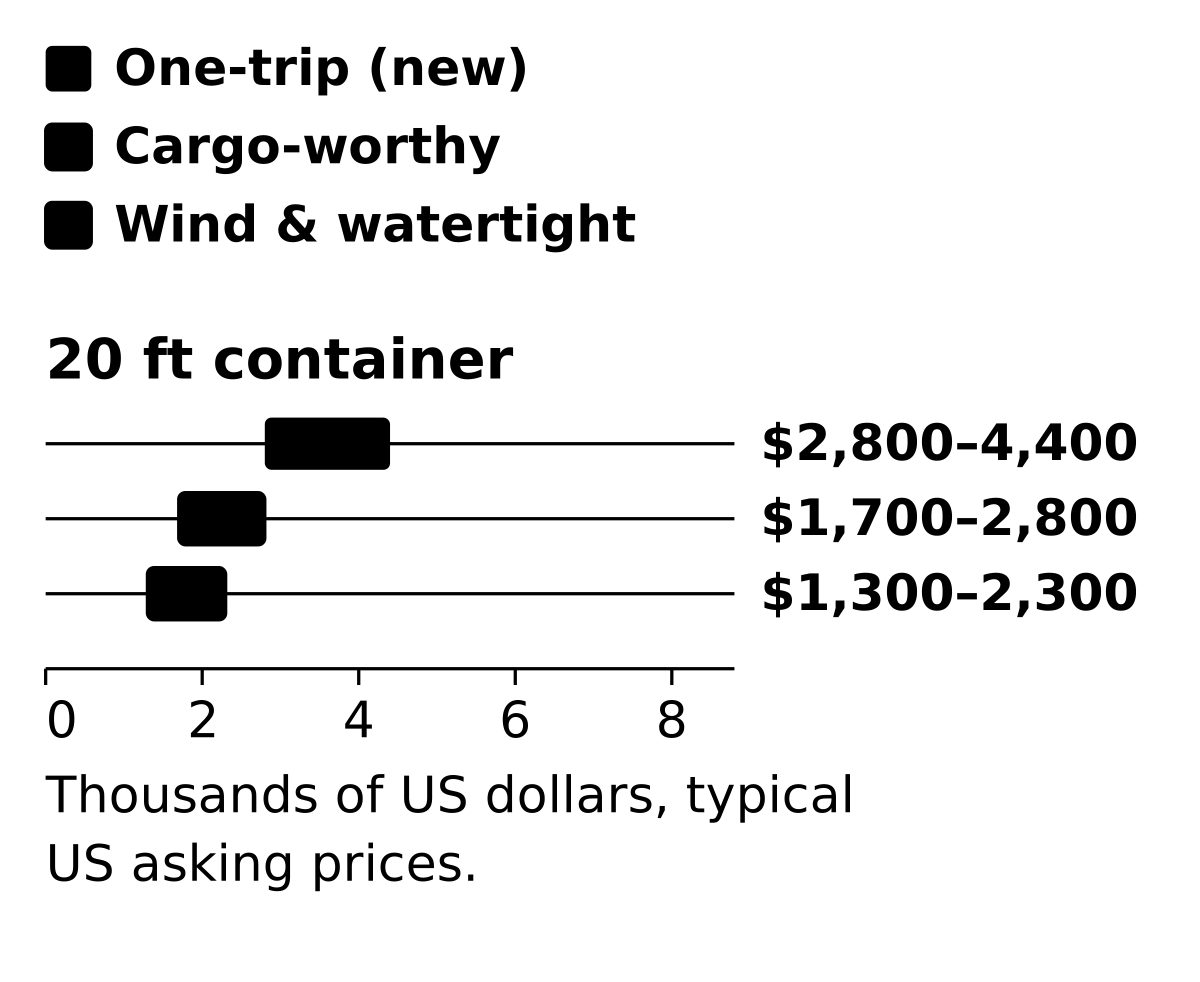
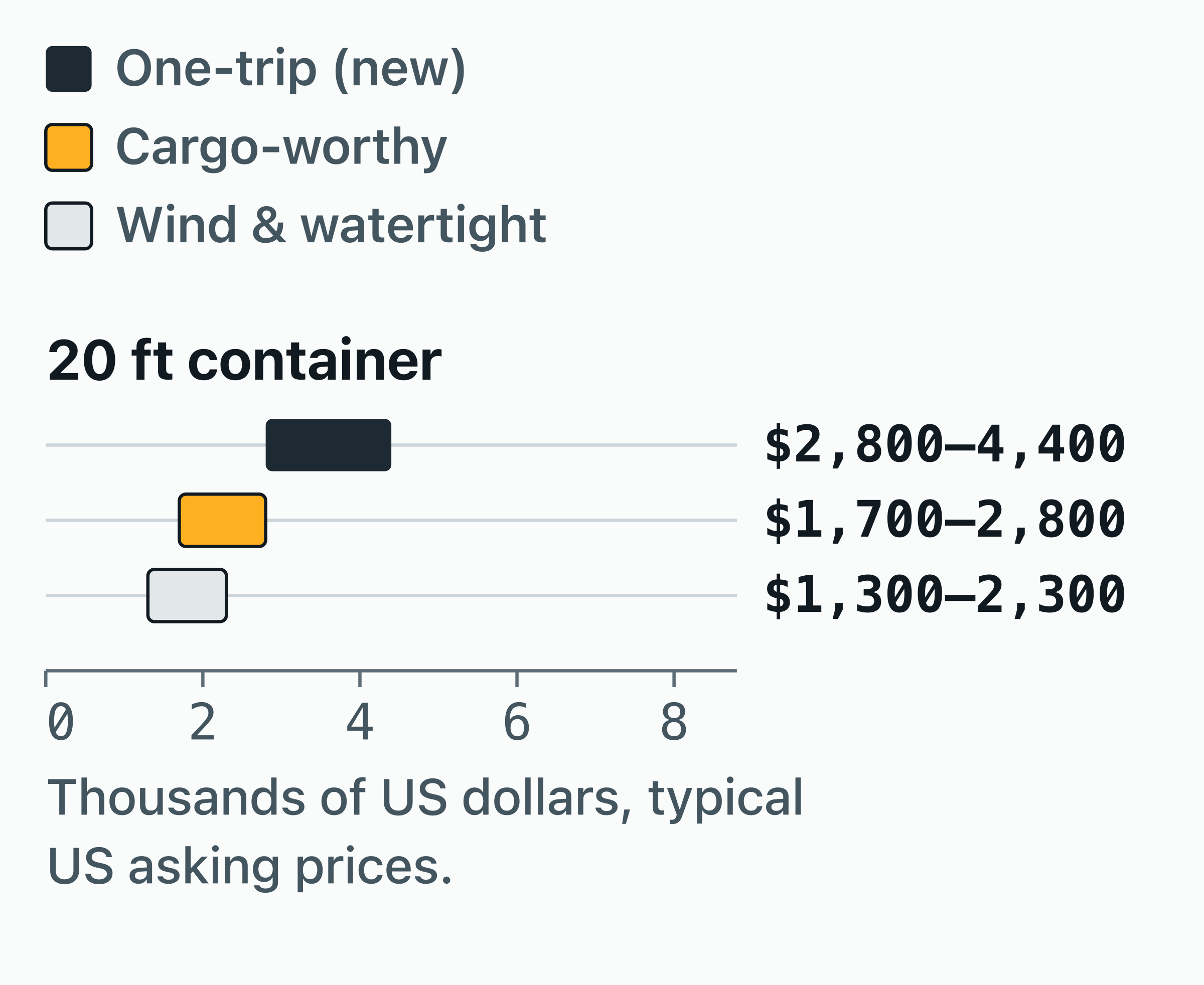
The numbers in this chart
| Size | One-trip (new) | Cargo-worthy | Wind & watertight |
|---|---|---|---|
| 20 ft container | $2,800–4,400 | $1,700–2,800 | $1,300–2,300 |

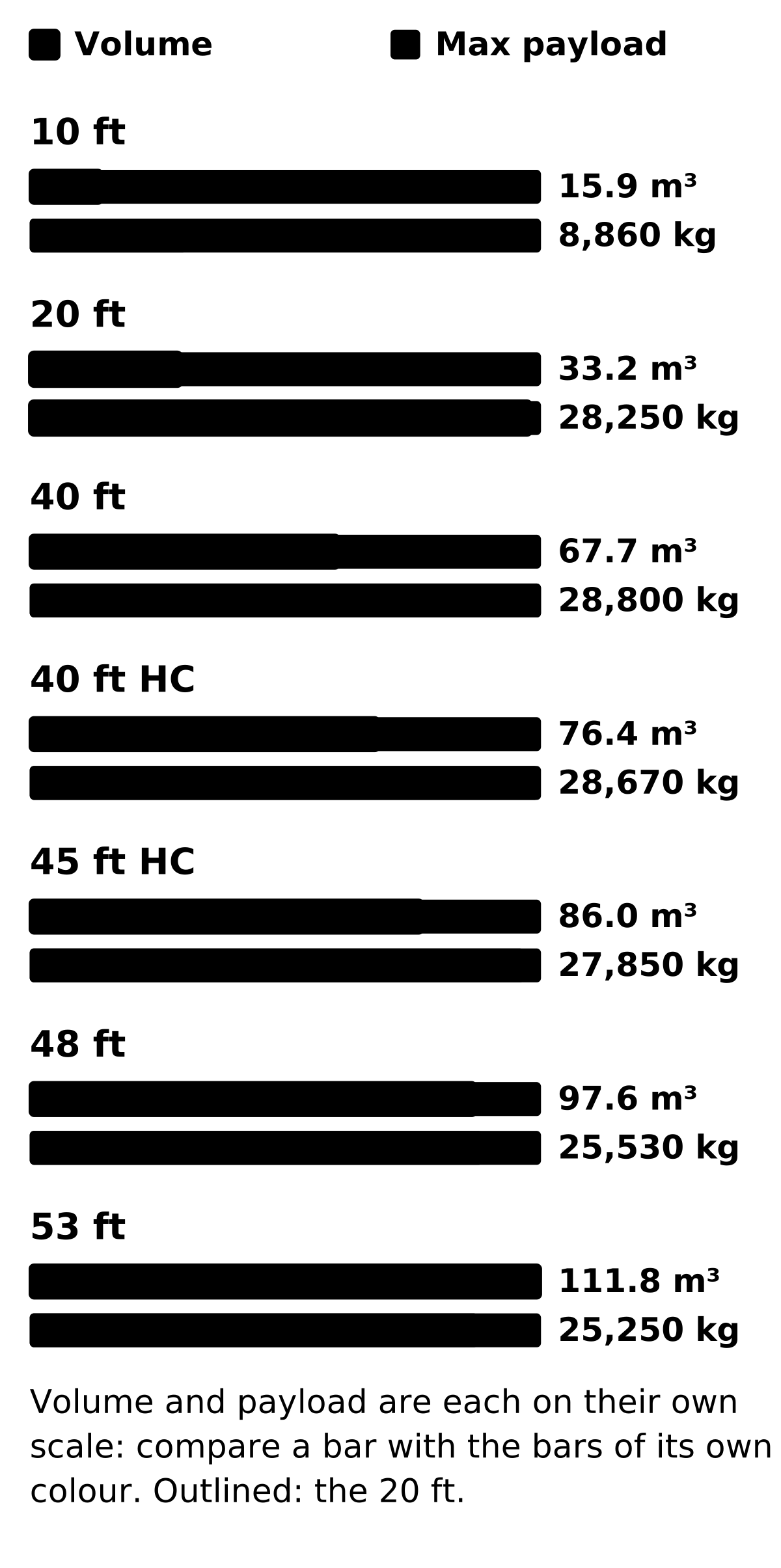
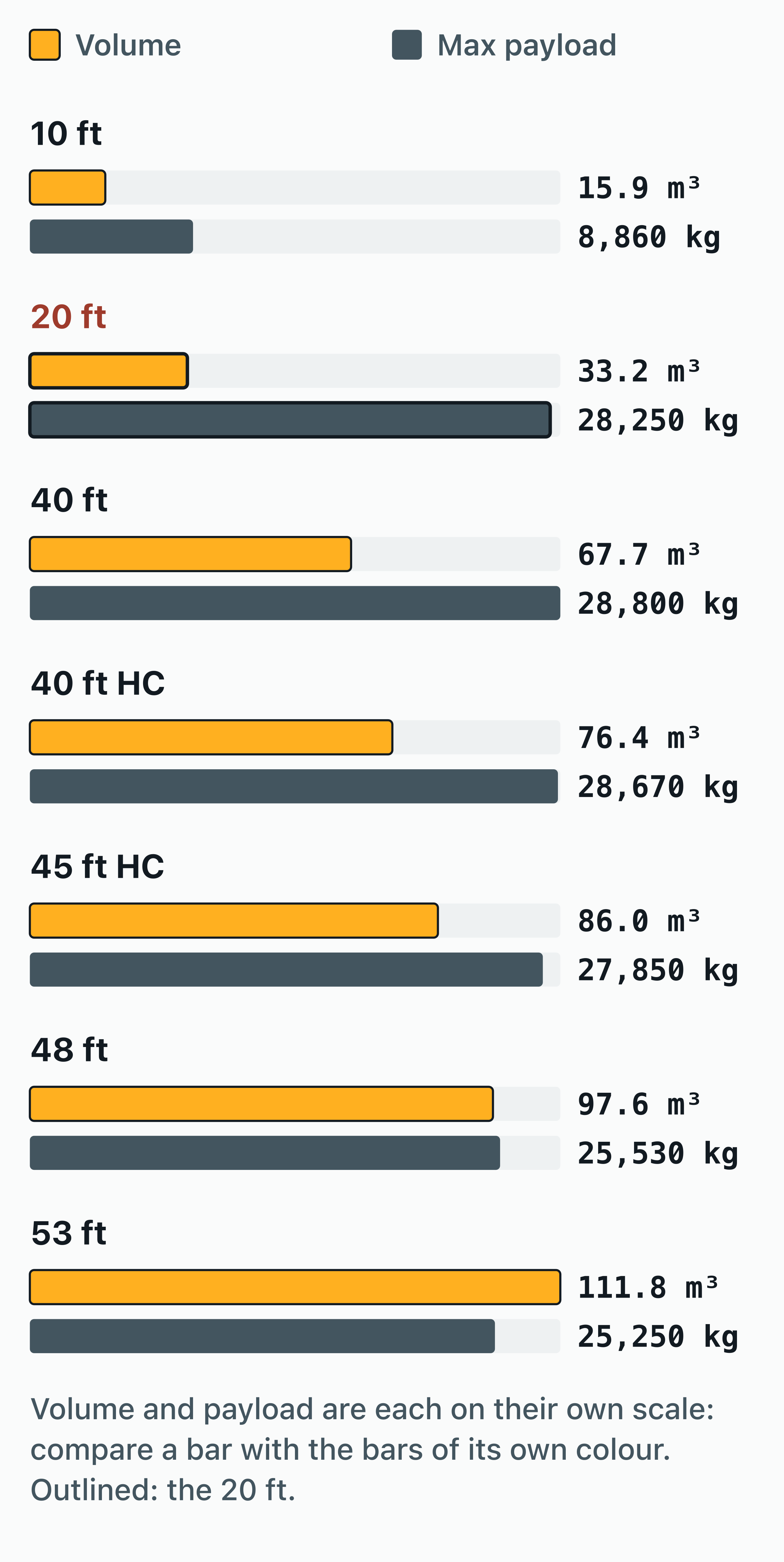
The numbers in this chart
| Size | Volume | Max payload |
|---|---|---|
| 10 ft container | 15.9 m³ · 562 ft³ | 8,860 kg · 19,533 lb |
| 20 ft container | 33.2 m³ · 1,172 ft³ | 28,250 kg · 62,281 lb |
| 40 ft container | 67.7 m³ · 2,391 ft³ | 28,800 kg · 63,493 lb |
| 40 ft high cube container | 76.4 m³ · 2,698 ft³ | 28,670 kg · 63,207 lb |
| 45 ft high cube container | 86.0 m³ · 3,037 ft³ | 27,850 kg · 61,399 lb |
| 48 ft container | 97.6 m³ · 3,447 ft³ | 25,530 kg · 56,284 lb |
| 53 ft container | 111.8 m³ · 3,948 ft³ | 25,250 kg · 55,667 lb |
Checked : the figures in this chart against 42 of 88 published sheets from 27 lines, lessors, makers and rail and road operators: those that print these figures. A sheet agrees within ±5 mm, or ±2 % for a mass and ±1 % for a volume; a maximum gross is a rating and must be the same. Every figure and its sources
What a 20 ft container is used for
The 20 ft dry container (ISO type 22G1) is the reference unit of global shipping — the “twenty-foot equivalent unit”, or TEU, that all vessel and port capacity is measured in. “20 ft” is the nominal length: ISO 668 sets the real one 38 mm short of it, at 6.058 m, so that two twenties and the 76 mm gap between them fill a forty’s 12.192 m slot.
Inside, the corrugated walls and the door frame take their share of the outside, which leaves the inside and the volume in the table above. It is the workhorse for dense, heavy cargo: with a payload near 28 tonnes it carries almost the same weight as a 40 ft container (28,800 kg) in half the volume.
The door opening explains much of the 20-footer’s second life on land: it is wide enough to drive a passenger car through, roll in machinery on a pallet truck, or carry in racking sections up to just under 2.280 m tall without tilting.
A high cube version of the twenty exists — ISO code 25G1, 2.896 m tall — but it is genuinely rare. Fleets that need extra height almost always jump straight to the 40 ft high cube, so if you specifically need a tall twenty, expect a search and a premium.
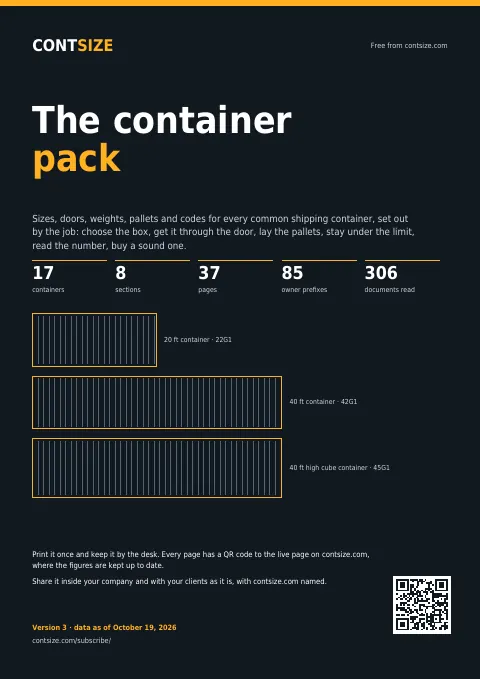
The 20 ft container on one page, plus the whole pack
Every dimension in millimetres, metres and feet, the door opening, tare, payload and volume, and the floor drawn to scale with EUR and US pallets on it. In the same email, the container pack: all 17 containers by the job, 17 sheets like this one, the 85 owner prefixes, an A3 wall chart and an Excel workbook.
- 17 containers, by the job
- 17 container sheets
- 85 owner prefixes
The bot check did not finish, so nothing was sent. Send the form again; if it stops again, allow challenges.cloudflare.com in your blocker or write to info@contsize.com from the address the file should go to.
Nothing was sent: the address could not be read, or a required box was not ticked. Check them and send the form again.
What fits in a 20 ft container
Floor-loaded in one tier, a 20 ft container takes 11 EUR pallets (1.2 × 0.8 m) or 10 US pallets (48″ × 40″). Loose-loaded, its 33.2 m³ swallow roughly the contents of a two-bedroom apartment; for cartons of your own size, a container load calculator gives the exact count and the loading plan. Layouts, stacking and the weight limit: how many pallets fit in a 20 ft container. One-page answers, the figure first: how many pallets fit, how many CBM it is and how much it weighs.
The weight math matters more than the volume for cargo like stone, metal, paper or liquids in drums: max payload of ~28,250 kg is reached with the box barely half full. That is exactly why heavy freight moves in twenties and light, bulky freight in forties.
Beyond freight. The 20 ft size is the sweet spot for static uses: it is the standard unit of self-storage yards, a ready-made site workshop with room for a bench down one wall, and the most common starting point for a tiny office or pop-up shop — 13.9 m² of floor is comparable to a small home office once insulated. A car fits through the 2.340 m door opening, which makes twenties popular for classic-car storage.
Handling is straightforward: at 2.2 t empty a 20 ft box moves with a HIAB truck, a forklift with extended tines (from the side, on the fork pockets), or a small crane — no specialised equipment needed.
20 ft vs 40 ft container
Length is the only outside measure that changes: 6.058 m (19′10½″) against 12.192 m (40′), on the same 2.438 × 2.591 m section and the same door.
So the volume about doubles, 33.2 against 67.7 m³, while the payload hardly moves: 28,250 kg against 28,800 kg.
Heavy cargo books twenties; light, bulky cargo books forties. The two side by side, with when two twenties beat one forty: the 20 ft and the 40 ft compared.
Frequently asked questions
What are the dimensions of a 20 ft container?
A 20 ft container is 6.058 × 2.438 × 2.591 m outside (19′10½″ × 8′ × 8′6″) and 5.898 × 2.352 × 2.393 m inside (19′4″ × 7′8½″ × 7′10″) — per ISO 668; inside, per 15 of 18 sheets. The door opening is 2.340 m wide × 2.280 m high (7′8″ × 7′6″; per 13 of 18 sheets), and the capacity 33.2 m³ (1,172 ft³).
How much does a 20 ft container weigh?
An empty 20 ft container weighs about 2,230 kg (4,916 lb) — sheets print 2,080–2,570 kg, depending on maker and floor. Its maximum gross weight is 30,480 kg (per 15 of 16 sheets; some newer twenties are rated 32,500 kg), which allows a payload of roughly 28,250 kg (62,281 lb).
How many cubic metres (cubic feet) is a 20 ft container?
A 20 ft container holds 33.2 m³ (1,172 ft³) inside — per all 18 sheets, and 33.2 m³ is the top of the range they print (32.9–33.2 m³), so a given box may hold a little less. Boxes and pallets never fill every corner: plan cargo on about 28.2 m³, roughly 85% of it.
How much does a 20 ft container cost?
In October 2026, a used cargo-worthy 20 ft container typically costs $1,700–2,800, while a one-trip (nearly new) unit runs $2,800–4,400. Prices vary widely by market and location — port cities are cheaper than inland areas because supply is deeper.
How many square meters (square feet) is a 20 ft container?
A 20 ft container has 13.9 m² (149 ft²) of internal floor — 5.898 m long by 2.352 m wide (19′4″ × 7′8½″), per 16 of 18 sheets. For comparison, that is roughly the floor area of a single-car garage.
How many pallets fit in a 20 ft container?
11 EUR pallets (1.2 × 0.8 m) or 10 standard US pallets (48″ × 40″) fit in a single floor tier, depending on the loading pattern.
Why is a 20 ft container called 1 TEU?
TEU stands for twenty-foot equivalent unit. The 20 ft container is the industry’s base measure of capacity: a 40 ft container equals 2 TEU, and ship or terminal capacity is quoted in TEU.
What is a 20 ft container in metres?
A 20 ft container is 6.058 m long, 2.438 m wide and 2.591 m high outside (19′10½″ × 8′ × 8′6″) — per ISO 668. The interior is 5.898 × 2.352 × 2.393 m (19′4″ × 7′8½″ × 7′10″), per 15 of 18 sheets.