US domestic
53 ft Container Dimensions
 Yuri Kan Checked against 8 of 88 published sheets
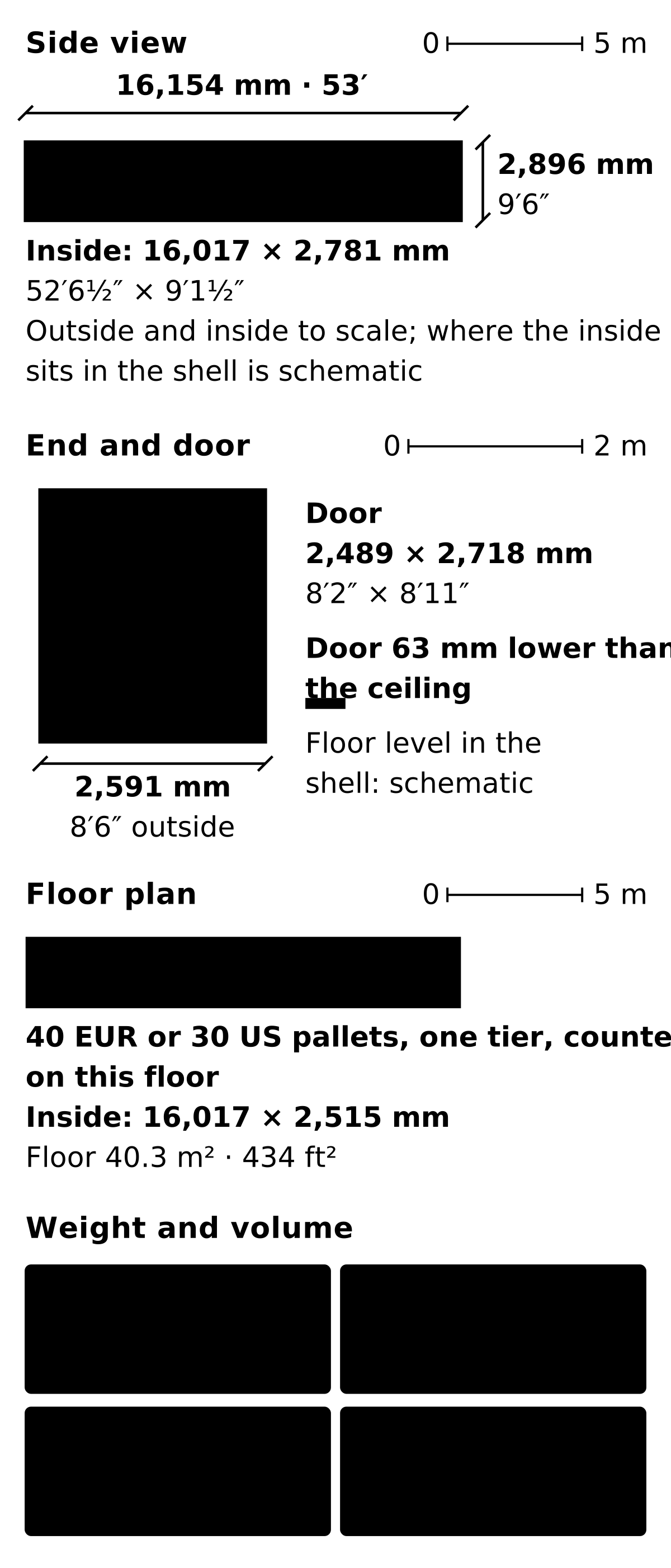
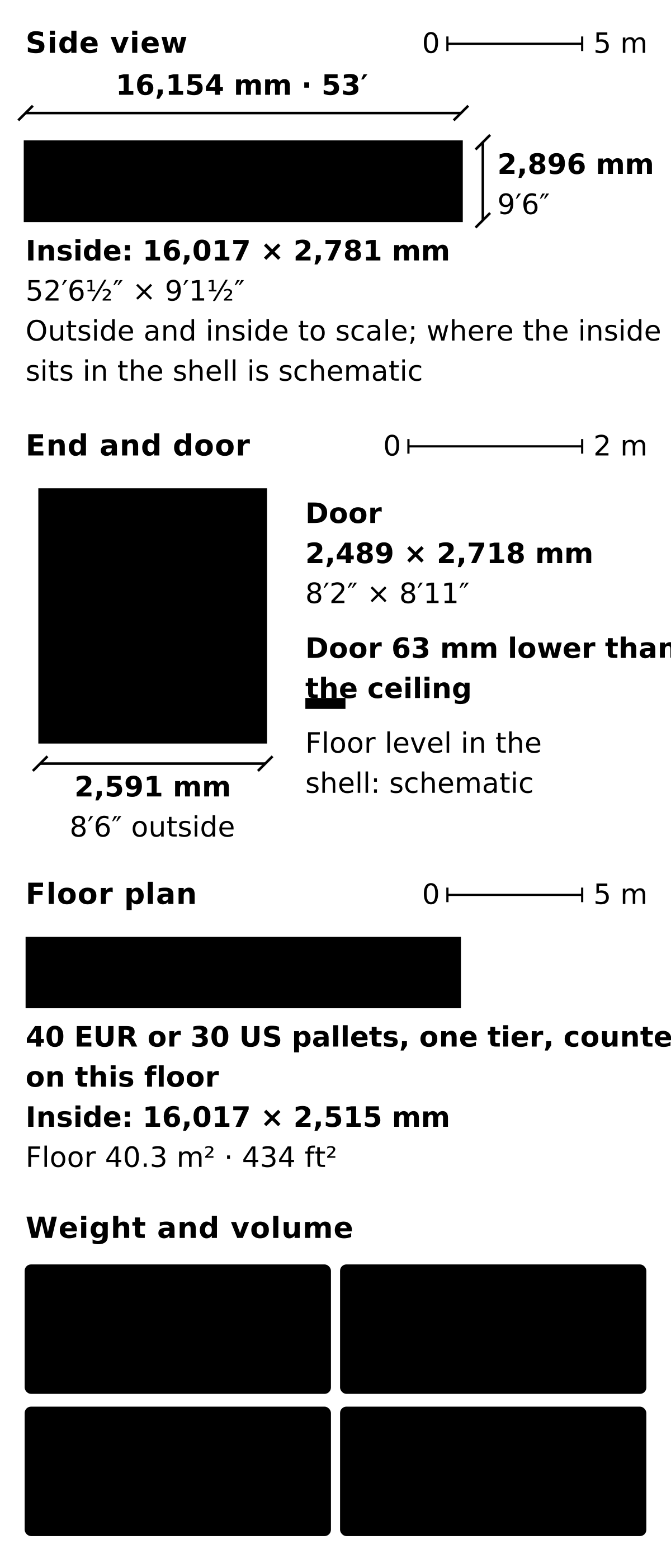
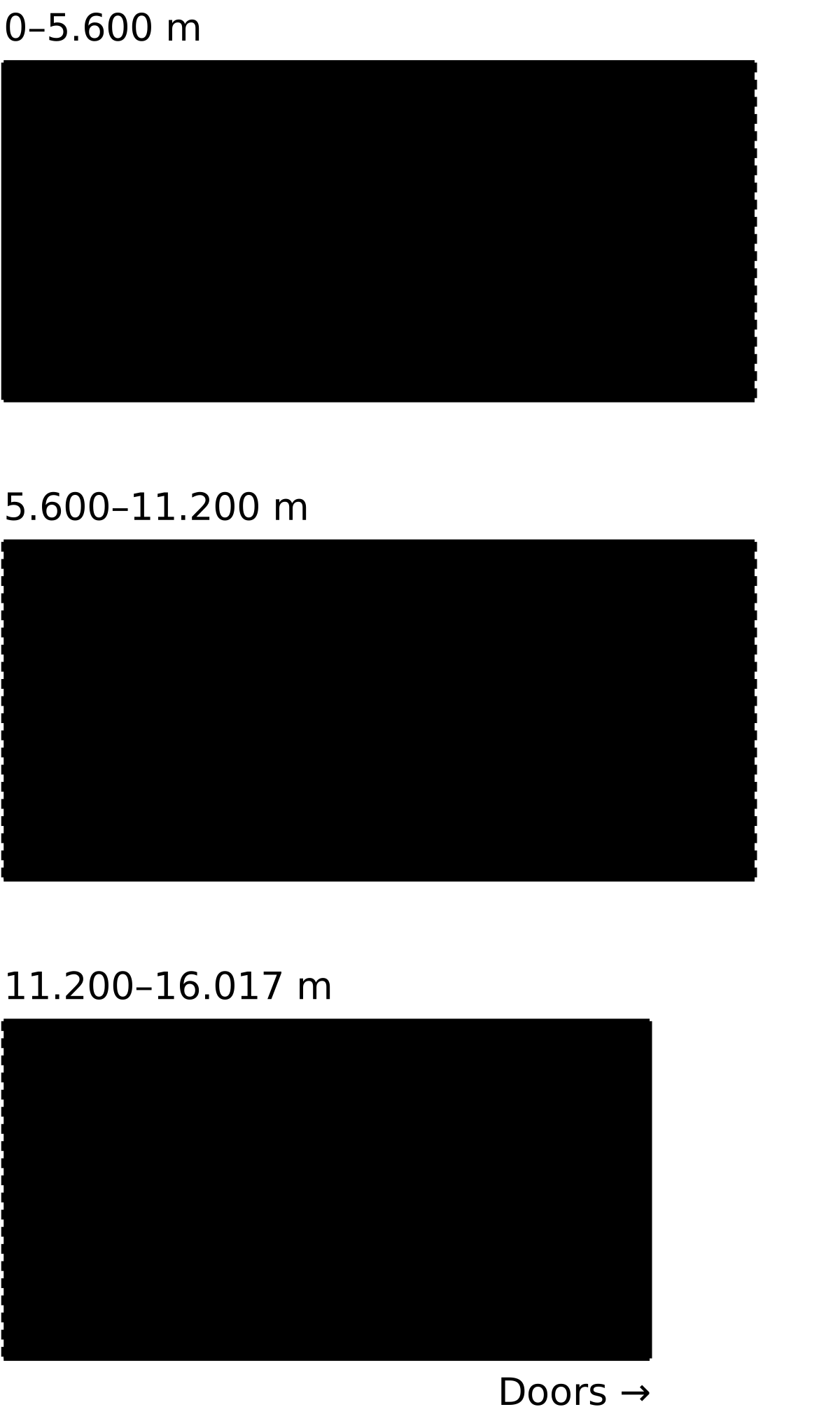
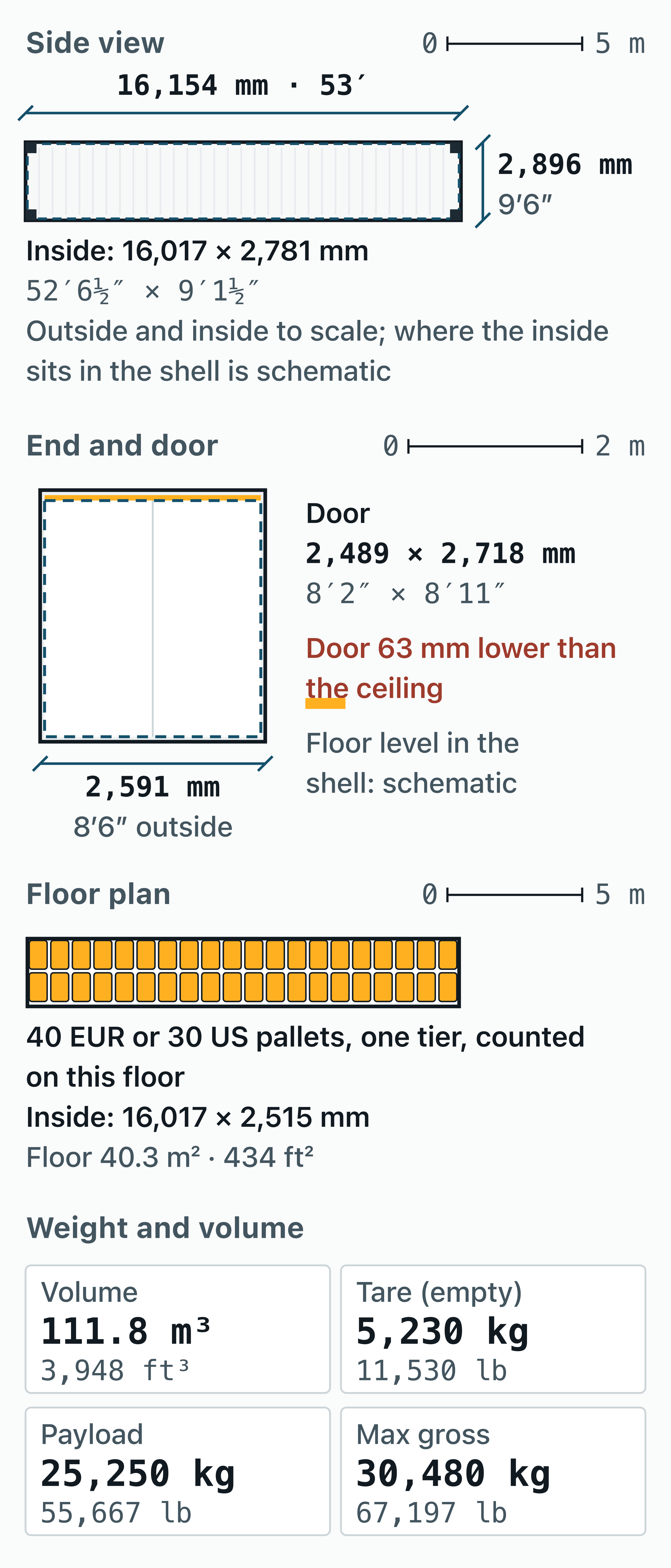
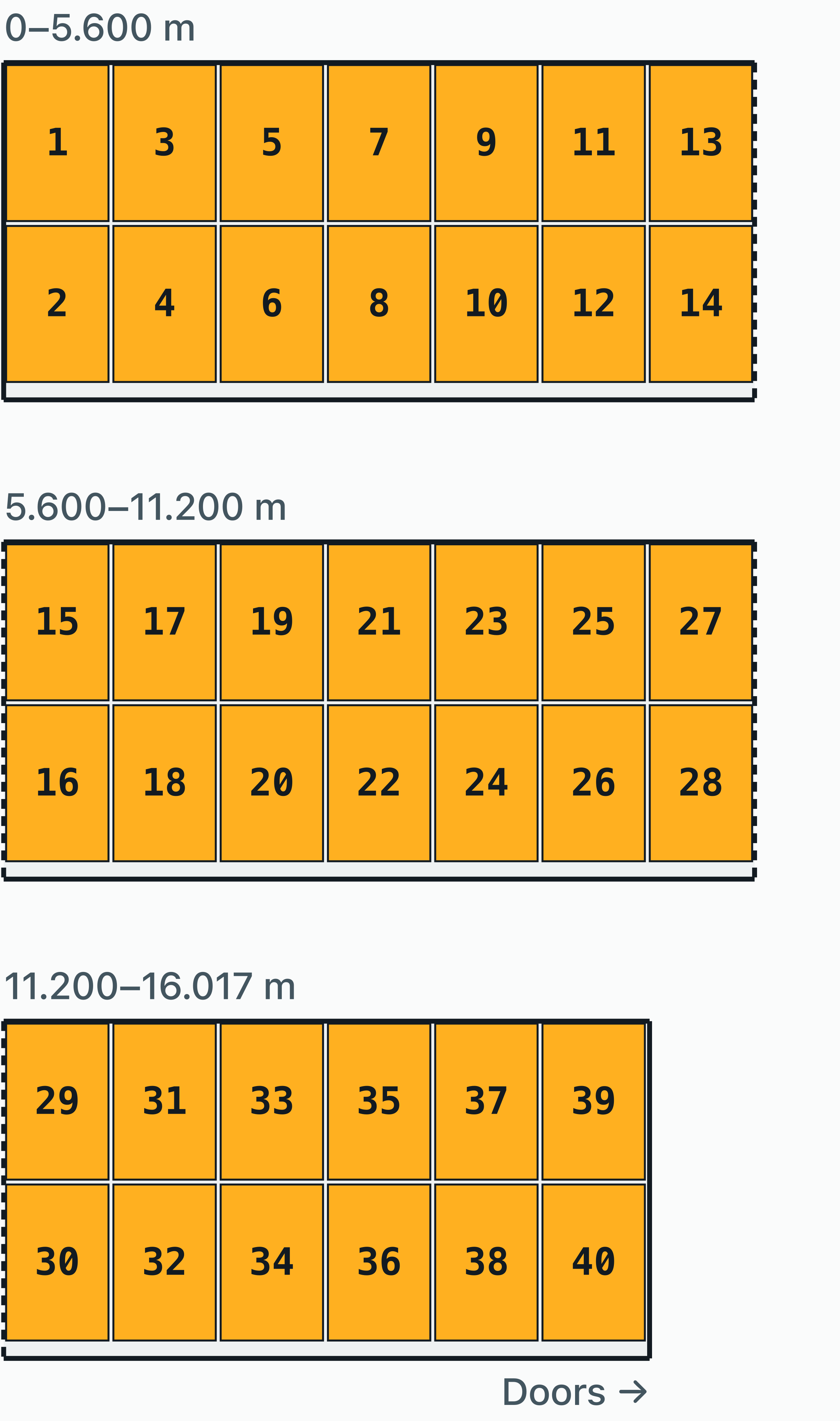
A 53 ft container measures 16.154 × 2.591 × 2.896 m outside (53′ × 8′6″ × 9′6″) and about 16.017 × 2.515 × 2.781 m inside (52′6½″ × 8′3″ × 9′1½″) — no ISO standard covers it, and builders differ: the 7 published sheets print 15,951–16,027 mm long, 2,489–2,540 mm wide and 2,718–2,781 mm high inside. That is roughly 111.8 m³ on 40.3 m² (434 ft²) of floor. It matches a 53 ft US road trailer and takes about 30 US pallets two abreast. Tare is around 5,230 kg (11,530 lb); it is the standard of North American domestic intermodal, not an ocean box.
The numbers in this chart
| Measure | Metric | Imperial |
|---|---|---|
| Length outside | 16,154 mm | 53′ |
| Width outside | 2,591 mm | 8′6″ |
| Height outside | 2,896 mm | 9′6″ |
| Length inside | 16,017 mm | 52′6½″ |
| Width inside | 2,515 mm | 8′3″ |
| Height inside | 2,781 mm | 9′1½″ |
| Door width | 2,489 mm | 8′2″ |
| Door height | 2,718 mm | 8′11″ |
| Floor area | 40.3 m² | 434 ft² |
| Volume | 111.8 m³ | 3,948 ft³ |
| Tare (empty) | 5,230 kg | 11,530 lb |
| Payload | 25,250 kg | 55,667 lb |
| Max gross | 30,480 kg | 67,197 lb |
| EUR pallets, one tier (counted) | 40 | — |
| US pallets, one tier (counted) | 30 | — |
Checked : no ISO standard covers this size; every figure against 8 published sheets of 8 lines, makers and rail and road operators. A sheet agrees within ±5 mm, or ±2 % for a mass and ±1 % for a volume; a maximum gross is a rating and must be the same. Every figure and its sources
53 ft container: dimensions and weight
| Metric | Imperial | |
|---|---|---|
| External dimensions | ||
| Length | 16.154 m | 53′ |
| Width | 2.591 m | 8′6″ |
| Height | 2.896 m | 9′6″ |
| Internal dimensions | ||
| Length | 16.017 m | 52′6½″ |
| Width | 2.515 m | 8′3″ |
| Height | 2.781 m | 9′1½″ |
| Door opening | ||
| Width | 2.489 m | 8′2″ |
| Height | 2.718 m | 8′11″ |
| Specification | ||
| Tare weight | 5,230 kg | 11,530 lb |
| Max gross weight | 30,480 kg | 67,197 lb |
| Max payload | 25,250 kg | 55,667 lb |
| Capacity (volume) | 111.8 m³ | 3,948 ft³ |
| Pallets (one tier, counted on the floor) | 40 EUR · 30 US | |
Beside each figure, its evidence: ISO set by the standard · ✓ 16 sheets that agree, counted · range the sheets disagree · 1 sheet one source. A mark opens the sheets behind the figure.
Checked : no ISO standard covers this size; every figure against 8 published sheets of 8 lines, makers and rail and road operators. A sheet agrees within ±5 mm, or ±2 % for a mass and ±1 % for a volume; a maximum gross is a rating and must be the same. Every figure and its sources
Machine-readable: /data/containers.json · closest published sheet: Trailer Bridge, 8 of 10 figures
Data: CN, Crowley, J.B. Hunt, Sea Box, STG, TOTE, Trailer Bridge, Union Pacific


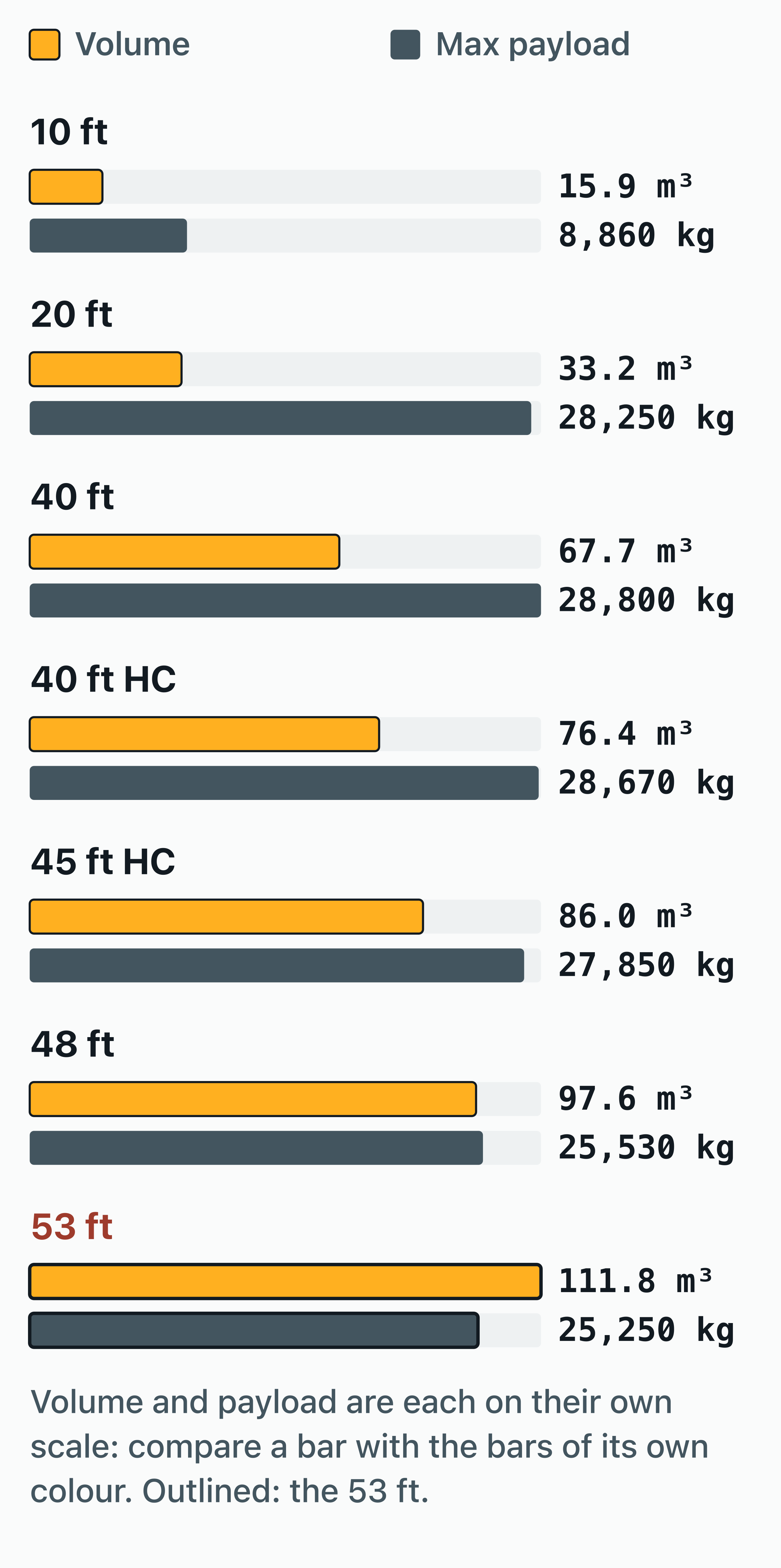
The numbers in this chart
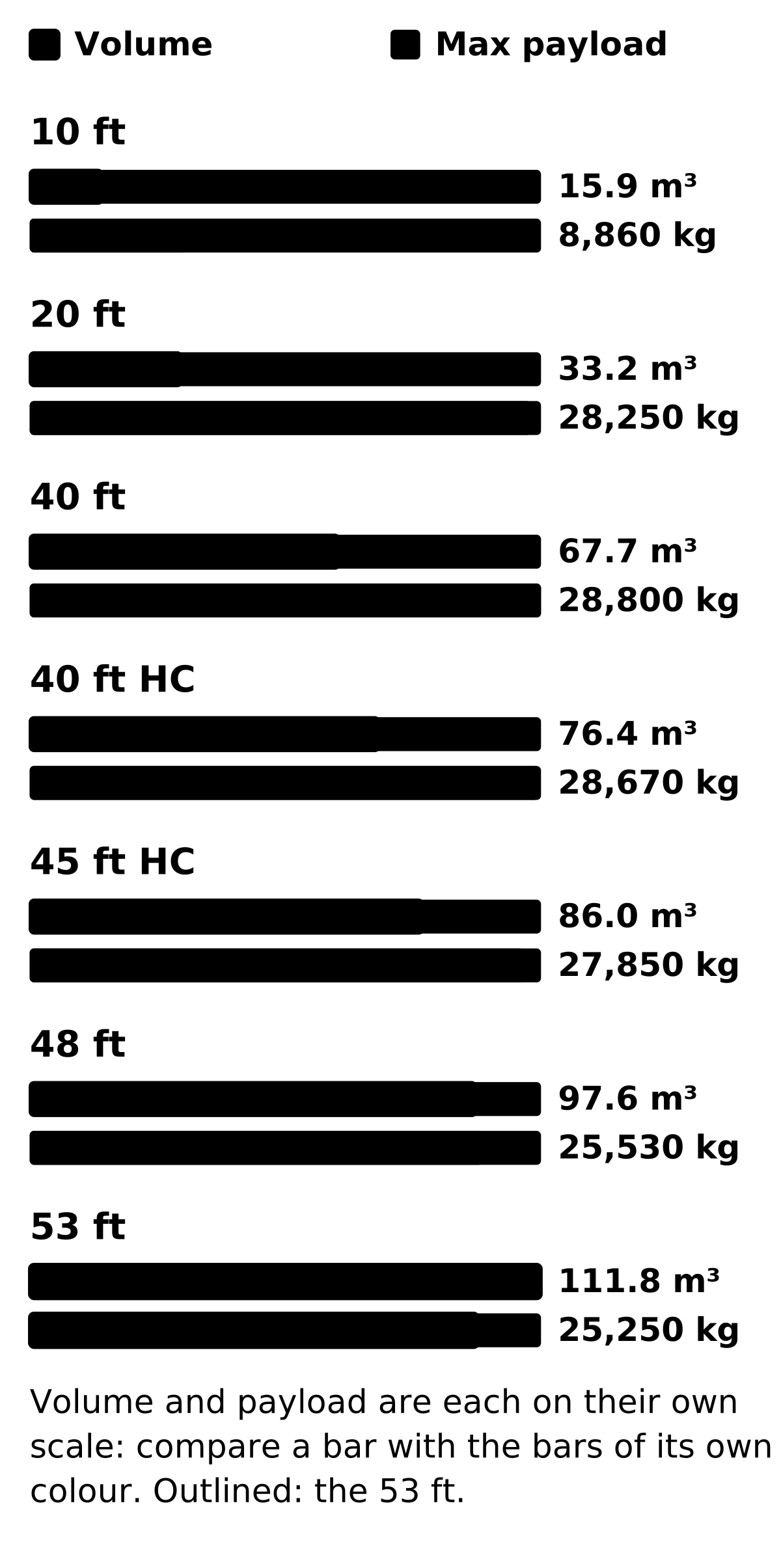
| Size | Volume | Max payload |
|---|---|---|
| 10 ft container | 15.9 m³ · 562 ft³ | 8,860 kg · 19,533 lb |
| 20 ft container | 33.2 m³ · 1,172 ft³ | 28,250 kg · 62,281 lb |
| 40 ft container | 67.7 m³ · 2,391 ft³ | 28,800 kg · 63,493 lb |
| 40 ft high cube container | 76.4 m³ · 2,698 ft³ | 28,670 kg · 63,207 lb |
| 45 ft high cube container | 86.0 m³ · 3,037 ft³ | 27,850 kg · 61,399 lb |
| 48 ft container | 97.6 m³ · 3,447 ft³ | 25,530 kg · 56,284 lb |
| 53 ft container | 111.8 m³ · 3,948 ft³ | 25,250 kg · 55,667 lb |
Checked : the figures in this chart against 42 of 88 published sheets from 27 lines, lessors, makers and rail and road operators: those that print these figures. A sheet agrees within ±5 mm, or ±2 % for a mass and ±1 % for a volume; a maximum gross is a rating and must be the same. Every figure and its sources
What a 53 ft container is used for
The 53 ft container is the North American domestic box sized to match the 53 ft road trailer, so freight moves between rail and highway without re-handling. Externally it runs 16.154 m long, 2.591 m (102″) wide and 2.896 m (9′6″) high.
Like the 48-footer it is a domestic, non-ISO size: built for double-stack rail cars and US/Canadian roads, not for deep-sea cell guides, and no ISO standard sets its dimensions. A handful of carriers have trialled 53 ft units on ocean lanes, but they remain a rarity outside North America.
Doors open to about 2.489 m wide × 2.718 m high — as wide as the 48 ft’s, 13 cm taller, but 3 cm narrower and 6 cm lower than the inside: the door, not the interior, limits what goes in. Construction differs from ocean boxes too: most 53s are lighter-gauge steel or steel-aluminium hybrids, built for rail and road loads rather than for stacking in a ship’s hold, which is one reason they stay on land.
The size has effectively won the domestic intermodal market: railroads price around it, truckload freight converts to it one-for-one, and new-build domestic containers are almost exclusively 53 ft. If you are comparing against the 48, the 53 carries about 15% more cube for the same rail slot.
The 53 ft container on one page, plus the whole pack
Every dimension in millimetres, metres and feet, the door opening, tare, payload and volume, and the floor drawn to scale with EUR and US pallets on it. In the same email, the container pack: all 17 containers by the job, 17 sheets like this one, the 85 owner prefixes, an A3 wall chart and an Excel workbook.
- 17 containers, by the job
- 17 container sheets
- 85 owner prefixes
The bot check did not finish, so nothing was sent. Send the form again; if it stops again, allow challenges.cloudflare.com in your blocker or write to info@contsize.com from the address the file should go to.
Nothing was sent: the address could not be read, or a required box was not ticked. Check them and send the form again.
What fits in a 53 ft container
Around 111.8 m³ — 46% more than a 40 ft high cube. The 2.515 m internal width takes US pallets two abreast, for roughly 30 pallet positions in a single tier.
As with all domestic equipment, road weight limits govern: US federal law caps the whole truck — tractor, chassis, box and cargo — at 80,000 lb (36,287 kg), per 23 CFR 658.17, so the cargo it takes on the road stays well below the box’s structural rating of 30,480 kg gross.
The one-for-one match with a 53 ft dry van trailer is the design brief made steel: same floor count (about 30 two-abreast US pallet positions), same cube class, so a shipper can move truckload freight to rail without touching the load plan. That is what “domestic intermodal” means in practice.
On the secondary market, retired 53s are prized for their sheer floor area — about 40.3 m² with ceilings up to 2.781 m, more floor than any other size on this site. They suit barns, workshops and warehouses; just note that trucking a 16.154 m box needs a specialised chassis and generous site access.
53 ft vs 40 ft high cube
| 53 ft container | 40 ft high cube container | |
|---|---|---|
| ISO type code | — | 45G1 |
| External dimensions — Length | 16.154 m53′ | 12.192 m 40 ft high cube container · Outside length 12,192 mm Set by the standard |
| External dimensions — Width | 2.591 m8′6″ | 2.438 m 40 ft high cube container · Outside width 2,438 mm Set by the standard |
| External dimensions — Height | 2.896 m9′6″ | 2.896 m 40 ft high cube container · Outside height 2,896 mm Set by the standard |
| Internal dimensions — Length | 16.017 m52′6½″ | 12.032 m39′5½″ |
| Internal dimensions — Width | 2.515 m8′3″ | 2.352 m7′8½″ |
| Internal dimensions — Height | 2.781 m9′1½″ | 2.698 m8′10″ |
| Tare weight | 5,230 kg11,530 lb | 3,830 kg8,444 lb |
| Max gross weight | 30,480 kg67,197 lb | 32,500 kg71,650 lb |
| Max payload | 25,250 kg55,667 lb | 28,670 kg63,207 lb |
| Capacity (volume) | 111.8 m³3,948 ft³ | 76.4 m³2,698 ft³ |
| EUR pallets | 40 | 25 |
| TEU | — | 2 |
Checked : the outside sizes of the ISO boxes set by ISO 668, read in IS 6566:2001, GOST R 51876-2008 and GOST R 53350-2009; the US domestic boxes, which no ISO standard covers, and every other figure against 25 published sheets of 25 lines, lessors, makers and rail and road operators. A sheet agrees within ±5 mm, or ±2 % for a mass and ±1 % for a volume; a maximum gross is a rating and must be the same. Every figure and its sources
Data: ISO 668 (1995 text, read in IS 6566:2001) · CMA CGM Equipment Guide · Evergreen Container Specifications · Hapag-Lloyd Container Specifications · Maersk Container Specifications · ONE Container Specifications · Singamas product range · CN, COSCO, Crowley, HMM, J.B. Hunt, Matson, MSC, OOCL, Sea Box, Seaco, SeaCube, STG, Textainer, TOTE, Trailer Bridge, Triton, Union Pacific, Yang Ming, ZIM
Frequently asked questions
What are the dimensions of a 53 ft container?
A 53 ft container is 16.154 × 2.591 × 2.896 m outside (53′ × 8′6″ × 9′6″), the length per all 6 sheets, and about 16.017 × 2.515 × 2.781 m inside (52′6½″ × 8′3″ × 9′1½″), with about 111.8 m³ of capacity. No ISO standard covers the size, and the inside varies by builder: 15,951–16,027 mm long, 2,489–2,540 mm wide and 2,718–2,781 mm high on the published sheets.
How much does a 53 ft container weigh?
An empty 53 ft container weighs about 5,230 kg (11,530 lb) — sheets print 4,536–5,375 kg, since no standard fixes it and builders use different steels. Structural max gross is around 30,480 kg (per 3 of 4 sheets), but on US roads the whole truck — tractor, chassis, box and cargo — may weigh no more than 80,000 lb (36,287 kg), per 23 CFR 658.17, so the road limit, not the box, sets the payload.
What are the door dimensions of a 53 ft container?
The end-door opening of a 53 ft container is about 2.489 m wide × 2.718 m high (98″ × 107″) — the width per 6 of 8 sheets, the height sheets print 2,646–2,781 mm. That is wider and taller than ISO container doors, sized to pass two-abreast pallet loads and wide machinery.
How much does a 53 ft container cost?
Named US dealers ask $4,900 for a cargo-worthy used 53 ft container (Worthy Container) and $8,299–12,999 for wind-and-watertight units (Conex Depot), read 18 October 2026, delivery extra. It is a regional North American market — plentiful near rail hubs, scarce elsewhere — so prices vary heavily by location and condition.
How many square meters (square feet) is a 53 ft container?
A 53 ft container has about 40.3 m² (434 ft²) of internal floor — 16.017 m long by 2.515 m wide (52′6½″ × 8′3″); the published sheets differ, printing 15,951–16,027 mm long and 2,489–2,540 mm wide. That is more floor than any other size on this site, comparable to a small one-bedroom apartment.
How many pallets fit in a 53 ft container?
About 30 US pallets (48″ × 40″) in a single floor tier, loaded two abreast in the 2.515 m (8′3″) wide interior.
Why do 53 ft containers exist?
To make intermodal freight match trucking: a 53 ft box carries the same load as the standard US semi-trailer, so shippers can switch between rail and road without repacking.