ISO 22U1 · 42U1
Open Top Container Dimensions
 Yuri Kan Checked against 17 of 88 published sheets
An open top container measures 5.898 × 2.352 × 2.348 m (19′4″ × 7′8½″ × 7′8½″) inside on a 20 ft, per 9 of 12 sheets, and 12.032 × 2.352 × 2.348 m (39′5½″ × 7′8½″ × 7′8½″) on a 40 ft, per 10 of 13 sheets, and swaps the steel roof for removable bows and a tarpaulin so cargo cranes in from above. The roof opening is 2.210–2.232 m wide and 5.338–5.674 m long on a 20 ft, 11.530–11.798 m on a 40 ft, on the sheets of Hapag-Lloyd, OOCL and Yang Ming. Payloads stay close to a dry box’s — about 28,230 kg (62,236 lb) on the 20 ft and 26,630 kg (58,709 lb) on the 40 ft — and over-height cargo can travel proud of the top rail at an out-of-gauge rate.
| Metric | Imperial | |
|---|---|---|
| External dimensions | 6.058 × 2.438 × 2.591 m | 19′10½″ × 8′ × 8′6″ |
| Internal dimensions | 5.898 × 2.352 × 2.348 m | 19′4″ × 7′8½″ × 7′8½″ |
| Door opening | 2.340 × 2.280 m | 7′8″ × 7′6″ |
| Capacity (volume) | 32.5 m³ | 1,148 ft³ |
| Tare weight | 2,250 kg | 4,960 lb |
| Max payload | 28,230 kg | 62,236 lb |
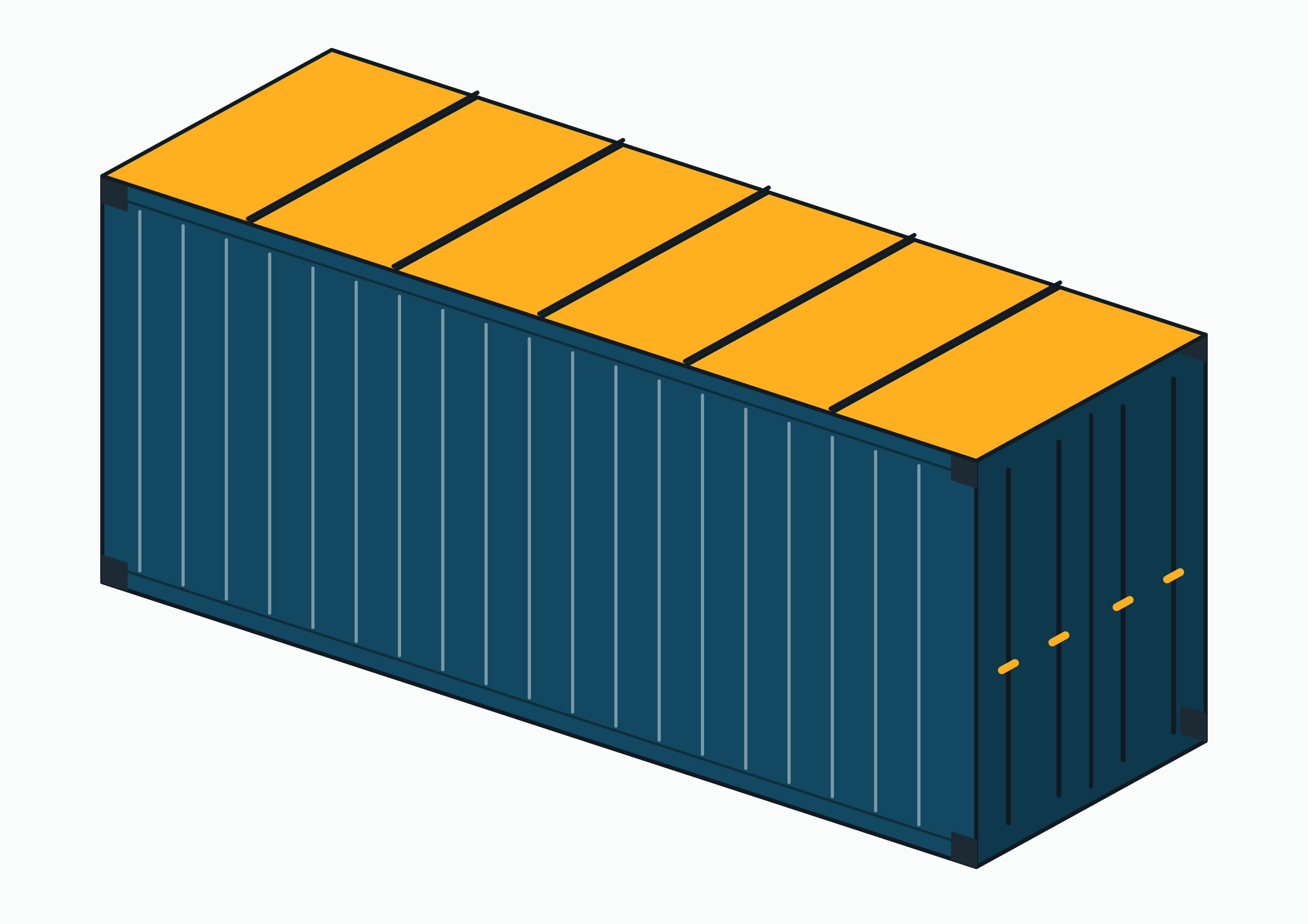
An open top container replaces the steel roof with removable bows and a tarpaulin, so cargo can be craned in from above — machinery, glass, timber, steel coils, anything too tall or too awkward for the door.
The numbers in this chart
| Figure | Value |
|---|---|
| Outside, L × W × H | 6.058 × 2.438 × 2.591 m |
| Volume | 32.5 m³ |
| Payload | 28,230 kg |
Checked : outside sizes set by ISO 668, read in IS 6566:2001, GOST R 51876-2008 and GOST R 53350-2009; every other figure against 12 published sheets of 12 lines and lessors. A sheet agrees within ±5 mm, or ±2 % for a mass and ±1 % for a volume; a maximum gross is a rating and must be the same. Every figure and its sources
Floor dimensions match the standard dry box; height to the top rail is a few centimetres lower (2.348 m usable, against 2.393 m in a dry twenty) because of the roof bows. The door header swings out, opening the full end of the container for loading.
Weights stay close to dry boxes: the 20 ft open top tares at about 2,250 kg with a 28,230 kg payload, practically a dry twenty’s, and the 40 ft at about 3,850 kg with a 30,480 kg max gross rating and roughly 26,630 kg of payload — 2,170 kg less than a standard dry forty rated 32,500 kg, so dense industrial cargo often goes in the twenty.
Because open tops are a small fraction of the fleet, availability is patchier and both purchase prices and freight rates carry a premium. Book them early on routes where project cargo is common, and confirm the tarp and bows travel with the box — replacements are surprisingly expensive.

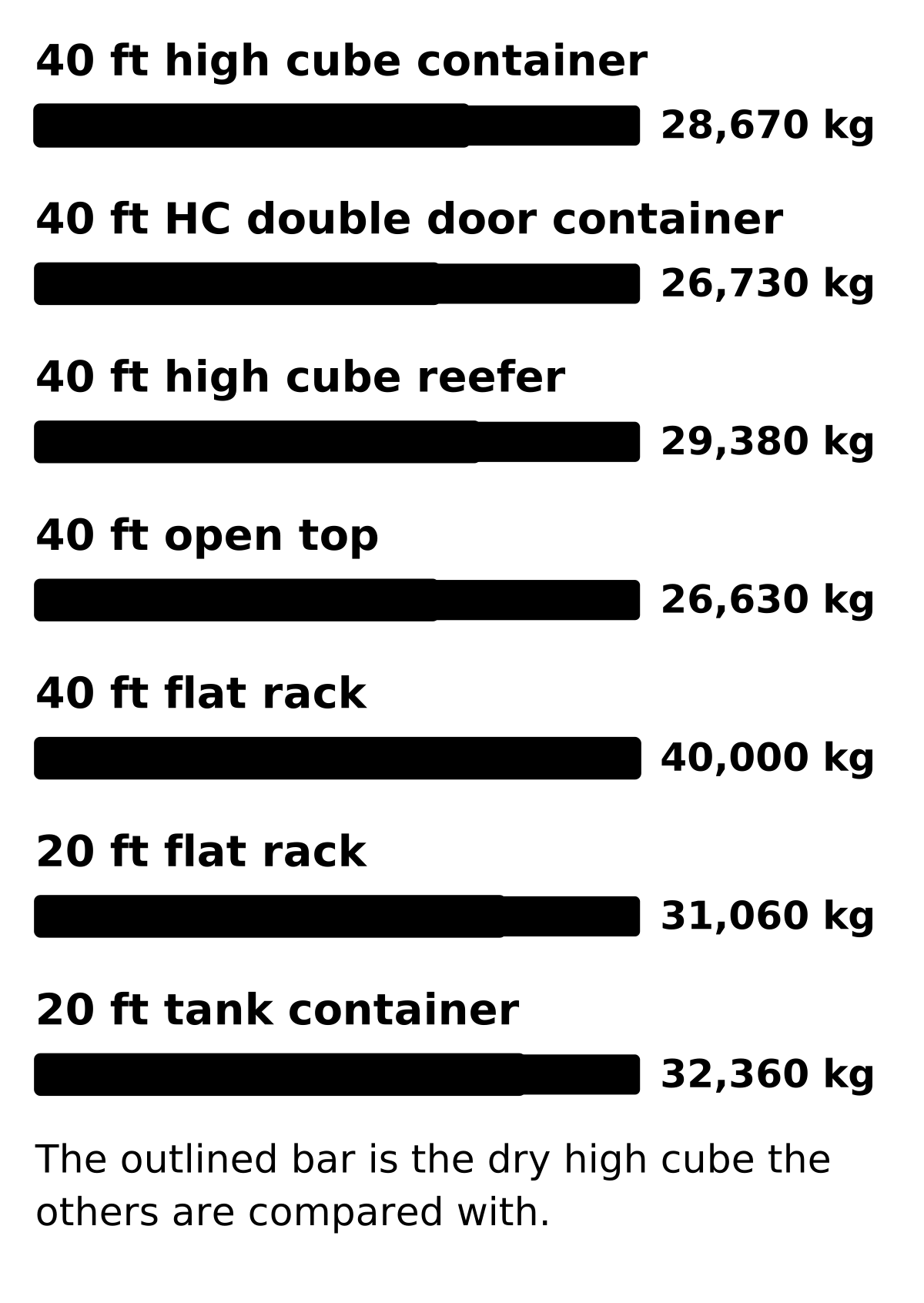
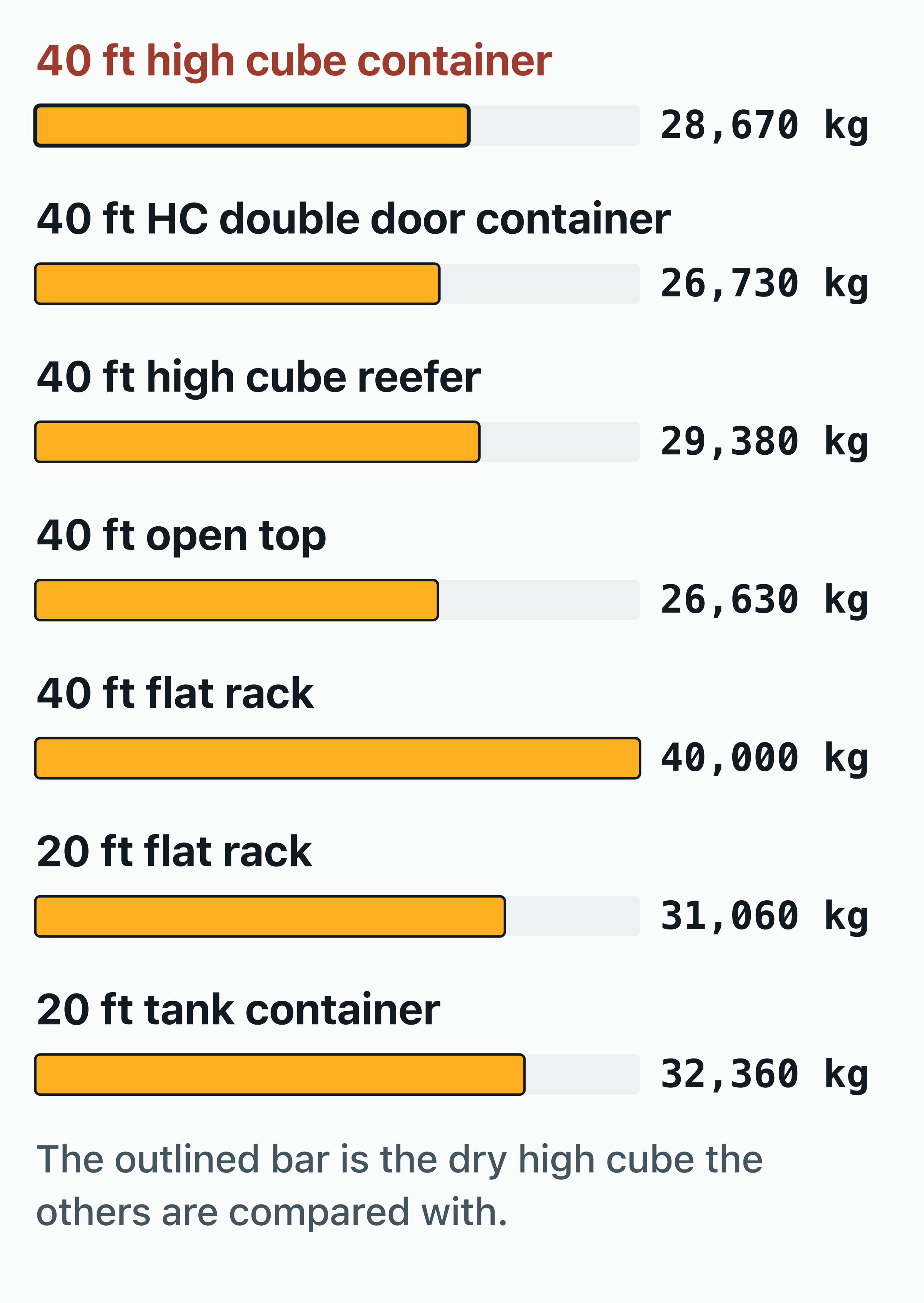
The numbers in this chart
| Container | kg | lb |
|---|---|---|
| 40 ft high cube container | 28,670 | 63,207 |
| 40 ft HC double door container | 26,730 | 58,930 |
| 40 ft high cube reefer | 29,380 | 64,772 |
| 40 ft open top | 26,630 | 58,709 |
| 40 ft flat rack | 40,000 | 88,185 |
| 20 ft flat rack | 31,060 | 68,476 |
| 20 ft tank container | 32,360 | 71,342 |
Checked : the figures in this chart against 44 of 88 published sheets from 20 lines, lessors and makers: those that print these figures. A sheet agrees within ±5 mm, or ±2 % for a mass and ±1 % for a volume; a maximum gross is a rating and must be the same. Every figure and its sources
20 ft open top and 40 ft open top: dimensions and weight
| Metric | Imperial | |
|---|---|---|
| External dimensions | ||
| Length | 6.058 m | 19′10½″ |
| Width | 2.438 m | 8′ |
| Height | 2.591 m | 8′6″ |
| Internal dimensions | ||
| Length | 5.898 m | 19′4″ |
| Width | 2.352 m | 7′8½″ |
| Height | 2.348 m | 7′8½″ |
| Door opening | ||
| Width | 2.340 m | 7′8″ |
| Height | 2.280 m | 7′6″ |
| Specification | ||
| Tare weight | 2,250 kg | 4,960 lb |
| Max gross weight | 30,480 kg | 67,197 lb |
| Max payload | 28,230 kg | 62,236 lb |
| Capacity (volume) | 32.5 m³ | 1,148 ft³ |
| Pallets (one tier, counted on the floor) | 11 EUR · 10 US | |
| TEU | 1 | |
Beside each figure, its evidence: ISO set by the standard · ✓ 16 sheets that agree, counted · range the sheets disagree · 1 sheet one source. A mark opens the sheets behind the figure.
Checked : outside sizes set by ISO 668, read in IS 6566:2001, GOST R 51876-2008 and GOST R 53350-2009; every other figure against 12 published sheets of 12 lines and lessors. A sheet agrees within ±5 mm, or ±2 % for a mass and ±1 % for a volume; a maximum gross is a rating and must be the same. Every figure and its sources
Data: ISO 668 (1995 text, read in IS 6566:2001) · CMA CGM Equipment Guide · Evergreen Container Specifications · Hapag-Lloyd Container Specifications · Maersk special cargo container specifications · ONE Container Specifications · COSCO, HMM, OOCL, Seaco, Triton, Yang Ming, ZIM
| Metric | Imperial | |
|---|---|---|
| External dimensions | ||
| Length | 12.192 m | 40′ |
| Width | 2.438 m | 8′ |
| Height | 2.591 m | 8′6″ |
| Internal dimensions | ||
| Length | 12.032 m | 39′5½″ |
| Width | 2.352 m | 7′8½″ |
| Height | 2.348 m | 7′8½″ |
| Door opening | ||
| Width | 2.340 m | 7′8″ |
| Height | 2.280 m | 7′6″ |
| Specification | ||
| Tare weight | 3,850 kg | 8,488 lb |
| Max gross weight | 30,480 kg | 67,197 lb |
| Max payload | 26,630 kg | 58,709 lb |
| Capacity (volume) | 66.4 m³ | 2,345 ft³ |
| Pallets (one tier, counted on the floor) | 25 EUR · 21 US | |
| TEU | 2 | |
Checked : outside sizes set by ISO 668, read in IS 6566:2001, GOST R 51876-2008 and GOST R 53350-2009; every other figure against 13 published sheets of 13 lines and lessors. A sheet agrees within ±5 mm, or ±2 % for a mass and ±1 % for a volume; a maximum gross is a rating and must be the same. Every figure and its sources
Data: ISO 668 (1995 text, read in IS 6566:2001) · CMA CGM Equipment Guide · Evergreen Container Specifications · Hapag-Lloyd Container Specifications · ONE Container Specifications · COSCO, HMM, Matson, OOCL, Seaco, TOTE, Triton, Yang Ming, ZIM
Roof opening and over-height cargo
The clear roof opening is 2.210–2.232 m wide on the sheets of Hapag-Lloyd, OOCL and Yang Ming; its length is 5.338–5.674 m on a 20 ft and 11.530–11.798 m on a 40 ft, varying by builder and floor, so measure the unit you are given. Cargo may stand proud of the top rail (an “over-height” shipment) — it then travels under an open tarp, the container cannot be stacked under others, and the slot is priced accordingly.
Note that the roof opening is narrower than the internal width (2.210–2.232 m against 2.352 m): the top side rails overhang slightly. Cargo wider than 2.210 m must angle in through the door end with the header swung out, or move to a flat rack.
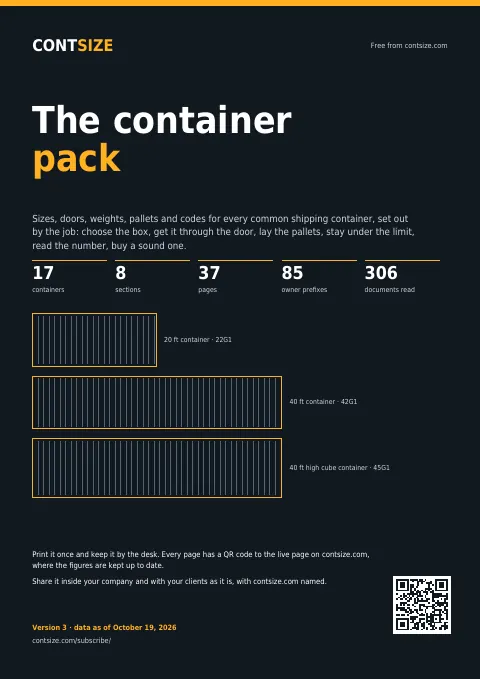
The Open top container on one page, plus the whole pack
Every dimension in millimetres, metres and feet, the door opening, tare, payload and volume, and the floor drawn to scale with EUR and US pallets on it. In the same email, the container pack: all 17 containers by the job, 17 sheets like this one, the 85 owner prefixes, an A3 wall chart and an Excel workbook.
- 17 containers, by the job
- 17 container sheets
- 85 owner prefixes
The bot check did not finish, so nothing was sent. Send the form again; if it stops again, allow challenges.cloudflare.com in your blocker or write to info@contsize.com from the address the file should go to.
Nothing was sent: the address could not be read, or a required box was not ticked. Check them and send the form again.
Tarp, bows and securing the load
A proper open top travels with a TIR-compatible tilt: a rope or cable threads through welded loops around the tarp edge and is sealed by customs, so the load cannot be touched without breaking the seal. The steel roof bows lift out one by one to clear the opening and drop back in to support the tarp — count them on hand-over, as missing bows are a classic interchange dispute.
Inside, cargo lashes to rings on the bottom side rails and corner posts, each rated at least 10 kN (about 1,000 kg) and often 20 kN (about 2,000 kg) on recent boxes, per CTU Code (MSC.1/Circ.1497). Heavy single pieces — coils, castings, machinery — need bedding timbers to spread point loads across the floor, exactly as on a flat rack.
Frequently asked questions
What is an open top container used for?
Cargo that must be loaded by crane from above or that exceeds standard door height: machinery, prefab elements, glass, marble slabs, steel, logs.
What are the roof opening dimensions of an open top container?
An open top’s roof opening is 2.210–2.232 m (7′3″–7′4″) wide, and 5.338–5.674 m (17′6″–18′7½″) long on a 20 ft and 11.530–11.798 m (37′10″–38′8½″) on a 40 ft, as the sheets of Hapag-Lloyd, OOCL and Yang Ming print it. The opening is slightly narrower than the 2.352 m internal width because the top side rails overhang the aperture.
How much weight can an open top container carry?
A 20 ft open top carries about 28,230 kg (62,236 lb) of payload (2,250 kg tare, 30,480 kg max gross), per 11 of 12 sheets, practically the same as a dry twenty; a 40 ft open top carries about 26,630 kg (58,709 lb) (3,850 kg tare, 30,480 kg max gross), per 8 of 12 sheets, 2,170 kg less than a dry forty rated 32,500 kg.
How much does an open top container cost?
In October 2026, the middle of the US prices we read (a dealer and a quote site for both lengths, and a marketplace for the 20 ft) puts a used cargo-worthy 20 ft open top at $3,500–4,000 and a 40 ft at $5,100–6,800, against $1,700–2,800 for a used dry 20 ft — a clear premium, because far fewer are built. Prices vary by market and location, and a complete, undamaged tarp-and-bows set adds real value.
Can an open top container carry taller-than-standard cargo?
Yes — as an over-height shipment with the tarp off or draped over the load. The container then loses its stacking position on the vessel, which increases the freight rate.
Is an open top container waterproof?
With the tarpaulin properly fitted and tensioned, yes — it is rated for sea passage. But it is not as tight as a steel roof, so moisture-sensitive cargo should be wrapped, and over-height loads under an open tarp travel essentially exposed.