US domestic
48 ft Container Dimensions
 Yuri Kan Checked against one published sheet (Sea Box)
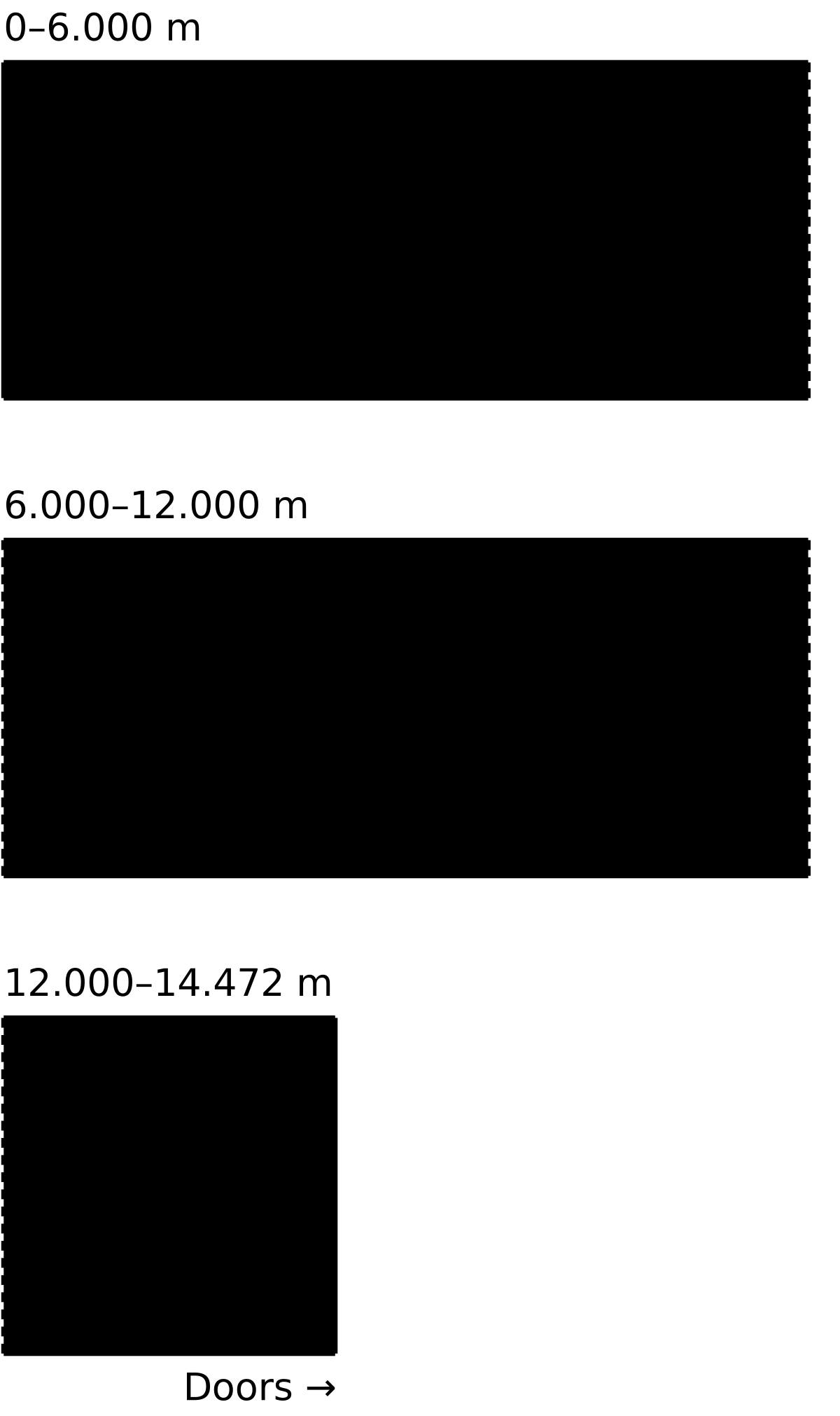
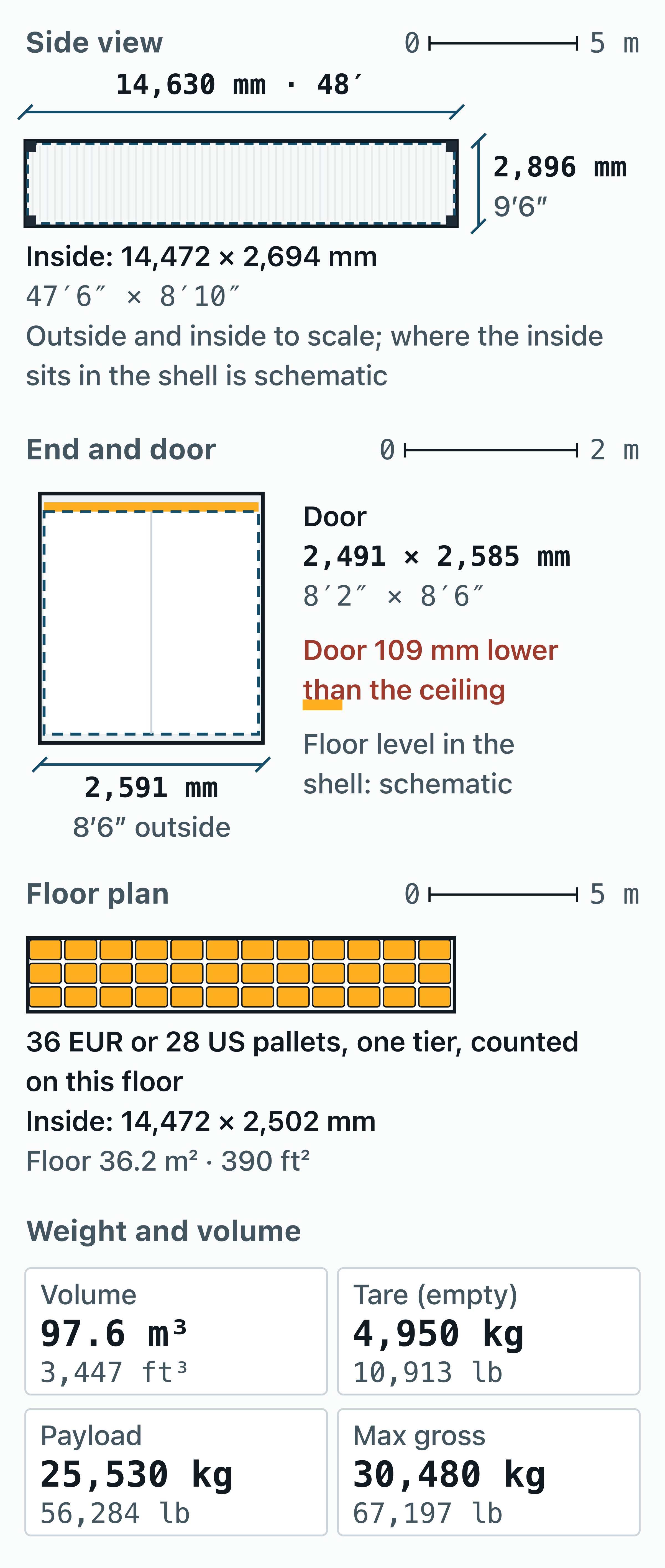
A 48 ft container measures 14.630 × 2.591 × 2.896 m outside (48′ × 8′6″ × 9′6″) and 14.472 × 2.502 × 2.694 m inside (47′6″ × 8′2½″ × 8′10″) — from one sheet (Sea Box), since no ISO standard covers this size. That is 97.6 m³ (3,447 ft³) on 36.2 m² (390 ft²) of floor. It is a US domestic size — 102″ wide against the ISO 96″ — so US pallets load two abreast, about 28 per tier by our layout of the inside floor. Tare is around 4,950 kg; it moves on North American rail and road, not deep-sea vessels, and holds about 28% more than a 40 ft high cube.
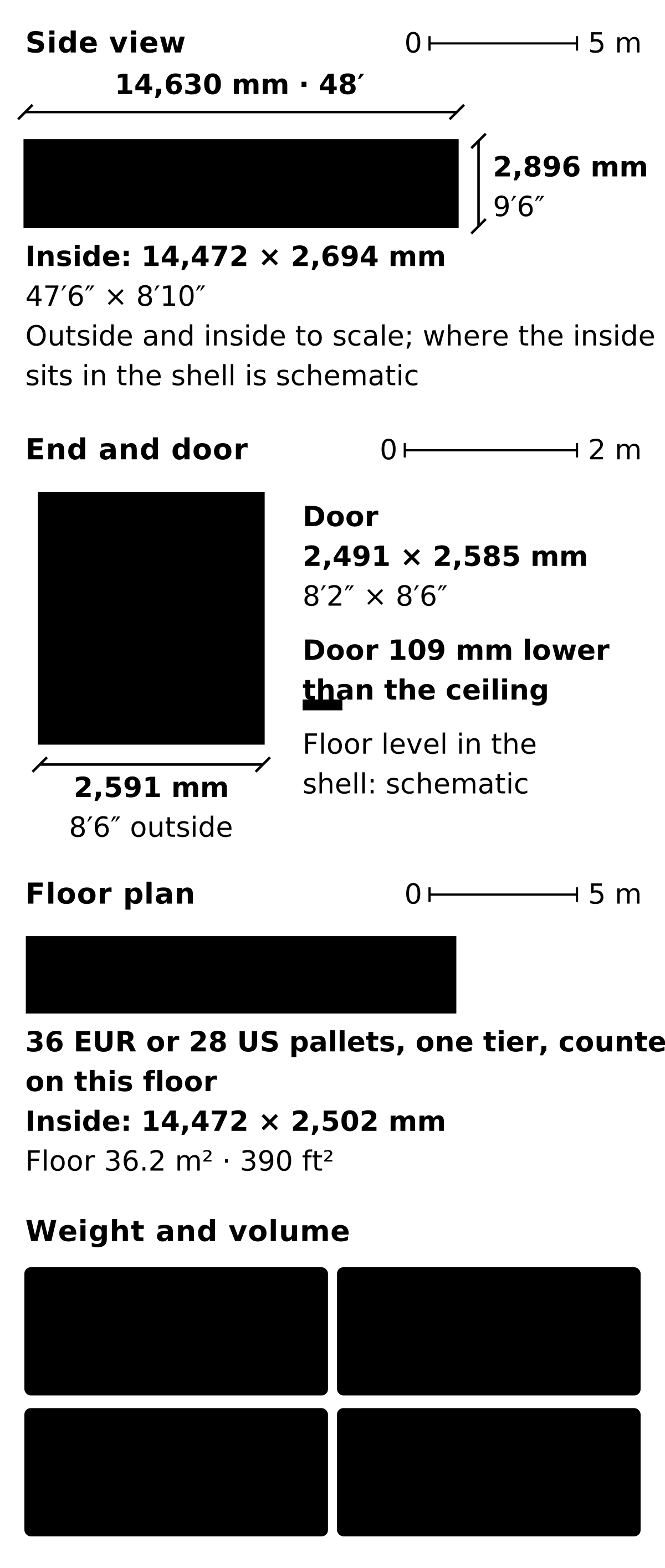
The numbers in this chart
| Measure | Metric | Imperial |
|---|---|---|
| Length outside | 14,630 mm | 48′ |
| Width outside | 2,591 mm | 8′6″ |
| Height outside | 2,896 mm | 9′6″ |
| Length inside | 14,472 mm | 47′6″ |
| Width inside | 2,502 mm | 8′2½″ |
| Height inside | 2,694 mm | 8′10″ |
| Door width | 2,491 mm | 8′2″ |
| Door height | 2,585 mm | 8′6″ |
| Floor area | 36.2 m² | 390 ft² |
| Volume | 97.6 m³ | 3,447 ft³ |
| Tare (empty) | 4,950 kg | 10,913 lb |
| Payload | 25,530 kg | 56,284 lb |
| Max gross | 30,480 kg | 67,197 lb |
| EUR pallets, one tier (counted) | 36 | — |
| US pallets, one tier (counted) | 28 | — |
Checked : one published sheet gives these figures (Sea Box); no second was found. Every figure and its sources
48 ft container: dimensions and weight
| Metric | Imperial | |
|---|---|---|
| External dimensions | ||
| Length | 14.630 m | 48′ |
| Width | 2.591 m | 8′6″ |
| Height | 2.896 m | 9′6″ |
| Internal dimensions | ||
| Length | 14.472 m | 47′6″ |
| Width | 2.502 m | 8′2½″ |
| Height | 2.694 m | 8′10″ |
| Door opening | ||
| Width | 2.491 m | 8′2″ |
| Height | 2.585 m | 8′6″ |
| Specification | ||
| Tare weight | 4,950 kg | 10,913 lb |
| Max gross weight | 30,480 kg | 67,197 lb |
| Max payload | 25,530 kg | 56,284 lb |
| Capacity (volume) | 97.6 m³ | 3,447 ft³ |
| Pallets (one tier, counted on the floor) | 36 EUR · 28 US | |
Beside each figure, its evidence: ISO set by the standard · ✓ 16 sheets that agree, counted · range the sheets disagree · 1 sheet one source. A mark opens the sheets behind the figure.
Checked : one published sheet gives these figures (Sea Box); no second was found. Every figure and its sources
Machine-readable: /data/containers.json · closest published sheet: Sea Box, 12 of 12 figures
Data: Sea Box


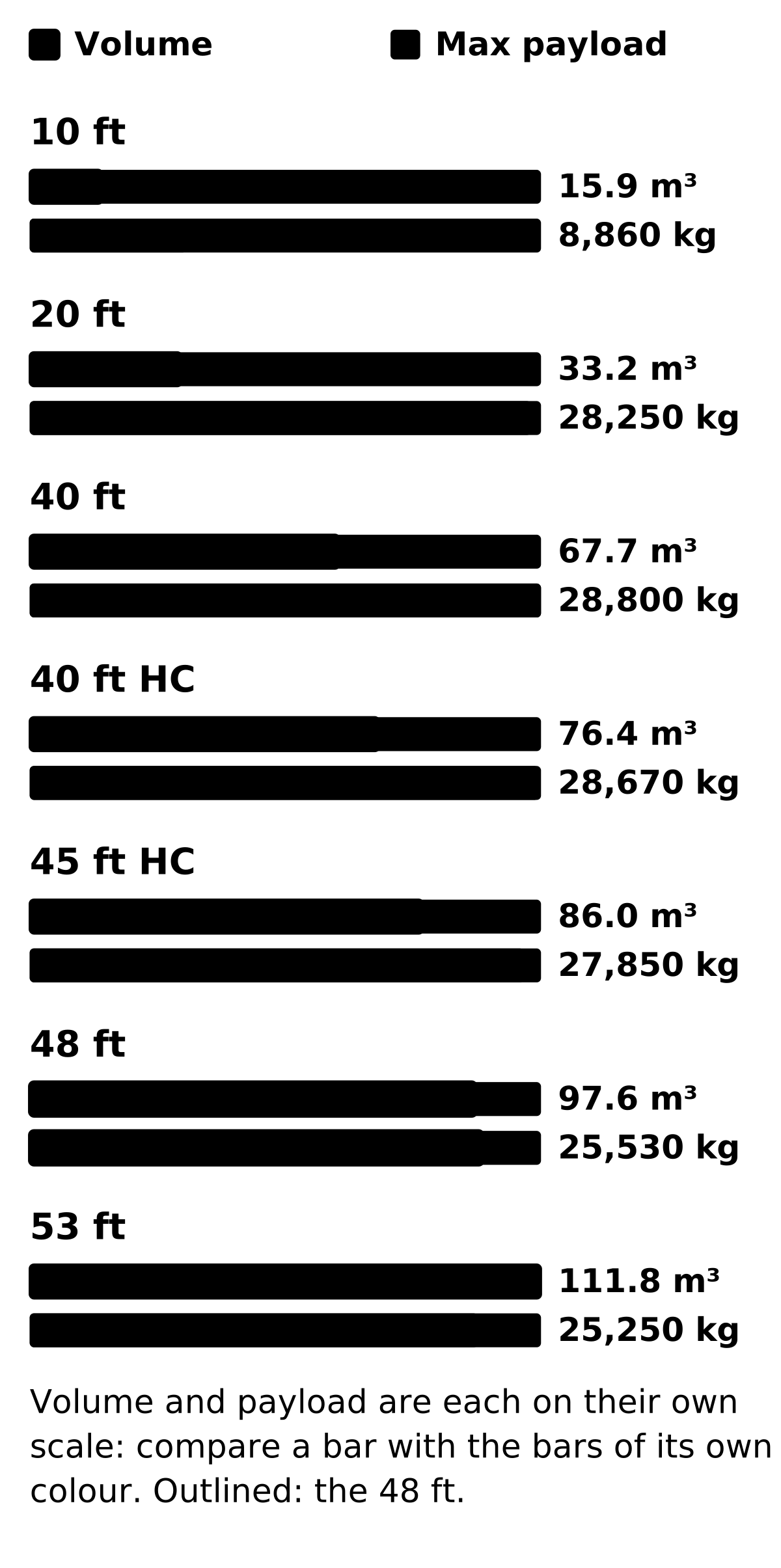
The numbers in this chart
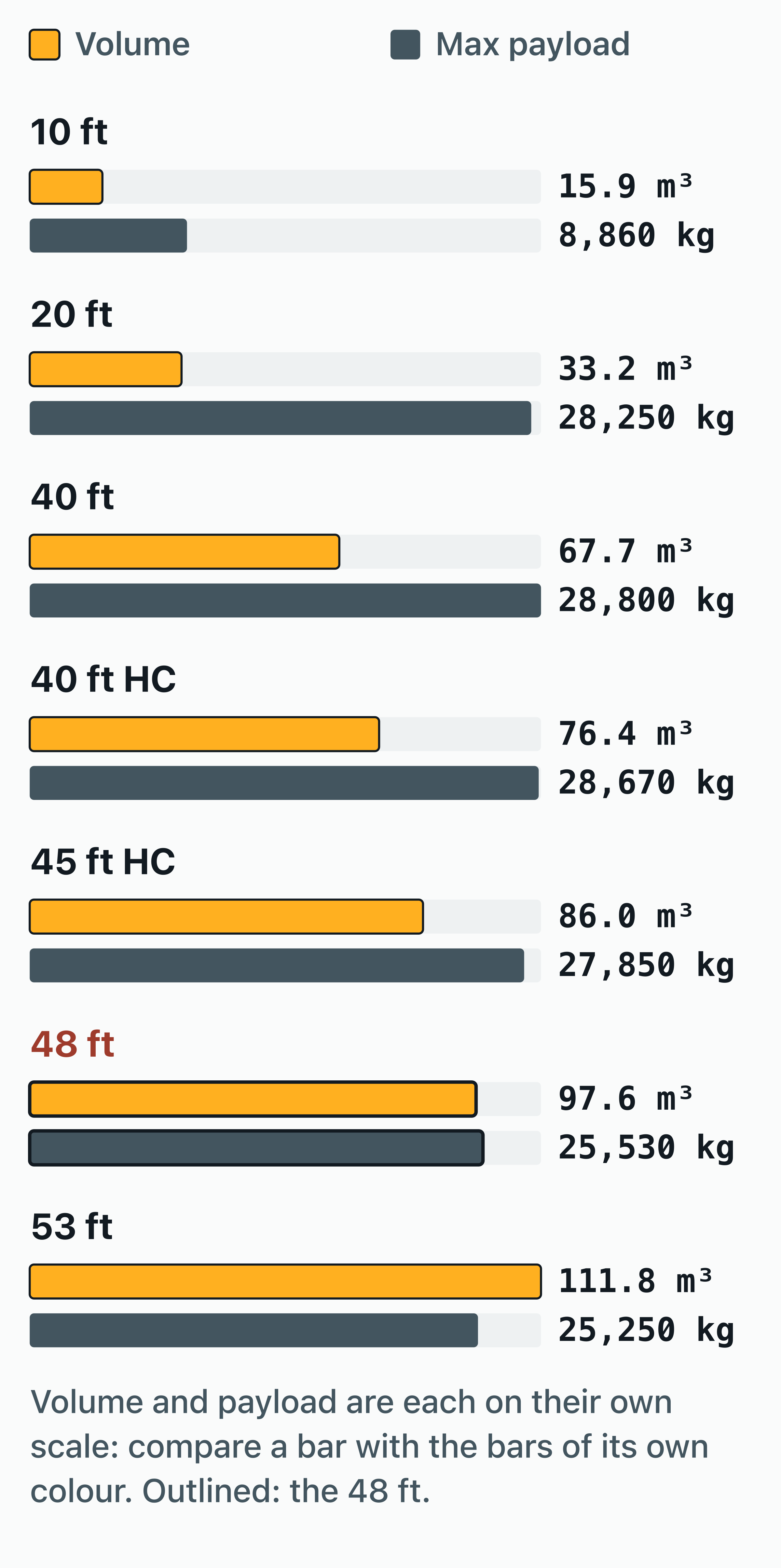
| Size | Volume | Max payload |
|---|---|---|
| 10 ft container | 15.9 m³ · 562 ft³ | 8,860 kg · 19,533 lb |
| 20 ft container | 33.2 m³ · 1,172 ft³ | 28,250 kg · 62,281 lb |
| 40 ft container | 67.7 m³ · 2,391 ft³ | 28,800 kg · 63,493 lb |
| 40 ft high cube container | 76.4 m³ · 2,698 ft³ | 28,670 kg · 63,207 lb |
| 45 ft high cube container | 86.0 m³ · 3,037 ft³ | 27,850 kg · 61,399 lb |
| 48 ft container | 97.6 m³ · 3,447 ft³ | 25,530 kg · 56,284 lb |
| 53 ft container | 111.8 m³ · 3,948 ft³ | 25,250 kg · 55,667 lb |
Checked : the figures in this chart against 42 of 88 published sheets from 27 lines, lessors, makers and rail and road operators: those that print these figures. A sheet agrees within ±5 mm, or ±2 % for a mass and ±1 % for a volume; a maximum gross is a rating and must be the same. Every figure and its sources
What a 48 ft container is used for
The 48 ft container is a US domestic size, not an ISO deep-sea unit: no ISO standard sets its dimensions. It is both longer and wider than international boxes: 14.630 m long and 2.591 m (102″) wide against the ISO standard 2.438 m (96″). The extra width lets two US pallets sit side by side with room to spare.
These units move on rail (double-stacked) and road within North America. You will not see them on deep-sea vessels — cell guides are built for ISO widths. The figures on this page are those of the one maker’s sheet we have found for the size (Sea Box); other fleets’ boxes may differ by a few centimetres.
Doors open to about 2.491 × 2.585 m — as wide as a 53 ft’s and about 15 cm wider than an ISO door — which is why 48s converted to storage take vehicles, wide machinery and full-width racking that ISO doors cannot pass.
48 vs 53 — which one? In practice the market has already answered: the 53-footer has become the domestic default, and railroads and truckers built their networks around it. The 48 ft fleet is mostly legacy equipment being run down rather than replaced — few new 48s are built. For shippers that means 53 ft capacity is easier to book; for buyers it means 48s appear on the secondary market at attractive prices as fleets retire them, with the same outside width and height as the 53.
The 48 ft container on one page, plus the whole pack
Every dimension in millimetres, metres and feet, the door opening, tare, payload and volume, and the floor drawn to scale with EUR and US pallets on it. In the same email, the container pack: all 17 containers by the job, 17 sheets like this one, the 85 owner prefixes, an A3 wall chart and an Excel workbook.
- 17 containers, by the job
- 17 container sheets
- 85 owner prefixes
The bot check did not finish, so nothing was sent. Send the form again; if it stops again, allow challenges.cloudflare.com in your blocker or write to info@contsize.com from the address the file should go to.
Nothing was sent: the address could not be read, or a required box was not ticked. Check them and send the form again.
What fits in a 48 ft container
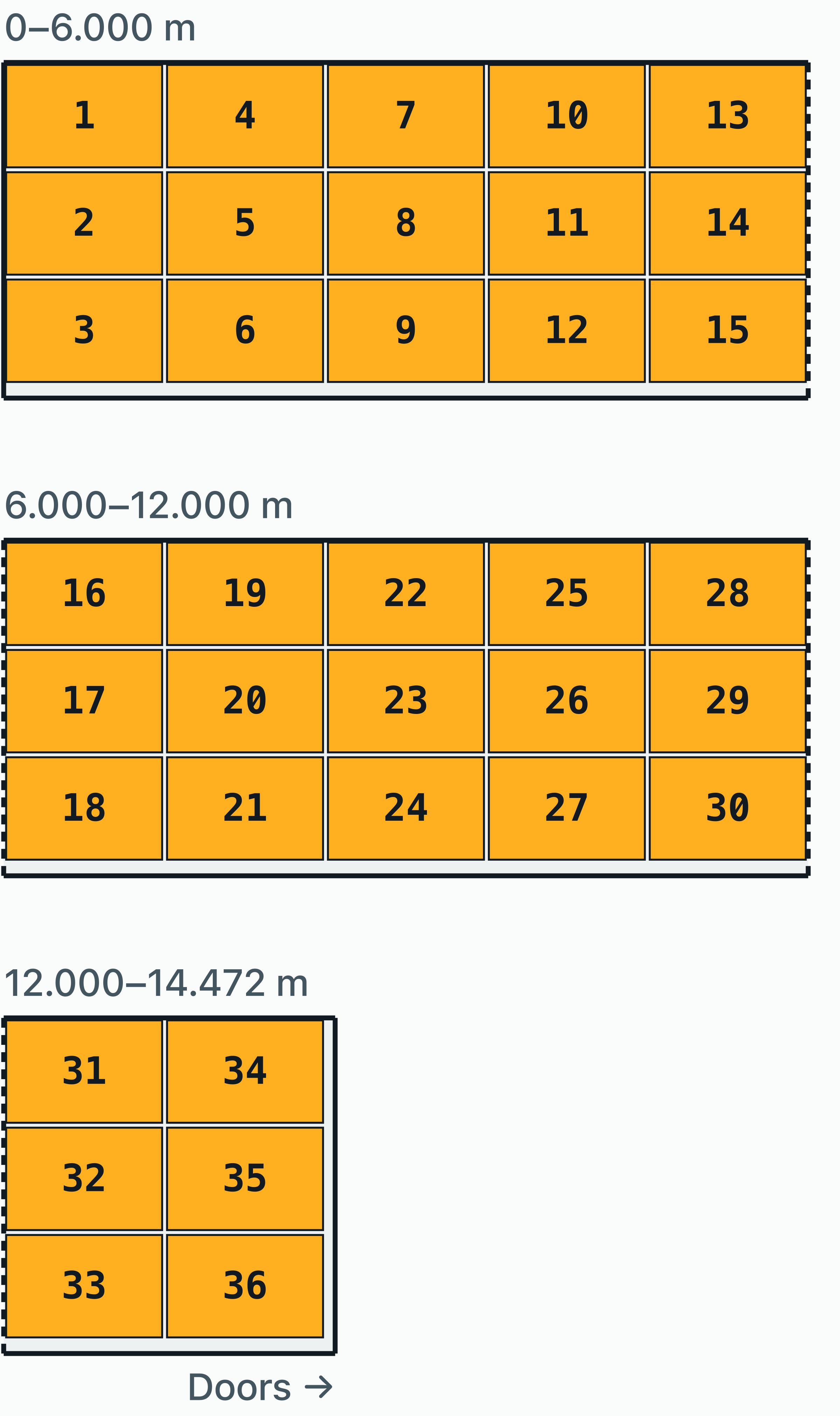
About 97.6 m³ of capacity — 28% more than a 40 ft high cube. The 2.502 m internal width fits US pallets two abreast without wasted inches, giving roughly 28 pallet positions per tier by our layout of the inside floor.
Payload is limited by road weight law rather than the box: US federal law caps the whole rig at 80,000 lb (36,287 kg), per 23 CFR 658.17, and the tractor, the chassis and the box itself count against that limit before the cargo does.
The two-abreast fit is the size’s whole argument. In an ISO forty, 48″ × 40″ US pallets load in a turned pattern that wastes inches on every row; in the 102″-wide 48, two pallets sit side by side with about 6 cm to spare, so the same floor plan loads faster and cubes out cleaner. EUR pallets fare even better, at roughly 36 positions by the same layout.
Off the rails, the 48 makes a generous static building block: 36.2 m² of floor with 2.694 m ceilings, roughly a one-bedroom apartment’s footprint in a single steel shell. Availability outside North America is close to zero, so plan on sourcing one domestically.
48 ft vs 53 ft container
| 48 ft container | 53 ft container | |
|---|---|---|
| ISO type code | — | — |
| External dimensions — Length | 14.630 m48′ | 16.154 m53′ |
| External dimensions — Width | 2.591 m8′6″ | 2.591 m8′6″ |
| External dimensions — Height | 2.896 m9′6″ | 2.896 m9′6″ |
| Internal dimensions — Length | 14.472 m47′6″ | 16.017 m52′6½″ |
| Internal dimensions — Width | 2.502 m8′2½″ | 2.515 m8′3″ |
| Internal dimensions — Height | 2.694 m8′10″ | 2.781 m9′1½″ |
| Tare weight | 4,950 kg10,913 lb | 5,230 kg11,530 lb |
| Max gross weight | 30,480 kg67,197 lb | 30,480 kg67,197 lb |
| Max payload | 25,530 kg56,284 lb | 25,250 kg55,667 lb |
| Capacity (volume) | 97.6 m³3,447 ft³ | 111.8 m³3,948 ft³ |
| EUR pallets | 36 | 40 |
| TEU | — | — |
Checked : no ISO standard covers this size; every figure against 9 published sheets of 8 lines, makers and rail and road operators. A sheet agrees within ±5 mm, or ±2 % for a mass and ±1 % for a volume; a maximum gross is a rating and must be the same. Every figure and its sources
Data: CN, Crowley, J.B. Hunt, Sea Box, STG, TOTE, Trailer Bridge, Union Pacific
Frequently asked questions
What are the dimensions of a 48 ft container?
A 48 ft container is 14.630 × 2.591 × 2.896 m outside (48′ × 8′6″ × 9′6″) and 14.472 × 2.502 × 2.694 m inside (47′6″ × 8′2½″ × 8′10″), with 97.6 m³ of capacity — from one sheet (Sea Box). As a domestic size it is not covered by ISO 668, so other fleets’ boxes may differ slightly.
How much does a 48 ft container weigh?
An empty 48 ft container weighs about 4,950 kg (10,913 lb) — from one sheet (Sea Box); no standard fixes it, so other builders’ boxes may differ. The same sheet rates it 30,480 kg gross, but on the road US federal law caps the whole rig — tractor, chassis, box and cargo — at 80,000 lb, per 23 CFR 658.17, so the road, not the box, sets the practical payload.
How many pallets fit in a 48 ft container?
About 28 standard US pallets (48″ × 40″) in a single floor tier by our layout of the inside floor, loaded two abreast in the 2.502 m (8′2½″) internal width — the extra width over ISO boxes is exactly what makes the two-abreast pattern work.
How much does a 48 ft container cost?
No two named US sellers publish a price for a used 48 ft container (read 18 October 2026), so we quote none: it is sold by quote. It is rarer than the ISO sizes and essentially a North American regional market, so prices vary sharply by location — ask depots near rail hubs, where fleets retire legacy 48s.
How many square meters (square feet) is a 48 ft container?
A 48 ft container has about 36.2 m² (390 ft²) of internal floor — 14.472 m long by 2.502 m wide (47′6″ × 8′2½″), from one sheet (Sea Box). That is roughly 28% more floor area than a 40 ft container.
Can a 48 ft container be shipped internationally?
Not in normal service. Deep-sea vessels and terminals are built around ISO 8 ft (2.438 m) widths; 48 ft domestic boxes are 102″ (2.591 m) wide and stay within North American rail and road networks.