ZIMU · ZCSU · ZMOU
ZIM Container Tracking
 Yuri Kan Trackers opened and tested Updated
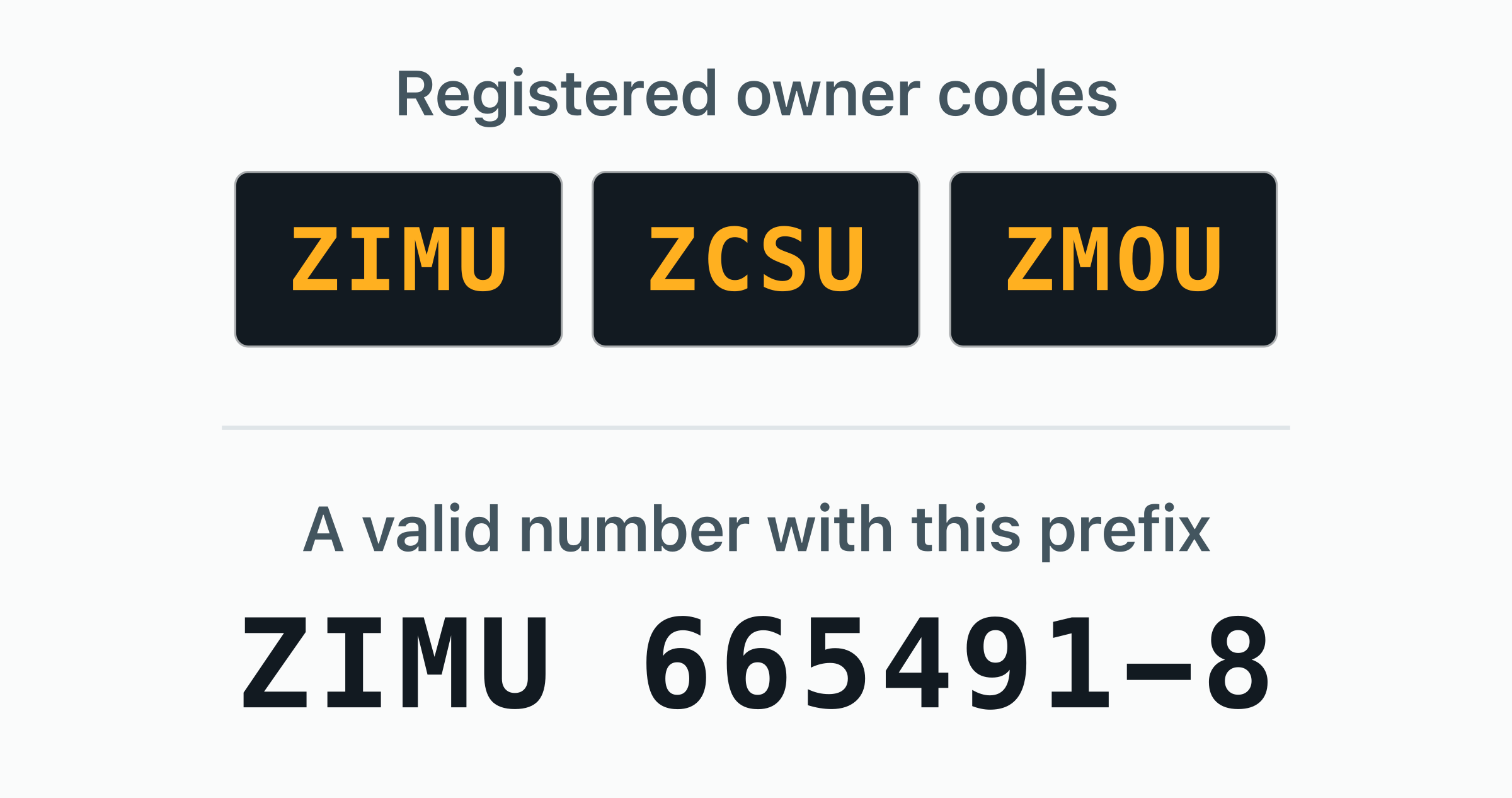
ZIM tracking runs at zim.com/tools/track-a-shipment with container or bill-of-lading numbers — every ZIM B/L now starts with ZIMU, since the carrier standardized all document prefixes to that single code. Equipment carries ZIMU, ZCSU or ZMOU. Two things set ZIM apart at the moment: ZIMonitor, a premium IoT service that streams temperature, door and location alerts from equipped reefers, and a pending ownership change — Hapag-Lloyd agreed on 16 February 2026 to acquire ZIM, with closing expected late 2026, so tracking tools may migrate after the deal completes. Today the zim.com tracker works as always.
Track a ZIM container by number
4 letters + 7 digits, printed on the doors. It is on your bill of lading too.
The answer appears as you type. Nothing is sent anywhere.
Israel’s national carrier, sailing since 1945, has long been the nimble independent among the top ten — no alliance membership, but a slot-swap partnership with MSC on Asia–US East Coast lanes running since February 2025. That independence is now in transition, and anyone bookmarking ZIM tools should know why.
On 16 February 2026 Hapag-Lloyd signed an agreement to acquire ZIM, expected to close late in the year. Nothing about the tracker has changed yet; this page will note it when something does. Meanwhile, validate your number here and search zim.com as usual.
ZIM containers carry the prefixes ZIMU, ZCSU and ZMOU; each is worked through, with its check digit and where the code came from, on the prefix page of ZIM.
ZIM prefixes: ZIMU, ZCSU and ZMOU
Three owner codes cover ZIM equipment, all registered to the Haifa-based line: ZIMU on most boxes, with ZCSU and ZMOU on the rest of the fleet. Whatever the stencil, all three search the same way at zim.com, and leased boxes riding under a ZIM booking track by their own number just as reliably.
| Prefix | What it is |
|---|---|
ZIMU | A house code of ZIM, registered to it directly. |
ZCSU | A house code of ZIM, registered to it directly. |
ZMOU | A house code of ZIM, registered to it directly. |
Data: BIC Container Prefix Register · ISO 6346 (1995 text, read in IS 6928:2001)

ZIM B/L numbers: everything is ZIMU now
ZIM collapsed its bill-of-lading numbering onto a single prefix: ZIMU opens every current document, regardless of which equipment code is on the container itself. That one-code rule makes ZIM paperwork unusually easy to recognize — if a supposed ZIM B/L starts with anything else, question the document before questioning the tracker.
Using zim.com — and what ZIMonitor adds
The track-a-shipment tool takes container or B/L numbers pasted into the form; we found no working pre-filled link format, so type the number rather than trusting shared URLs. The myZIM app mirrors the feed with notifications. Reefer shippers can go further with ZIMonitor, ZIM’s paid IoT layer: sensor-equipped containers report temperature deviations, door openings and live position, with alerts pushed the moment a threshold trips — a different product from the free milestone tracking.
| Container number | ✓ yes |
|---|---|
| Bill of lading (B/L) | ✓ yes |
| Booking reference | — no |
| Mobile app | ✓ yes |
| Pre-filled link | not tried yet |
| Its bill of lading starts with | ZIMU |
Browser-verified 2026-08-03
Can you see where the ship is?
Not from the container. A standard dry box has no power, no radio and no satellite receiver — it is a steel case with a number painted on it, and it reports nothing about itself. Every position you see against a ZIM shipment was reported by something else: a terminal crane, a gate reader, or the ship.
A live map on a carrier’s tracking page is almost always plotting AIS, the transponder every large vessel broadcasts with its position, course and speed. That is genuinely useful at sea: it is a real position rather than a schedule, and an ETA recalculated from actual movement. It is also the ship’s position, not your box’s, and the two part company the moment the container is discharged.
On land the map goes quiet. Between the gate-out and the delivery there is no vessel to follow, and the road leg appears only as whatever events the terminal and the trucker report. A container sitting on a chassis in a yard shows the last position of a ship it left days ago. Only specialised IoT equipment reports its own location, and wherever that exists it is a paid product sold to the shipper, not something a tracking page gives away.
ZIM sails outside the alliances, and your tracking is simpler for it
The three big alliances cover most of the world fleet, and on an alliance service your container routinely travels on a partner’s ship — so the vessel name in your tracking belongs to a company you never booked with. ZIM is one of the few sizeable lines that never joined one. It operates its own network and buys slots where it needs them, including a long-running pairing with MSC on Asia to US East Coast lanes.
The practical effect is that a ZIM shipment usually sits on a ZIM vessel, and the name in the feed matches the name on the document. Where a slot partner is carrying the box, the events are still published by whoever issued your bill of lading — and ZIM collapsed all of its document numbering onto the single ZIMU prefix, so there is rarely any ambiguity about which that is.
When zim.com returns nothing
Check the number first. ZIMU, ZCSU and ZMOU are close enough to each other that a misread first letter is easy, and a single wrong character in the serial produces a number that looks right and matches nothing. The checker here recomputes the check digit.
Question the document if it is not ZIMU. Every current ZIM bill of lading opens with ZIMU, whatever code is painted on the container. A supposed ZIM document starting with anything else is worth checking before you blame the tracker.
Do not trust a shared link. We found no working pre-filled URL format for zim.com, so a link someone sent you most likely opens an empty form — type the number in rather than assuming the page failed.
Too new, or archived. The first event lands at gate-in or loading, and completed shipments leave the live system after some weeks.
Carrier profile
ZIM at a glance
- World fleet rank
- #10by capacity · Alphaliner, read 18 October 2026
- Founded
- 194581 years in business
- Container prefixes
- 3verified against the BIC register
- Alliance
- Independentnot a member of Gemini, Ocean or Premier
The company
- Headquarters
- Haifa, Israel
- Mobile app
- Yes, published by the line
Founded in Haifa in 1945, ZIM ranks tenth in the world fleet — roughly neck-and-neck with Yang Ming — and has stayed outside the alliances, pairing with MSC on Asia–US East Coast slots instead. The agreed Hapag-Lloyd acquisition, signed 16 February 2026, would end that independent chapter when it closes.
Data: Alphaliner Top 100 · BIC Container Prefix Register
Checked 2026-08-03
Frequently asked questions
Will ZIM tracking change after the Hapag-Lloyd deal?
Probably eventually, not yet. The acquisition agreement was signed on 16 February 2026 and closing is expected late 2026; carrier integrations typically migrate customer tools gradually afterward. Until then zim.com tracking operates unchanged.
What is ZIMonitor?
ZIM’s premium reefer-monitoring service: IoT-equipped containers stream temperature, humidity-relevant door events and GPS position, and subscribers get real-time alerts on deviations. It is a paid add-on, separate from the free public tracker.
Why does my ZIM B/L start with ZIMU when the box says ZCSU?
ZIM standardized every bill of lading onto the ZIMU prefix, while equipment still carries ZIMU, ZCSU or ZMOU. Document code and box code answer different questions, so the mismatch is expected.
Is ZIM in a shipping alliance?
No — ZIM operates independently, though it has swapped slots with MSC on Asia–US East Coast services since February 2025. The pending Hapag-Lloyd acquisition would change the picture after closing.
One page, every owner code
Know whose box it is before you search
All 85 owner prefixes mapped to their line or leasing company, with the leased ones marked — so you can tell at a glance when to track with the line instead. It comes in the container pack, with every container’s dimensions.
The bot check did not finish, so nothing was sent. Send the form again; if it stops again, allow challenges.cloudflare.com in your blocker or write to info@contsize.com from the address the file should go to.
Nothing was sent: the address could not be read, or a required box was not ticked. Check them and send the form again.