HLCU · HLXU · HLBU · …
Hapag-Lloyd Container Tracking
 Yuri Kan Trackers opened and tested Updated
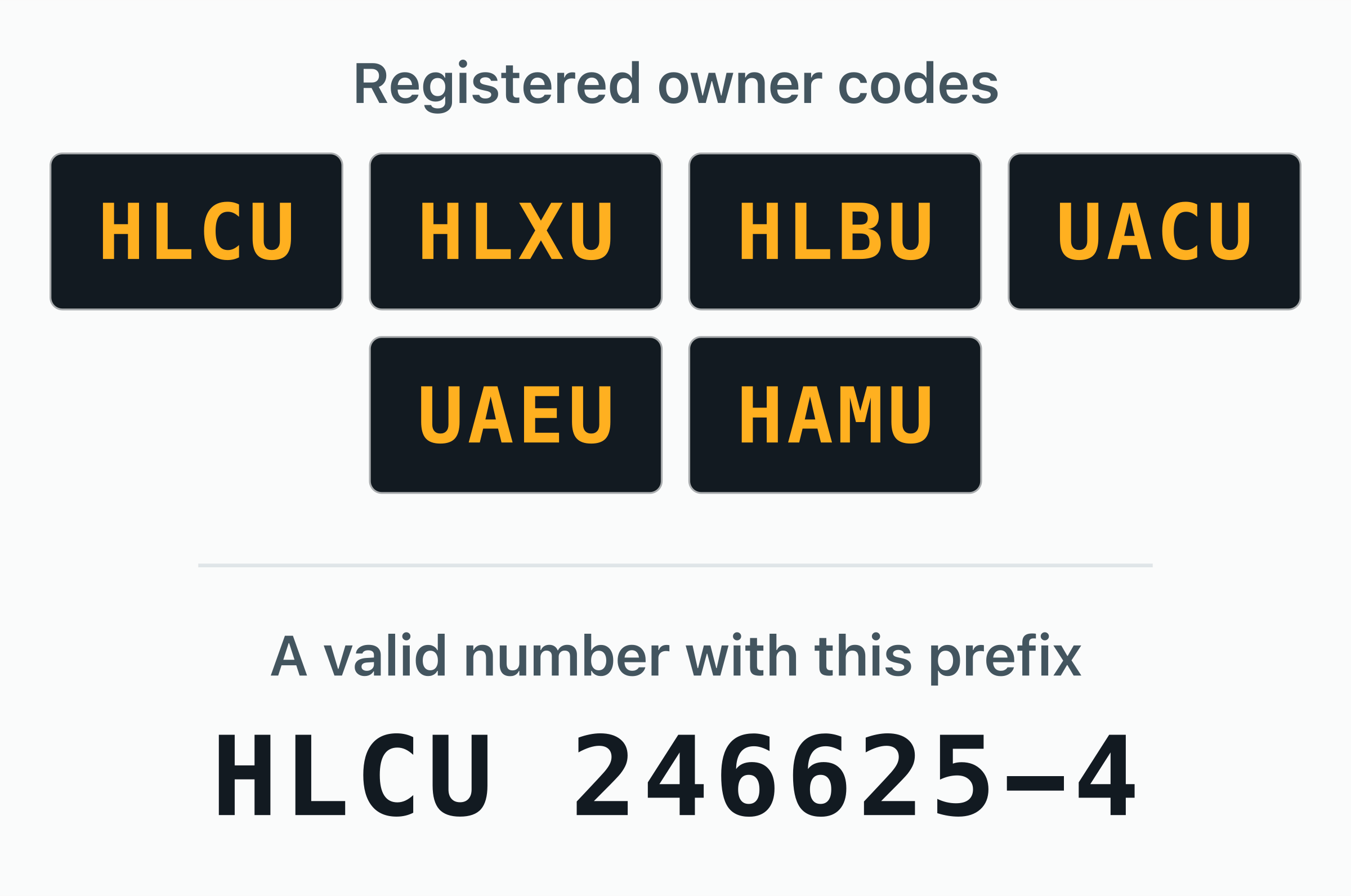
Hapag-Lloyd containers track at hapag-lloyd.com, where a result shows a Live Position map and a Live ETA beside the event timeline. The tracker accepts container, bill of lading and booking numbers, though never via pre-filled links; a strict bot wall means manual entry in a normal browser. Six prefixes are registered — HLCU, HLXU, HLBU, UACU, UAEU and HAMU — and bills of lading start with HLCU plus eight to twelve characters.
Track a Hapag-Lloyd container by number
4 letters + 7 digits, printed on the doors. It is on your bill of lading too.
The answer appears as you type. Nothing is sent anywhere.
A Hapag-Lloyd result is more than a list of terminal events: beside the timeline sit a Live Position map and a Live ETA. Read them for what they are — a position and an arrival estimate the line publishes — and keep the event timeline as the record of what has actually happened to the box.
Check the number here first, because two of the six prefixes have a habit of being misfiled by third-party sites, and one of them gets attributed to an entirely different carrier.
Hapag-Lloyd containers carry the prefixes HLCU, HLXU, HLBU, UACU, UAEU and HAMU; each is worked through, with its check digit and where the code came from, on the prefix page of Hapag-Lloyd.
Hapag-Lloyd prefixes: HLCU, UACU and UAEU, and the HAMU mix-up
Six codes resolve to Hapag-Lloyd in the BIC register. HLCU, HLXU and HLBU are house codes; UACU and UAEU arrived with United Arab Shipping Company, absorbed in the 2017 merger; and HAMU is the troublemaker — aggregators routinely file it under HMM because the letters look Korean-adjacent, but the register is unambiguous that it belongs to Hapag-Lloyd.
Owner codes like these are assigned under the ISO 6346 standard, and the register — not the paint scheme or a lookalike acronym — is the authority our checker follows.
| Prefix | What it is |
|---|---|
HLCU | A house code of Hapag-Lloyd, registered to it directly. |
HLXU | A house code of Hapag-Lloyd, registered to it directly. |
HLBU | A house code of Hapag-Lloyd, registered to it directly. |
UACU | UACU is registered to Hapag-Lloyd AG in the BIC register. |
UAEU | UAEU, like UACU, stands under Hapag-Lloyd AG in the BIC register and is tracked on hapag-lloyd.com. |
HAMU | A house code of Hapag-Lloyd, registered to it directly. |
Data: BIC Container Prefix Register · ISO 6346 (1995 text, read in IS 6928:2001)

Hapag-Lloyd B/L numbers: HLCU plus 8–12 characters
Shipment documents open with HLCU and continue with eight to twelve characters mixing letters and digits — noticeably longer and more varied than the fixed 6+1 digits of a container number, which is how you can tell the two apart at a glance. The website search takes either, along with booking references, and the document view links out to the same Live Position data per box.
How to track and trace a Hapag-Lloyd container
What you get after the (mandatory) manual paste: alongside the event timeline sit a Live Position map and a Live ETA. Deep links are blocked and the bot protection is severe, so ignore any site promising a one-click Hapag-Lloyd result. The Hapag-Lloyd Mobile app offers the same tracking with notifications.
| Container number | ✓ yes |
|---|---|
| Bill of lading (B/L) | ✓ yes |
| Booking reference | ✓ yes |
| Mobile app | ✓ yes |
| Pre-filled link | not tried yet |
| Its bill of lading starts with | HLCU |
Browser-verified 2026-08-03
Can you see where the ship is?
Not from the container. A standard dry box has no power, no radio and no satellite receiver — it is a steel case with a number painted on it, and it reports nothing about itself. Every position you see against a Hapag-Lloyd shipment was reported by something else: a terminal crane, a gate reader, or the ship.
A live map on a carrier’s tracking page is almost always plotting AIS, the transponder every large vessel broadcasts with its position, course and speed. That is genuinely useful at sea: it is a real position rather than a schedule, and an ETA recalculated from actual movement. It is also the ship’s position, not your box’s, and the two part company the moment the container is discharged.
On land the map goes quiet. Between the gate-out and the delivery there is no vessel to follow, and the road leg appears only as whatever events the terminal and the trucker report. A container sitting on a chassis in a yard shows the last position of a ship it left days ago. Only specialised IoT equipment reports its own location, and wherever that exists it is a paid product sold to the shipper, not something a tracking page gives away.
What the Live Position map can and cannot tell you
Hapag-Lloyd shows a Live Position map beside the event timeline, and it is easy to read the dot as the box reporting its own location. No Hapag-Lloyd document we have read says what feeds the map or how often it updates, so treat it as an indication rather than a measurement. A standard dry container has no power and no radio of its own; a box that reports its own location carries a device added to it.
The event timeline is the record that counts: gate-out, loading, discharge and delivery are filed by the terminal and the line as they happen. Where the map and the timeline disagree — a box shown at sea that the timeline already has discharged, or a box on a chassis in a yard — go by the timeline.
When the Hapag-Lloyd tracker returns nothing
You may have been blocked rather than answered. The bot protection here is among the strictest of the eighteen trackers we opened, and a hardened or automated browser can be stopped before the search runs. Ignore any site offering a one-click Hapag-Lloyd result: deep links are blocked, so it is opening the same empty form you would.
HAMU is not HMM. That prefix belongs to Hapag-Lloyd and is routinely misfiled elsewhere under the Korean line because the letters look similar. If a prefix lookup sent you to HMM, that is why the number returns nothing there.
Check which identifier you hold. An HLCU bill of lading runs eight to twelve mixed characters, noticeably longer than the fixed four letters and seven digits of a container number — and pasting one into the wrong field returns an empty result rather than an error.
Too new, or archived. Events start at gate-in or loading, not at booking, and finished shipments drop out after some weeks.
Carrier profile
Hapag-Lloyd at a glance
- World fleet rank
- #5by capacity · Alphaliner, read 18 October 2026
- Formed by merger
- 1970roots 1847
- Container prefixes
- 6verified against the BIC register
- Alliance
- Gemini Cooperationwith 1 partner line
The company
- Headquarters
- Hamburg, Germany
- Alliance partners
- MaerskThey share ships, not trackers: search on the site of the line that issued your document.
- Mobile app
- Yes, published by the line
On your paperwork
Formed in 1970 by merging Hapag, which the company dates back to 1847, with Norddeutscher Lloyd, Hapag-Lloyd ranks fifth worldwide and runs the Gemini Cooperation with Maersk since 1 February 2025, chasing a ~90% schedule-reliability target. In February 2026 it signed an agreement to acquire ZIM, with closing expected late in the year.
Data: Alphaliner Top 100 · BIC Container Prefix Register
Checked 2026-08-03
Frequently asked questions
What is HLCU tracking?
HLCU tracking means searching by the bill of lading, which opens with HLCU and runs 8–12 characters further. The same four letters also head one of the six container prefixes, and hapag-lloyd.com resolves either form from a single field.
Is Hapag the same carrier as Hapag-Lloyd?
“Hapag” is everyday shorthand for Hapag-Lloyd, the Hamburg line created in 1970 when Hapag and Norddeutscher Lloyd combined. Whichever name you searched for, the cargo lookup is the one tool on hapag-lloyd.com.
Is HAMU a Hapag-Lloyd or HMM prefix?
Hapag-Lloyd — the BIC register lists HAMU under Hapag-Lloyd, though many aggregator sites misfile it under HMM. Track HAMU boxes at hapag-lloyd.com — an HMM search will find nothing.
Does every Hapag-Lloyd container have a GPS tracker?
We cannot confirm it: no Hapag-Lloyd document we have read says how many of its boxes carry a tracker or how often they report. What the tracker shows after a manual search is a Live Position map and a Live ETA beside the event timeline, and the timeline remains the record of what happened to the box.
What are UACU and UAEU containers?
Heritage codes from United Arab Shipping Company, which merged into Hapag-Lloyd in 2017. Both prefixes remain in active service and track normally on the Hapag-Lloyd site.
How is Live ETA different from a normal ETA?
A conventional ETA follows the schedule and changes when a port event is filed; Live ETA is the arrival estimate Hapag-Lloyd shows beside the Live Position map. No Hapag-Lloyd document we have read says how it is calculated, so check it against the next port event before you plan around it.
Can a link open my Hapag-Lloyd tracking result directly?
No — the tracker rejects URL-borne numbers and sits behind one of the stricter bot walls we tested. Paste the HLCU document or container number into the search field yourself.
Will ZIM containers track on Hapag-Lloyd after the acquisition?
Not yet — the agreement was signed in February 2026 with closing expected late 2026, and until integration actually happens, ZIMU numbers continue to track only on zim.com.
One page, every owner code
Know whose box it is before you search
All 85 owner prefixes mapped to their line or leasing company, with the leased ones marked — so you can tell at a glance when to track with the line instead. It comes in the container pack, with every container’s dimensions.
The bot check did not finish, so nothing was sent. Send the form again; if it stops again, allow challenges.cloudflare.com in your blocker or write to info@contsize.com from the address the file should go to.
Nothing was sent: the address could not be read, or a required box was not ticked. Check them and send the form again.