Guide · Loading and pallets
Standard Pallet Sizes & Dimensions
 Yuri Kan Updated
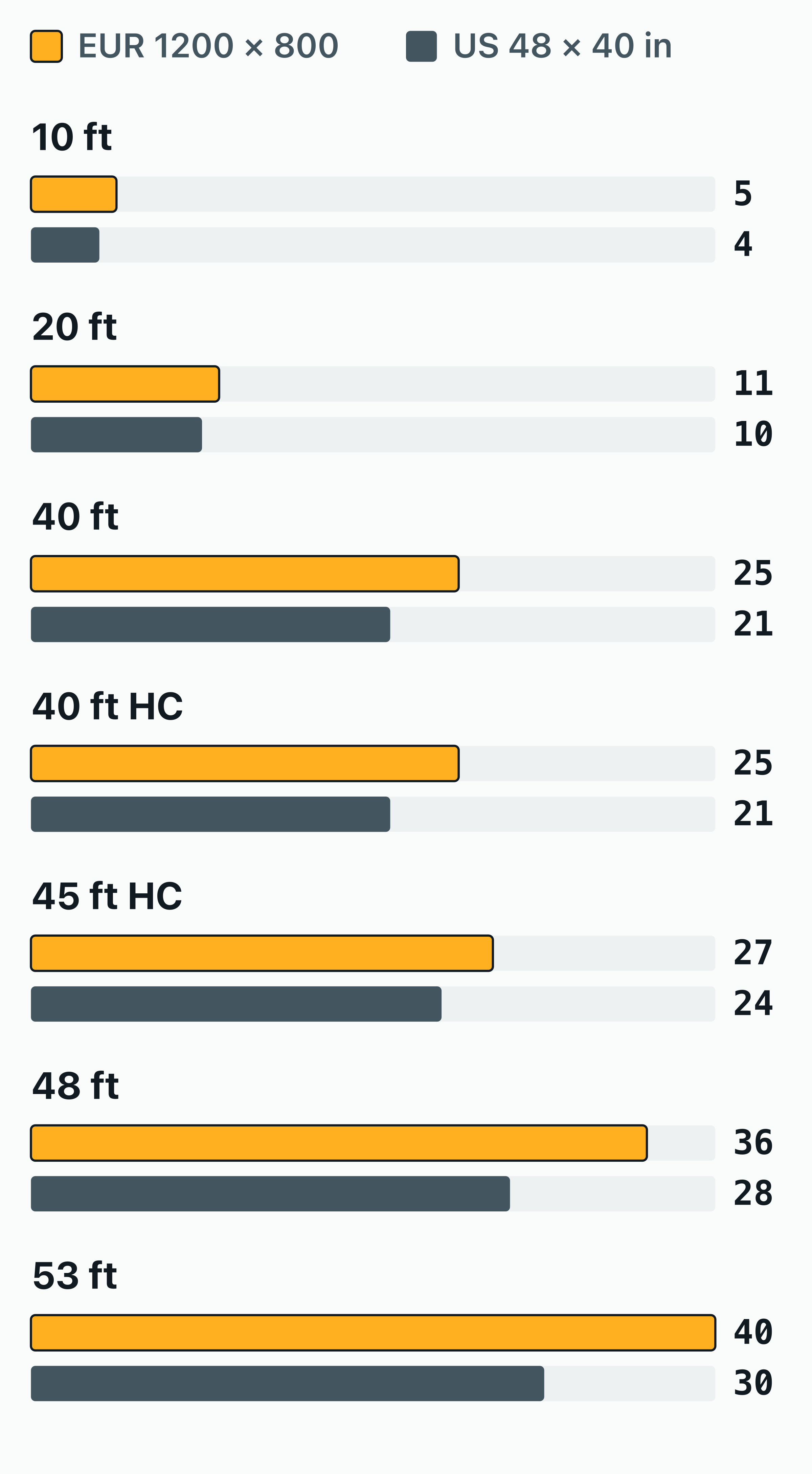
The standard pallet size in North America is 48 × 40 inches (1,219 × 1,016 mm), the GMA pallet, as 5 makers’ and poolers’ sheets print it; in Europe it is the EUR/EPAL pallet, 1,200 × 800 mm (47.2 × 31.5 in), per EPAL data sheet 05/2025. An empty EUR pallet weighs about 25 kg (55 lb) and stands 144 mm (5.7 in); a 48 × 40 stands about 140 mm (5.5 in) on the pooled block pallets and 121 mm (4.8 in) as a wood stringer pallet, which weighs about 38–43 lb (17–20 kg) dry. A 40 ft container floor-loads 25 EUR pallets or 21 US pallets by our pallet calculator’s count; a lessor’s sheet such as Seaco’s prints 23 and 20.
Container maths starts with the pallet. The world runs on two footprints — the European 1,200 × 800 mm EPAL pallet and the American 48 × 40 inch GMA pallet — with four more sizes in common use covering Asia-Pacific and specialty freight.
Neither of the two big pallets divides cleanly into a 2.352 m container width, which is why pallet counts per container are pattern puzzles rather than simple division — and why the 2.5 m wide pallet-wide container exists (CMA CGM’s sheet).
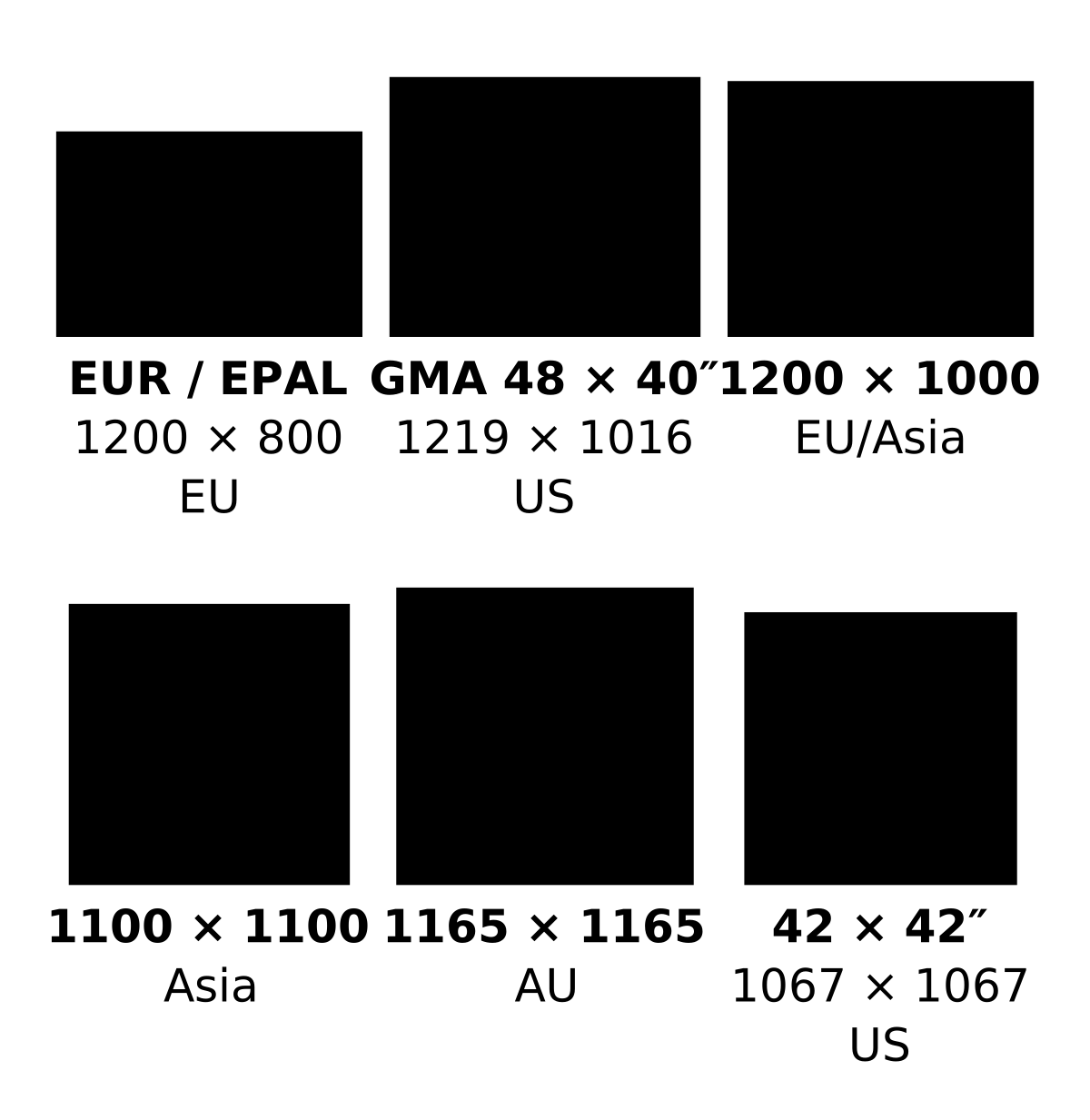
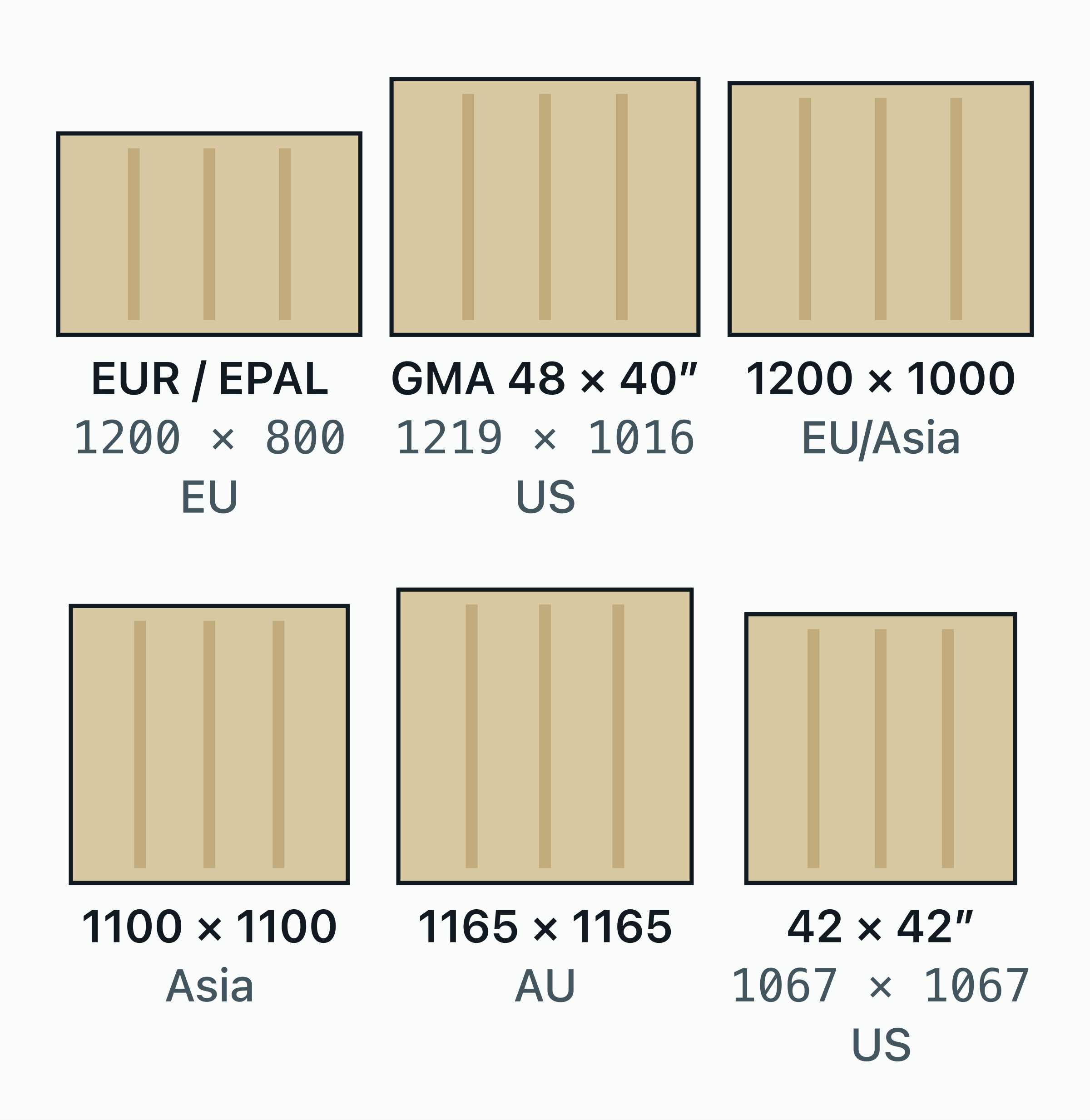
The numbers in this chart
| Pallet | Region | Length, mm | Width, mm |
|---|---|---|---|
| EUR / EPAL | EU | 1200 | 800 |
| GMA 48 × 40″ | US | 1219 | 1016 |
| 1200 × 1000 | EU/Asia | 1200 | 1000 |
| 1100 × 1100 | Asia | 1100 | 1100 |
| 1165 × 1165 | AU | 1165 | 1165 |
| 42 × 42″ | US | 1067 | 1067 |
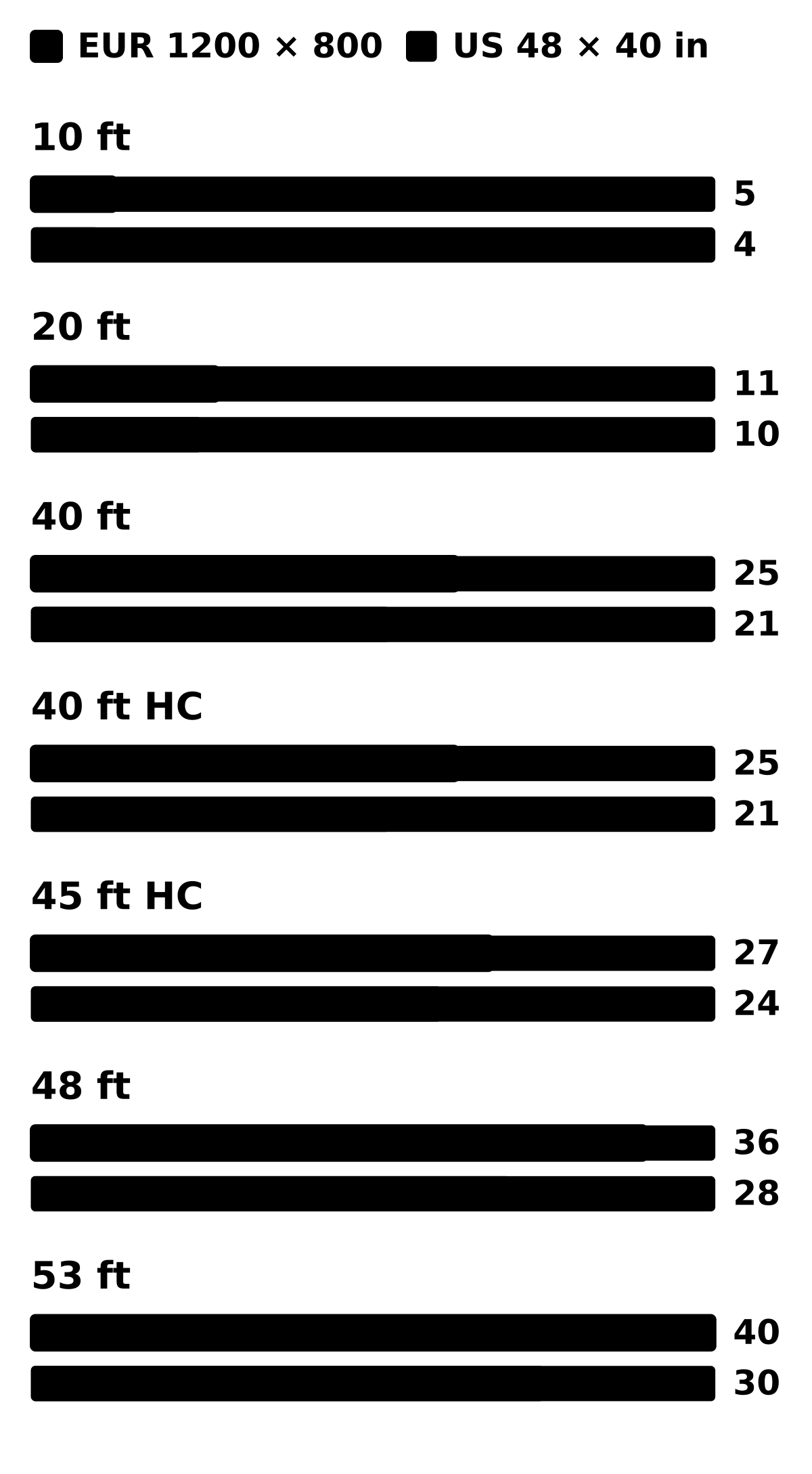
The numbers in this chart
| Size | EUR | US |
|---|---|---|
| 10 ft container | 5 | 4 |
| 20 ft container | 11 | 10 |
| 40 ft container | 25 | 21 |
| 40 ft high cube container | 25 | 21 |
| 45 ft high cube container | 27 | 24 |
| 48 ft container | 36 | 28 |
| 53 ft container | 40 | 30 |
Checked : the outside sizes of the ISO boxes (of the 10 ft, its length and width) set by ISO 668, read in IS 6566:2001, GOST R 51876-2008 and GOST R 53350-2009; the US domestic boxes, which no ISO standard covers, and every other figure against 44 published sheets of 28 lines, lessors, makers and rail and road operators. A sheet agrees within ±5 mm, or ±2 % for a mass and ±1 % for a volume; a maximum gross is a rating and must be the same. Every figure and its sources
The six common pallet sizes
Six pallet footprints are in common use, each tied to a region:
- 1,200 × 800 mm — EUR/EPAL pallet, Europe
- 1,219 × 1,016 mm — 48 × 40″ GMA pallet, North America
- 1,165 × 1,165 mm — Australian pallet
- 1,100 × 1,100 mm — Asian pallet
- 1,200 × 1,000 mm — industrial pallet, Europe/Asia
- 1,067 × 1,067 mm — 42 × 42″ pallet, North America, Europe and Asia
These six are usually listed as the ISO 6780 sizes. We have not read that standard, so the last four footprints and their regions are given from one sheet (Logistics Cluster).
An EPAL Euro pallet is 144 mm tall and weighs about 25 kg — per EPAL data sheet 05/2025. Its safe working load is 1,500 kg. On a solid, even floor, the bottom pallet of a stack may carry up to 5,500 kg.
A 48 × 40 in pallet has no standard height. The pooled block pallets print 141–143 mm (PECO, CHEP, iGPS, Rehrig), about 140 mm or 5.5 in. The wood stringer GMA pallet of the NWPCA Pallet Design System sheet is 121 mm (4.8 in).
CHEP, PECO and iGPS rate their 48 × 40 in pallets at 2,800 lb (1,270 kg) of evenly spread load. Rehrig’s plastic GMA pallet prints 2,400 lb (1,089 kg).
Pallet weight: wood, plastic and EUR
An empty pallet’s weight depends on its footprint and its material:
- A 48 × 40 in wood stringer pallet weighs about 38–43 lb (17–20 kg) once dried, as the NWPCA Pallet Design System sheet of a GMA pallet gives it. Straight from manufacture, while the wood is still wet, it weighs about 59 lb (27 kg).
- The plastic pooled pallets print 47–54 lb (21.3–24.5 kg) (Rehrig, iGPS).
- A EUR/EPAL pallet weighs about 25 kg (55 lb), per EPAL data sheet 05/2025.
No standard fixes a 48 × 40’s weight: the GMA name sets the size only. The weight depends on the wood, its moisture and the build.
For freight, count the pallet in: 21 empty wood pallets add about 360–410 kg (790–900 lb) to a 40 ft load before any cargo.
Pallets per container, by pallet size
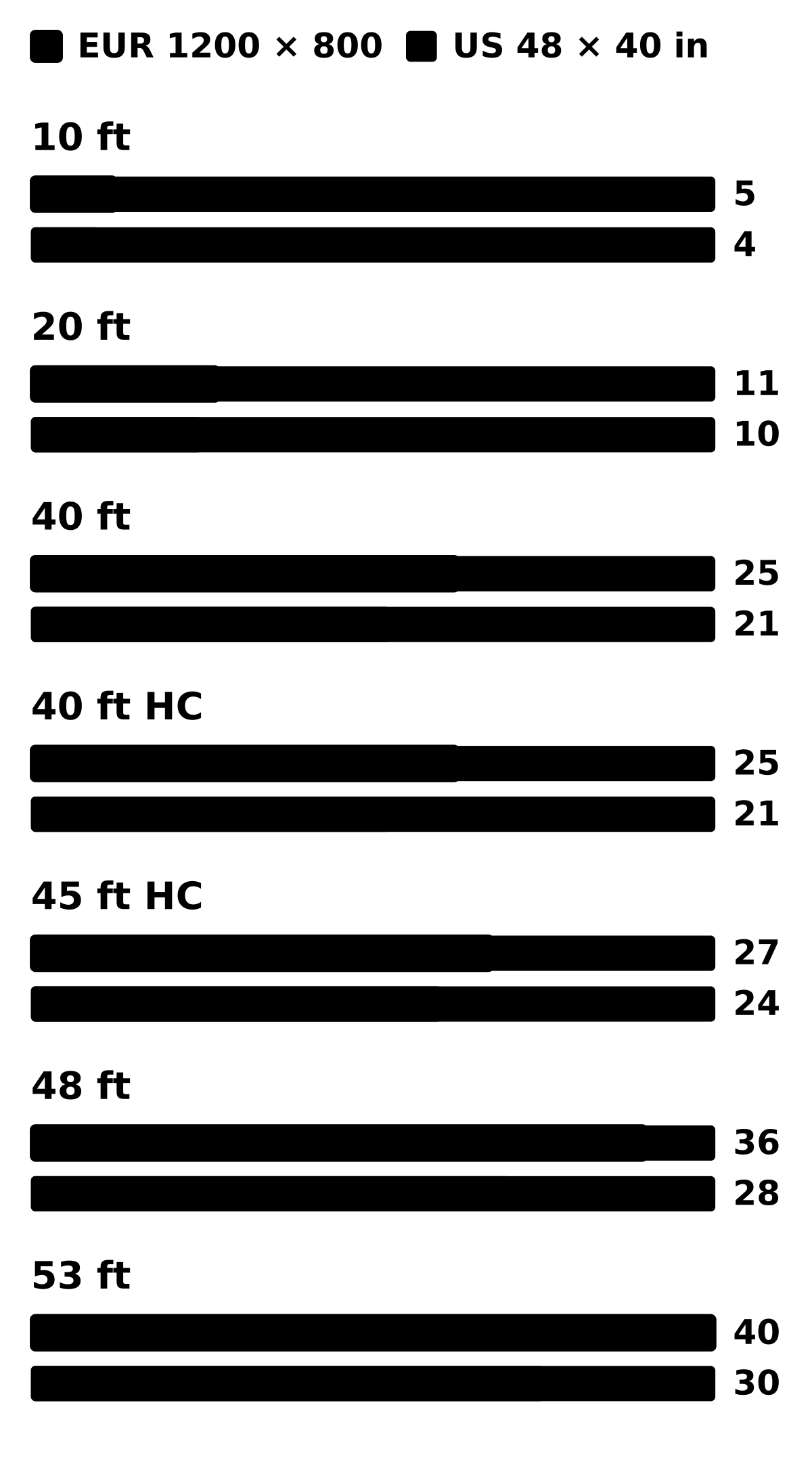
A 40 ft container takes 25 EUR pallets or 21 GMA pallets, floor-loaded in a single tier by our pallet calculator. The counts by pallet and container:
- EUR 1,200 × 800 → 11 in a 20 ft, 25 in a 40 ft, 27 in a 45 ft (33 in a 45 ft pallet-wide)
- GMA 48 × 40″ → 10 in a 20 ft, 21 in a 40 ft, 30 in a 53 ft
- Asian 1,100 × 1,100 → 10 in a 20 ft, 20 in a 40 ft
Those are geometric counts, every pallet tight. Lessor sheets may print fewer: Seaco’s gives 23 EUR and 20 US for a 40 ft. Run your own size through the pallet calculator.
ISPM-15: the stamp on the pallet
Wooden pallets crossing borders must carry the ISPM-15 mark: the wheat-stamp logo with a country code and a treatment code. There are two treatment codes:
- HT: heated to 56 °C core temperature for 30 minutes, per ISPM 15
- MB: methyl bromide fumigated, now banned in the EU
Untreated wood packaging gets a shipment refused, fumigated or destroyed at the border, at the shipper’s expense. Plastic pallets are exempt entirely.
Beyond the two big footprints, the chemical industry runs its own CP1–CP9 pallet series, standardised by the European chemical producers.
Plastic pallets trade durability and exemption from ISPM-15 against a higher price than wood, a slippery deck and near-impossible field repair. They are common in closed loops and rare in one-way export.
Frequently asked questions
How much does a pallet weigh?
An empty 48 × 40 in wood stringer pallet weighs about 38–43 lb (17–20 kg) once dried, a plastic pooled one 47–54 lb (21.3–24.5 kg), and a EUR pallet about 25 kg (55 lb) — per the NWPCA design sheet, Rehrig’s and iGPS’s sheets, and EPAL’s data sheet. For the 48 × 40 no standard fixes the weight; it depends on the wood and the build.
What is the standard pallet size?
In North America, 48 × 40 inches (1,219 × 1,016 mm, the GMA pallet). In Europe, 1,200 × 800 mm (47.2 × 31.5 in, the EUR/EPAL pallet). Four more footprints are in common use: 1,165 × 1,165 mm in Australia, 1,100 × 1,100 mm in Asia, 1,200 × 1,000 mm industrial and 42 × 42 in (1,067 × 1,067 mm).
What are euro pallet dimensions?
1,200 × 800 mm (47.2 × 31.5 in) footprint, 144 mm (5.7 in) tall, about 25 kg empty and a 1,500 kg safe working load, per EPAL data sheet 05/2025. Up to 5,500 kg may rest on the bottom pallet of a stack on a solid, even floor; the pallet is marked EPAL on its corner blocks.
How tall is a standard pallet?
An empty EUR pallet is 144 mm (5.7 in), per EPAL data sheet 05/2025; a 48 × 40 in pallet about 140 mm (5.5 in) — the pooled block pallets print 141–143 mm, a wood stringer pallet 121 mm (4.8 in). A loaded pallet’s height is the cargo’s plus the pallet’s; to go two high through the 2.280 m door of a standard 20 ft or 40 ft, each must stay under 1.140 m.
Are pallet dimensions listed as length × width or width × length?
Length first, where length runs along the stringers — the boards the forks enter parallel to. A 48 × 40 in GMA pallet has 48-inch stringers and 40-inch deckboards, so “48 × 40” and “40 × 48” describe the same pallet, but loading-pattern maths should always start from the stringer dimension.
What is the ISPM-15 stamp?
The international mark certifying wood packaging has been treated against pests — heat treatment (HT) or methyl bromide fumigation (MB). Required on wooden pallets for international shipments; pallets without it are refused or fumigated at the border. Plastic pallets need no stamp.