Guide · Buying and owning
Moving a Shipping Container
 Yuri Kan Checked against 19 of 88 published sheets Updated
Local container delivery costs $400–800 with a tilt-bed truck within about 50 miles, $500–800 for 50–100 miles and $700–1,700 for 100–200 miles, by dealers’ published rates; past that, haulers quote by the mile. A tilt-bed needs a straight, level approach of about 18 m (60 ft) for a 20 ft and 37 m (120 ft) for a 40 ft, with 4.3–4.9 m (14–16 ft) of overhead clearance, by two dealers’ published site requirements. An empty 20 ft — 2,230 kg (4,916 lb) tare, sheets print 2,080–2,570 kg — can be lifted by a HIAB truck-mounted crane — most HIAB configurations are limited to empty 20 ft units — or by a heavy forklift rated for that weight with its centre 1.219 m out from the forks; a standard warehouse forklift cannot move any container safely, even empty. A loaded box, typically 30,480 kg gross for a 20 ft (32,500 kg on some) and 32,500 kg for a 40 ft, needs a mobile crane, reach stacker or side-loader. No permit is needed for the container itself in most places: at 2.438 m wide it is inside the road width limits, and the height limit is the road’s — 4.0 m in the EU, 4.11–4.27 m (13 ft 6 in to 14 ft) in most US States.
A container is easy to move with the right machine and impossible with the wrong one. This guide covers the four delivery methods, what each weighs against your site’s clearances, and what the trucking actually costs.
The single most common delivery failure is site access, not equipment: measure your approach before booking, because a truck that cannot line up simply drops the box at the kerb — or leaves with it.
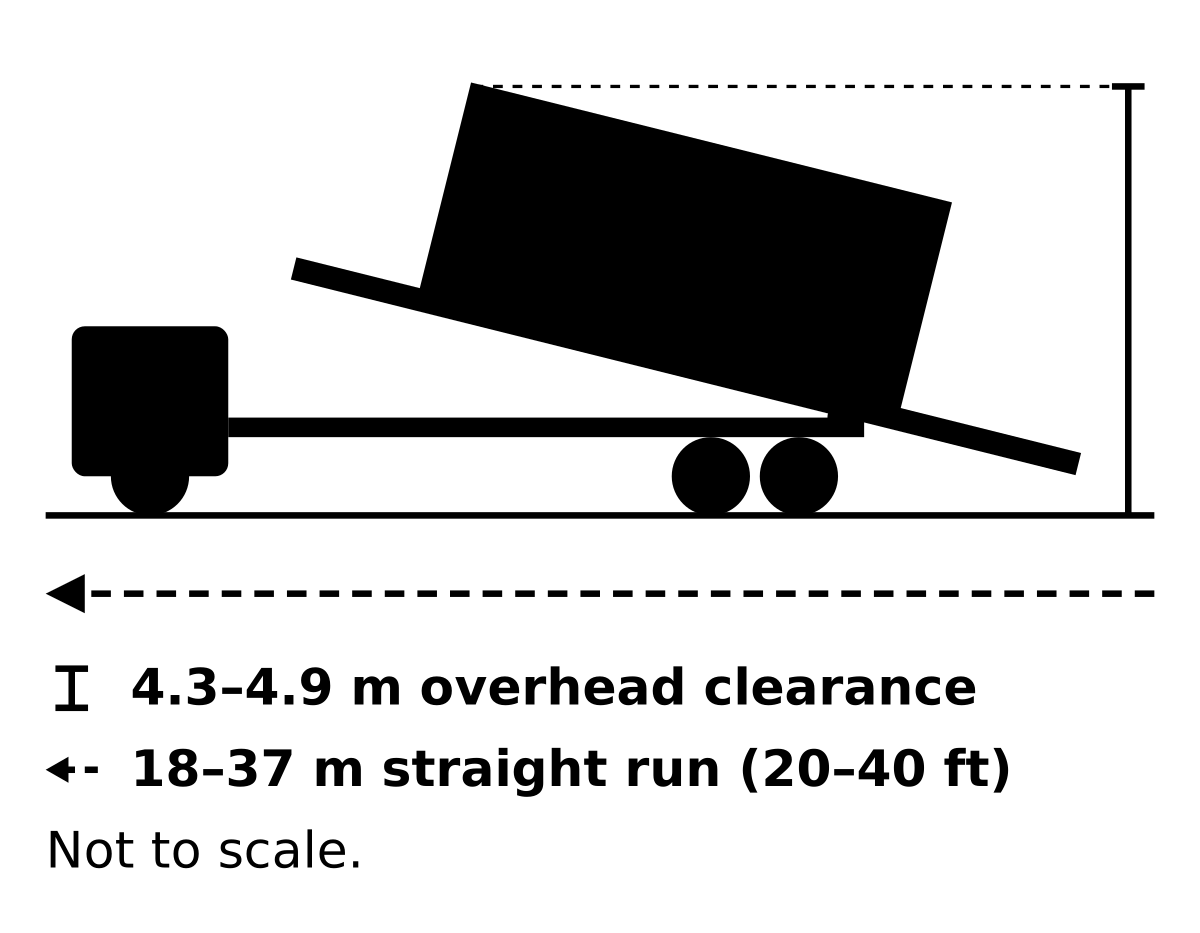
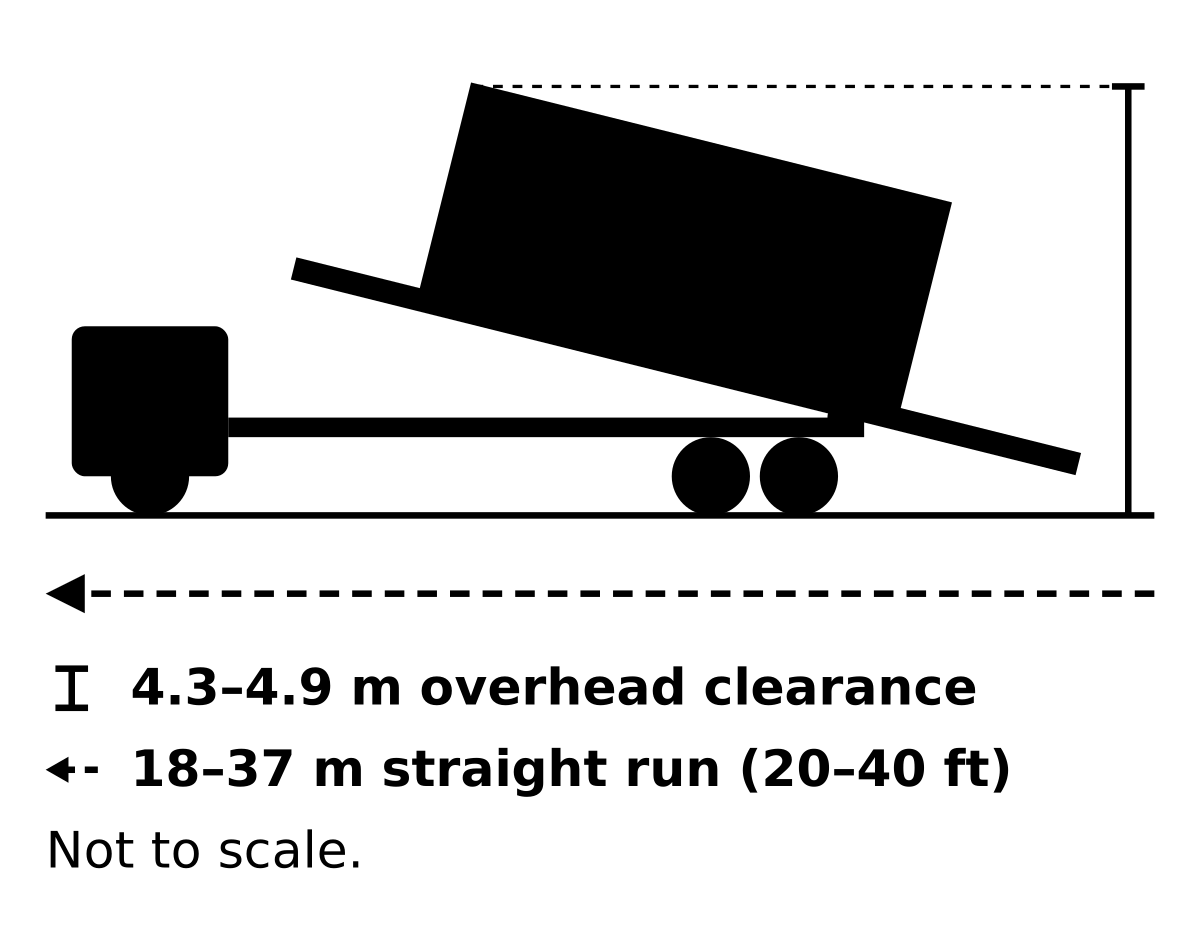
Four ways to move a container, and what each can lift
- Tilt-bed (roll-off) truck: the default for local delivery. The bed tilts, and the container slides off onto the ground as the truck pulls forward. Cheapest, but needs the longest straight run.
- HIAB (truck-mounted crane): the truck carries its own crane and can place an empty 20 ft (2,230 kg tare) over a fence or beside a building. Limited reach and capacity — empty 20 ft units only, in most configurations.
- Mobile crane: places any container, loaded or empty, exactly where you want it — including over obstacles. The most expensive option, hired by the hour on top of the trucking.
- Side-loader: a trailer with two hydraulic cranes that sets the container down parallel to the truck. Common in Australia and Europe, rarer in North America.
| Method | Handles | Straight approach | Overhead |
|---|---|---|---|
| Tilt-bed | Empty, any size | 20 ft: ~18 m (60 ft); 40 ft: ~37 m (120 ft) | 4.3–4.9 m (14–16 ft) |
| HIAB | Empty 20 ft (2,230 kg) | Truck length + reach | Boom height |
| Crane | Loaded or empty, any size | Crane pad access | Site-specific |
| Side-loader | Loaded or empty, to its rated lift | Truck length, lateral room | Boom height |
Checked : outside sizes set by ISO 668, read in IS 6566:2001, GOST R 51876-2008 and GOST R 53350-2009; every other figure against 19 published sheets of 19 lines, lessors and makers. A sheet agrees within ±5 mm, or ±2 % for a mass and ±1 % for a volume; a maximum gross is a rating and must be the same. Every figure and its sources
What container delivery costs, near and far
Local delivery within ~50 miles of the depot: $400–800, usually quoted flat, by dealers’ published rates; $500–800 for 50–100 miles and $700–1,700 for 100–200 miles. Beyond that, haulers quote by the mile. A long haul can cost more than a used 20 ft container itself, which is why buying close to home matters (see container prices).
Loaded moves cost more. The trucking is the same, but you add crane hire at both ends, because a tilt-bed cannot slide a loaded box.
Weight decides the machine: empty or loaded
Empty containers are light for their size: a 20 ft tares 2,230 kg (4,916 lb) and a 40 ft high cube 3,830 kg (8,444 lb). Both tares are within 2 % of what 8 of 18 and 10 of 19 published sheets print (full figures in the container weight guide). That is HIAB and heavy-forklift territory.
Loaded, the same boxes gross up to 30,480 kg for the 20 ft and 32,500 kg for the 40 ft high cube. At that point only a mobile crane, reach stacker or side-loader is rated for the lift.
A standard warehouse forklift cannot move any container safely, even empty. Its rating assumes a load centred close to the mast, and a container’s centre sits half its width, 1.219 m, out from the forks.
Permits and road rules: when a container needs a permit
A standard container on a standard trailer needs no permit in most jurisdictions. At 2.438 m it is narrower than the road width limits (2.55 m in the EU, per Directive (EU) 2015/719 and Directive 96/53/EC; 102 in on the US National Network).
The height limit is the road’s, not the box’s; check it for a high cube, which rides highest:
- 4.0 m in the EU (per Directive 96/53/EC);
- 4.11–4.27 m (13 ft 6 in to 14 ft) in most US States, which have no federal limit (per U.S. Federal Highway Administration, Office of Freight Management and Operations);
- 4.15 m on Canada’s interprovincial roads.
Permits enter the picture when the cargo inside pushes gross vehicle weight over the road limit, or for 45 ft+ units on restricted routes. The gross limit is 40 t for a five-axle EU combination, 44 t when it carries containers in intermodal transport, and 80,000 lb on US Interstates (per 23 CFR 658.17).
If you are placing the container permanently, check local zoning and setback rules before delivery day, not after.
Frequently asked questions
How much does it cost to move a shipping container?
Moving a shipping container locally costs $400–800 by tilt-bed truck within about 50 miles, by dealers’ published rates; $500–800 for 50–100 miles and $700–1,700 for 100–200 miles; longer hauls are quoted by the mile. Moving a loaded container adds crane hire at each end, quoted by the hour.
Can you move a shipping container with a forklift?
Only empty — an empty 20 ft weighs 2,230 kg (4,916 lb) — and only with a heavy forklift rated for that weight with its centre 1.219 m out from the forks, lifting from the bottom side rails or fork pockets, which most 20 ft units have and 40 ft units lack. A standard warehouse forklift is rated for a load centred close to the mast and cannot do it safely at any weight.
How much space does container delivery need?
A tilt-bed truck needs a straight, level approach of about 18 m (60 ft) for a 20 ft and 37 m (120 ft) for a 40 ft — truck plus container plus slide-off room — with 4.3–4.9 m (14–16 ft) of overhead clearance, by two dealers’ published site requirements. No overhead wires or branches along the run.
Do I need a permit to transport a shipping container?
Not for the container itself in most places — at 2.438 m (8 ft) wide, per ISO 668, it is inside the road width limits (2.55 m in the EU, 102 in in the US). Its travelling height must stay under the road’s limit: 4.0 m in the EU, 4.11–4.27 m (13 ft 6 in to 14 ft) in most US States. Permits apply when gross vehicle weight exceeds the road limit or on restricted routes. Permanent placement may need local zoning approval.
Can you move a loaded shipping container?
Yes, but not with a tilt-bed: a loaded box — up to 30,480 kg (67,197 lb) gross for a 20 ft, 32,500 kg for a 40 ft — needs a mobile crane or reach stacker to lift on and off a flatbed, or a side-loader trailer. Budget crane time at both ends.