Original research · measured 7–8 October 2026 · we built one of the four
Four Free Container Load Calculators, Tested on Ten Loads

On ten reference loads typed into each tool by hand on 7 and 8 October 2026, containerloadcalculator.com and our planner packed about the same: 262 and 270 cartons of 60 × 40 × 40 cm in the first 20 ft, and 95.5 % and 95.4 % of a 40 ft high cube with twelve carton sizes. cbm3.net loaded 258 and 80.2 % on the same two; Gateway Lines, which cannot lay a carton on its side and took ten of the twelve lines, 255 and 84.8 %. The tools differ more in what they check than in how densely they pack: only Gateway Lines and ours refused a 2.32 m crate at a 2.28 m door by default, and only ours kept a reefer load under its load line. We built one of the four tools and tuned it on these ten loads, so read our column with that in mind.
Disclosure first. contsize.com publishes this study and also built one of the four tools in it, the container load calculator on this site. The ten loads are the ones we wrote to develop it: our planner was tuned until it handled them, while the other three met them for the first time. That is a home advantage, and nothing in the method removes it. What we can do is publish the inputs, each tool’s own figures and the dates, and say plainly where another tool does better or where we could not check.
The point is not a ranking. A free load calculator answers two questions — how much fits, and will the plan work at the dock — and each of the ten loads was built so that one rule decides it: a door, a load line, a delivery order, a payload. The tables show what each tool did with each of them.

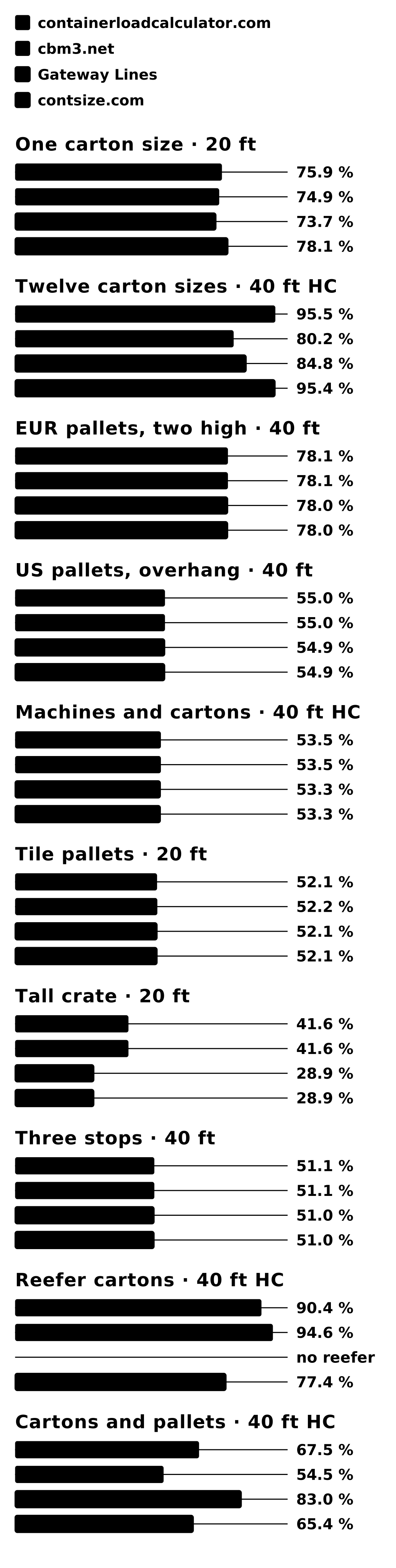
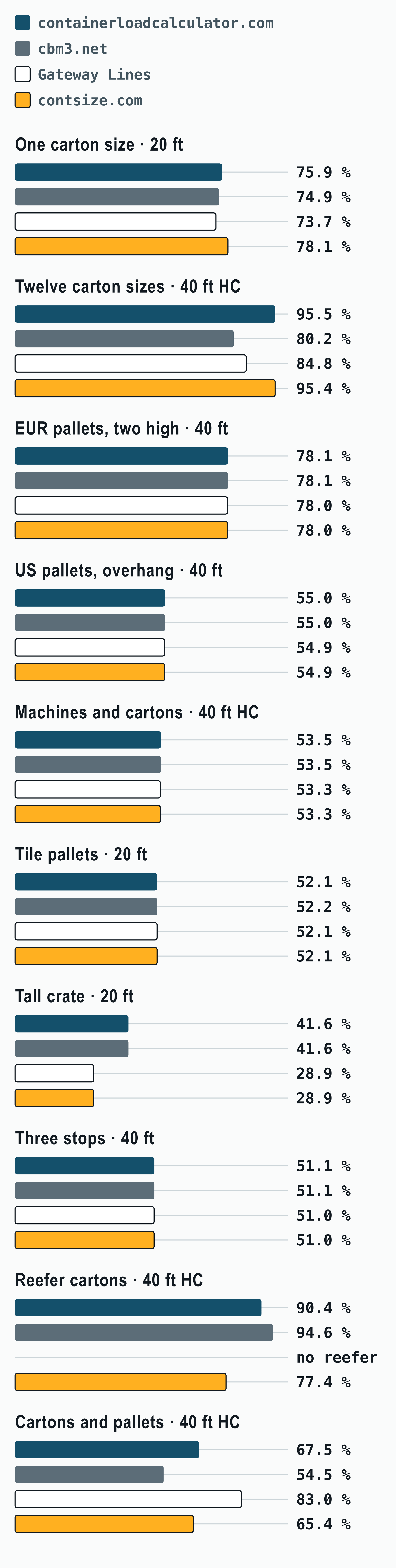
The numbers in this chart
| Load | containerloadcalculator.com | cbm3.net | Gateway Lines | contsize.com |
|---|---|---|---|---|
| One carton size, 20 ft | 75.9 % | 74.9 % | 73.7 % | 78.1 % |
| Twelve carton sizes, 40 ft high cube | 95.5 % | 80.2 % | 84.8 % | 95.4 % |
| EUR pallets, two high, 40 ft | 78.1 % | 78.1 % | 78.0 % | 78.0 % |
| US pallets, overhang, 40 ft | 55.0 % | 55.0 % | 54.9 % | 54.9 % |
| Machines and cartons, 40 ft high cube | 53.5 % | 53.5 % | 53.3 % | 53.3 % |
| Tile pallets, 20 ft | 52.1 % | 52.2 % | 52.1 % | 52.1 % |
| Tall crate, 20 ft | 41.6 % | 41.6 % | 28.9 % | 28.9 % |
| Three stops, 40 ft | 51.1 % | 51.1 % | 51.0 % | 51.0 % |
| Reefer cartons, 40 ft high cube reefer | 90.4 % | 94.6 % | no reefer | 77.4 % |
| Cartons and pallets, 40 ft high cube | 67.5 % | 54.5 % | 83.0 % | 65.4 % |

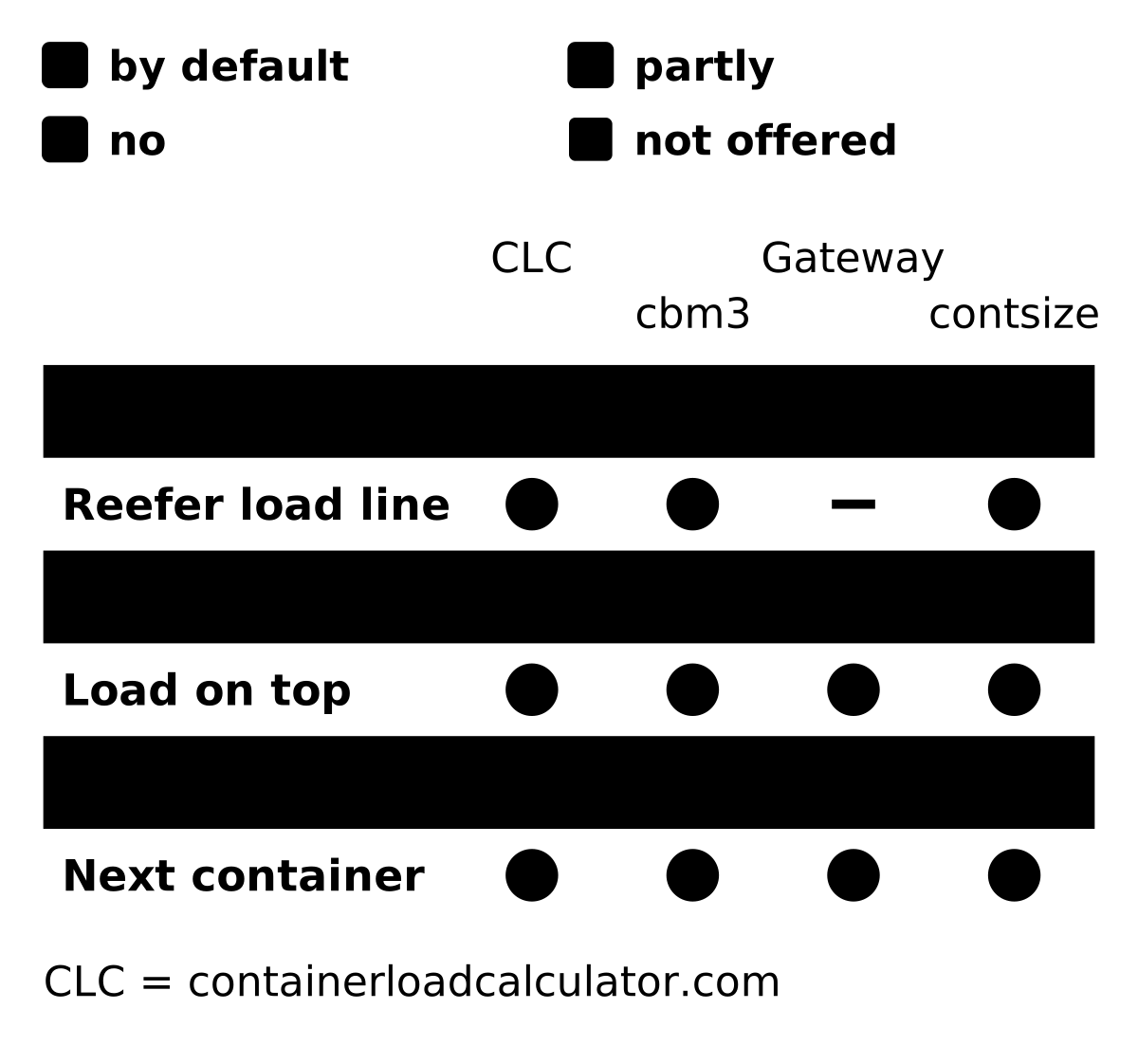
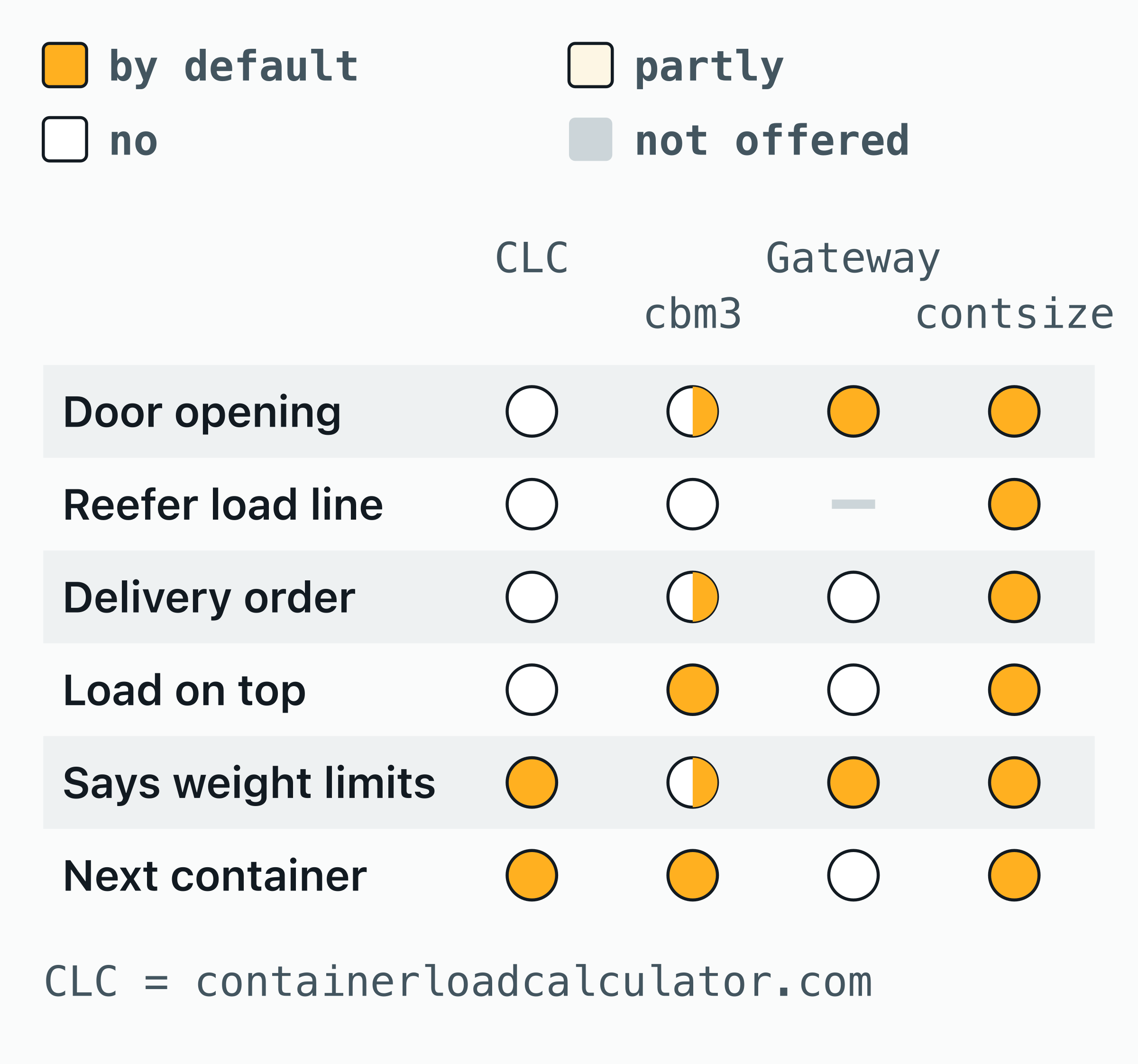
The numbers in this chart
| Check | containerloadcalculator.com | cbm3.net | Gateway Lines | contsize.com |
|---|---|---|---|---|
| Door opening | no | partly | by default | by default |
| Reefer load line | no | no | not offered | by default |
| Delivery order | no | partly | no | by default |
| Load on top | no | by default | no | by default |
| Says weight limits | by default | partly | by default | by default |
| Next container | by default | by default | no | by default |
Method: what we did, and what we set for our own run
Each load was entered by hand into the free tier of every tool we could reach without an account or a payment, on 7 and 8 October 2026, in Chromium 151 at 1,280 px wide. Sizes went in as centimetres (our millimetres divided by 10, with one decimal where needed) and masses as kilograms per piece. “May turn any way” was entered as each tool’s free rotation and “this side up” as its upright setting; where a tool has no such setting, the results say so.
Each tool used its own preset for the container named — 20 ft, 40 ft, 40 ft high cube, 40 ft high cube reefer — because a reader would not type a custom box either. The presets differ a little from ours and from each other: the inside heights of the dry boxes agree within a centimetre, but payloads for a 40 ft high cube are up to 2,100 kg apart, and reefer heights run from 243 to 255.4 cm. So each volume percentage is against the tool’s own container, and weight percentages cannot be compared across tools at all.
Times run from the action that starts a calculation to the result on screen, by wall clock on one machine. containerloadcalculator.com calculates as its page opens, so its times include the page load. Gateway Lines draws its packing as an animation; it was run in a visible browser with its fast-forward button pressed, which changes how fast the plan is drawn but not the plan.
Our planner ran on the same ten lists outside a browser, with two settings changed from its page defaults to match what the other tools do: full support under every piece (the page defaults to 70 %, which suits shrink-wrapped units and usually loads more), and what does not fit going into another container of the same type. Its improvement search was given 1 s per container, where the page gives it 0.6 s. The time in our column is that budget, not a measured page time.
| Tool | 20 ft | 40 ft | 40 ft high cube | 40 ft high cube reefer |
|---|---|---|---|---|
| containerloadcalculator.com | 590 × 235 × 239 28,200 kg | 1,203 × 235 × 239 26,700 kg | 1,203 × 235 × 269 26,500 kg | 1,158 × 229 × 250 29,000 kg |
| cbm3.net | 589 × 235 × 239 28,200 kg | 1,203 × 235 × 239 28,600 kg | 1,203 × 235 × 269 28,600 kg | 1,160 × 229 × 243 29,580 kg |
| Gateway Lines | 590 × 235 × 239 28,200 kg | 1,200 × 235 × 239 26,680 kg | 1,200 × 235 × 270 26,580 kg | not offered |
| contsize.com (ours) | 589.8 × 235.2 × 239.3 28,250 kg | 1,203.2 × 235.2 × 239.3 26,740 kg | 1,203.2 × 235.2 × 269.8 28,600 kg | 1,158.3 × 229 × 255.4 29,520 kg |
Gateway Lines shows its sizes rounded to the centimetre in metres. Our 40 ft high cube reefer has a load line at 239.4 cm.
Data: containerloadcalculator.com, read 2026-10-07/08 · cbm3.net, read 2026-10-07/08 · Gateway Lines Smart Load Planner, read 2026-10-07/08
Results: ten loads, four tools
Each cell is the tool’s own reading: pieces loaded of pieces given, the containers used, and for each container the pieces, the share of its volume and, where the tool gives one, the share of its payload. On five of the ten loads — the EUR pallets, the US pallets, the machinery, the tile pallets and the three stops — all four tools put the same number of pieces in the first container, within two tenths of a point of volume. The other five are where they part.
Gateway Lines plans one container. Where a load needs two, it lists the rest as not fitting instead of planning it, which is why its loaded count is lower on five loads; that is a design choice rather than a packing result. On the cartons-and-pallets load its single 40 ft high cube holds 83.0 % of its volume, more than any tool’s first container.
| Load | containerloadcalculator.com | cbm3.net | Gateway Lines | contsize.com (ours) |
|---|---|---|---|---|
| One carton size 20 ft | 300/300 loaded · 2 containers #1: 262 pcs, 75.9 %, weight 11.1 % #2: 38 pcs, 11.0 % 0.8 s | 300/300 loaded · 2 containers #1: 258 pcs, 74.9 %, weight: not given #2: 42 pcs, 12.2 % 3.0 s | 255/300 loaded · 1 container #1: 255 pcs, 73.7 %, weight 10.9 % 10 s | 300/300 loaded · 2 containers #1: 270 pcs, 78.1 %, weight 11.5 % #2: 30 pcs, 8.7 %, weight 1.3 % 2.0 s |
| Twelve carton sizes 40 ft high cube | 1,480/1,480 loaded · 2 containers #1: 1,283 pcs, 95.5 %, weight 39.6 % #2: 197 pcs, 13.2 % 1.7 s | 1,480/1,480 loaded · 2 containers #1: 611 pcs, 80.2 %, weight: not given #2: 869 pcs, 28.4 % 6.4 s | 999/1,340 loaded · 1 container #1: 999 pcs, 84.8 %, weight 32.6 % 46 s | 1,480/1,480 loaded · 2 containers #1: 1,133 pcs, 95.4 %, weight 35.8 % #2: 347 pcs, 12.9 %, weight 5.4 % 2.0 s |
| EUR pallets, two high 40 ft | 50/50 loaded · 1 container #1: 50 pcs, 78.1 %, weight 84.3 % 0.6 s | 50/50 loaded · 1 container #1: 50 pcs, 78.1 %, weight: not given 2.8 s | 50/50 loaded · 1 container #1: 50 pcs, 78.0 %, weight 84.3 % 7.0 s | 50/50 loaded · 1 container #1: 50 pcs, 78.0 %, weight 84.1 % 0.0 s |
| US pallets, overhang 40 ft | 21/21 loaded · 2 containers #1: 18 pcs, 55.0 %, weight 40.4 % #2: 3 pcs, 9.2 % 0.7 s | 21/21 loaded · 2 containers #1: 18 pcs, 55.0 %, weight: not given #2: 3 pcs, 9.2 % 2.5 s | 18/21 loaded · 1 container #1: 18 pcs, 54.9 %, weight 40.5 % 12 s | 21/21 loaded · 2 containers #1: 18 pcs, 54.9 %, weight 40.4 % #2: 3 pcs, 9.1 %, weight 6.7 % 2.0 s |
| Machines and cartons 40 ft high cube | 302/302 loaded · 1 container #1: 302 pcs, 53.5 %, weight 35.1 % 0.8 s | 302/302 loaded · 1 container #1: 302 pcs, 53.5 %, weight: not given 3.1 s | 302/302 loaded · 1 container #1: 302 pcs, 53.3 %, weight 35.0 % 10 s | 302/302 loaded · 1 container #1: 302 pcs, 53.3 %, weight 32.5 % 1.0 s |
| Tile pallets 20 ft | 30/30 loaded · 2 containers #1: 20 pcs, 52.1 %, weight 99.3 % #2: 10 pcs, 26.1 % 0.7 s | 30/30 loaded · 2 containers #1: 20 pcs, 52.2 %, weight: not given #2: 10 pcs, 26.1 % 2.5 s | 20/30 loaded · 1 container #1: 20 pcs, 52.1 %, weight 99.3 % 12 s | 30/30 loaded · 2 containers #1: 20 pcs, 52.1 %, weight 99.1 % #2: 10 pcs, 26.0 %, weight 49.6 % 2.0 s |
| Tall crate 20 ft | 101/101 loaded · 1 container #1: 101 pcs, 41.6 %, weight 7.4 % 0.7 s | 101/101 loaded · 1 container #1: 101 pcs, 41.6 %, weight: not given 2.6 s | 100/101 loaded · 1 container #1: 100 pcs, 28.9 %, weight 4.3 % 7.0 s | 100/101 loaded · 1 container #1: 100 pcs, 28.9 %, weight 4.2 % 1.0 s |
| Three stops 40 ft | 360/360 loaded · 1 container #1: 360 pcs, 51.1 %, weight 16.2 % 0.8 s | 360/360 loaded · 1 container #1: 360 pcs, 51.1 %, weight: not given 2.8 s | 360/360 loaded · 1 container #1: 360 pcs, 51.0 %, weight 16.2 % 13 s | 360/360 loaded · 1 container #1: 360 pcs, 51.0 %, weight 16.2 % 1.0 s |
| Reefer cartons 40 ft high cube reefer | 900/900 loaded · 2 containers #1: 832 pcs, 90.4 %, weight 40.2 % #2: 68 pcs, 7.4 % 0.9 s | 900/900 loaded · 2 containers #1: 848 pcs, 94.6 %, weight: not given #2: 52 pcs, 5.8 % 2.8 s | not offered | 900/900 loaded · 2 containers #1: 728 pcs, 77.4 %, weight 34.5 % #2: 172 pcs, 18.3 %, weight 8.2 % 2.0 s |
| Cartons and pallets 40 ft high cube | 420/420 loaded · 2 containers #1: 409 pcs, 67.5 %, weight 35.1 % #2: 11 pcs, 20.8 % 0.8 s | 420/420 loaded · 2 containers #1: 152 pcs, 54.5 %, weight: not given #2: 268 pcs, 33.8 % 3.2 s | 380/420 loaded · 1 container #1: 380 pcs, 83.0 %, weight 53.9 % 13 s | 420/420 loaded · 2 containers #1: 408 pcs, 65.4 %, weight 30.8 % #2: 12 pcs, 22.6 %, weight 21.0 % 2.0 s |
Volume % and weight % are each tool’s own, against its own container. Gateway Lines plans one container only, and took ten of the twelve lines of the second load. Times are approximate: containerloadcalculator.com’s include the page load; ours are the search budget set for the study, measured outside a browser.
Data: containerloadcalculator.com, read 2026-10-07/08 · cbm3.net, read 2026-10-07/08 · Gateway Lines Smart Load Planner, read 2026-10-07/08
Density: level with one tool on these loads
Three loads measure packing alone. On the single carton size in a 20 ft, no plan can hold more than 292 cartons: lengths of 600 and 400 mm add up to at most 5,800 mm within the 5,898 mm floor, and to at most 2,200 mm within the width and the height, so at most 5.8 × 2.2 × 2.2 m of carton fits. Our planner put 270 in the first container, about 92 % of that bound; containerloadcalculator.com 262, about 90 %; cbm3.net 258 and Gateway Lines 255. Gateway Lines cannot lay a carton on its side: its rotation setting swaps length and width only.
On twelve carton sizes in a 40 ft high cube, containerloadcalculator.com filled 95.5 % of its first container and ours 95.4 % of ours, which is 0.8 cm taller. That is level. cbm3.net filled 80.2 % of its first container and 28.4 % of its second: on this load it did not fill the first container before starting the next. Gateway Lines accepts ten lines at most, so it was given ten of the twelve, and filled 84.8 %.
On cartons with EUR pallets that may carry nothing, containerloadcalculator.com put 409 pieces in the first container and ours 408, at 67.5 % and 65.4 % of the volume; cbm3.net put 152 there, at 54.5 %.
Our improvement search stops on a clock, so a faster or slower computer can change a plan slightly. Two runs of the twelve-carton load on the same machine put 1,133 and 1,167 pieces in the first container, both at 95.4 %. The table shows the first run.
containerloadcalculator.com’s plans were also checked geometrically, not only on screen: its packer is a plain JavaScript module, and running it on the same inputs gives every piece’s position. In every container it used, no piece overlaps another, sticks out of the box, stands on less than its full base, or stands on a piece marked not stackable or on a lighter one. The one exception is the tall crate, which is taller than its own door. cbm3.net and Gateway Lines were judged on their 3D views, where we saw no floating or overlapping pieces.
The checks: door, load line, delivery order, weight
The door. The tall crate is 2.32 m high: under the 2.39 m roof of a 20 ft, over its 2.28 m door. Gateway Lines leaves it out and names the reason, “door opening”, and so does our planner. containerloadcalculator.com loads it without a warning; its packer compares a piece with the inside of the box and never reads the door size it stores. cbm3.net loads it unless the user types the door size under its equipment restrictions; with the size typed in, it leaves the crate out and notes “No definitive physical reason was established.”
The reefer load line. The reefer load is 900 cartons 30 cm high in a 40 ft high cube reefer. Eight tiers reach 2,400 mm. That is under the red line in some boxes — Hapag-Lloyd publishes 2,420 to 2,474 mm, Maersk 2,415 mm — and 6 mm over it in CMA CGM’s, at 2,394 mm. Our planner uses the lowest, so that a plan holds in any of the three, and loads seven tiers: 728 cartons in the first container, against 832 for containerloadcalculator.com and 848 for cbm3.net, which load eight. Neither has a load-line setting, and Gateway Lines offers no reefer. Part of the gap in that row is our cautious line, not packing.
Delivery order. The three-stop load has 120 cartons per stop. containerloadcalculator.com has no stop field and loads lines in the order typed, so with stop 1 listed first, stop 1 stood against the front wall and stop 3 at the door: the reverse of the unloading order. We did not test whether typing the stops in reverse puts them right. cbm3.net takes a stop per line, and its plan put a stop 1 carton in last, but it says “Strict stop order is off, so the delivery sequence is not enforced”, and the result was the same with it on. Gateway Lines has no stops. Ours never places a piece for a later stop between the door and a piece for an earlier one; on this load it gave each stop a lane along the length, with stop 1 reaching the door.
Load on top and weight. Only cbm3.net and ours take a limit on the mass that may rest on a piece; on the EUR pallets, containerloadcalculator.com stayed within the 500 kg limit without being told it. On the tile pallets, where the payload runs out before the floor, containerloadcalculator.com says “This load reaches the weight limit before the volume limit”, Gateway Lines leaves ten pallets out as “over weight”, and our planner shows the payload used, 99.1 % in the first container, and in a single container gives “the payload is used up” as the reason for what stays out. cbm3.net also stops at 20 pallets per 20 ft — with the same pallets at 100 kg it loads 22 — but its weight panel reads “Payload: not assessed”.
| Check | containerloadcalculator.com | cbm3.net | Gateway Lines | contsize.com (ours) |
|---|---|---|---|---|
| Door opening | no | partly | by default | by default |
| Reefer load line | no | no | not offered | by default |
| Delivery order | no | partly | no | by default |
| Load on top | no | by default | no | by default |
| Says weight limits | by default | partly | by default | by default |
| Next container | by default | by default | no | by default |
“Partly”: cbm3.net checks the door only when a door size is typed in, applies the payload but reports it as not assessed, and takes a stop per line while saying that stop order is not enforced.
Data: containerloadcalculator.com, read 2026-10-07/08 · cbm3.net, read 2026-10-07/08 · Gateway Lines Smart Load Planner, read 2026-10-07/08
Where we are not better
On density our planner is level with containerloadcalculator.com, not ahead of it: eight cartons more on one load, a tenth of a point and one piece less on two others, and the same count on five. Those are the loads ours was tuned on; on a load nobody tuned for, we would not expect a clear winner.
On speed, containerloadcalculator.com returned every plan in 0.6 to 1.7 s, page load included, in the browser, with no account. We gave our search 1 s per container and timed it outside a browser, so we make no claim to be faster. cbm3.net took 2.5 to 6.4 s, and Gateway Lines, drawing an animation, 7 to 46 s.
On inputs, cbm3.net takes the most per line of the three — this side up, not stackable, load on top and a stop for each line — and says aloud when stop order is not enforced. Gateway Lines names a reason for every piece it leaves out, which is the behaviour we copied. All three give a result in a browser in seconds without an account, and that is the bar.
And our planner refuses more than the others: cartons that would sit under the load line of a Hapag-Lloyd or Maersk reefer but over CMA CGM’s are left out everywhere, which costs volume in the boxes with the higher line.
What we did not test
Goodloading has no demo without an account: its demo address returned an error page, and the app opens on a login that offers the free version after sign-up. We did not create an account, so it has no results here. The SeaRates load calculator could not be opened on 7 or 8 October 2026, because searates.com and its subdomains had no address record in public DNS on either day. Both will be measured when they can be reached without an account.
Only free tiers were used, on one machine, in one browser, with each tool’s preset containers. No paid plan, mobile app or custom container was tried. Each load was entered once per tool; only our own planner was run twice. Where cbm3.net’s weight and containerloadcalculator.com’s second-container weight are blank, the tool showed none.
cbm3.net’s and Gateway Lines’ plans were judged from their 3D views and screenshots, not geometrically, so a piece hidden behind others could break a rule without our seeing it.
Repeat it, or correct us
The ten lists — every size in millimetres, every mass in kilograms, the rules of each line — and every figure in the tables above are published as load-study.json, free to reuse with attribution. Anyone can type them into any calculator and compare.
If you build one of these tools and our reading of it is wrong, or it has changed since 8 October 2026, write to us and we will measure it again and publish the new result with its date. How we check figures is on how we verify data, and corrections are logged on the about page. The rules our own planner follows, and their sources, are on the load calculator page.
Frequently asked questions
Which free container load calculator packs the most cartons?
None by a clear margin: containerloadcalculator.com and our planner put 262 and 270 cartons of 60 × 40 × 40 cm (23.6 × 15.7 × 15.7 in) in the first 20 ft, out of at most 292, and filled 95.5 % and 95.4 % of a 40 ft high cube with twelve carton sizes. cbm3.net loaded 258 and 80.2 %, Gateway Lines 255 and 84.8 % of a shorter list. We built one of the tools and tuned it on these loads.
Do container load calculators check the door height?
Two of the four did by default: Gateway Lines and ours left a 2.32 m (7 ft 7¼ in) crate out of a 20 ft whose door is 2.28 m (7 ft 5¾ in) high. containerloadcalculator.com loaded it without a warning, and cbm3.net loaded it unless the door size was typed in by hand.
Which load calculator respects a reefer load line?
Of the four, only ours: it keeps cargo under a 2,394 mm (7 ft 10¼ in) line, so it loaded 7 tiers of 30 cm cartons, 728 in the first container. containerloadcalculator.com and cbm3.net loaded 8 tiers, to 2,400 mm (7 ft 10½ in), which is under the line in some carriers’ boxes and over it in others; Gateway Lines offers no reefer.
How fast are free container load calculators?
containerloadcalculator.com answered in 0.6 to 1.7 s including the page load, cbm3.net in 2.5 to 6.4 s, and Gateway Lines in 7 to 46 s while drawing its animation. Ours was given 1 s per container and timed outside a browser, so its times are not comparable and we claim no speed advantage.
Is this comparison fair to the other tools?
Only partly, and we say why: we built 1 of the 4 tools tested and tuned it on these same 10 loads, which gives it a home advantage. Every other figure is the tool’s own, read on 7 or 8 October 2026, and the inputs are published so anyone can repeat the test.
Can I repeat the test?
Yes: the 10 load lists, with sizes in millimetres and masses in kilograms, and every result in the tables are in load-study.json, free to reuse with attribution. Type a list into any calculator with its own 20 ft, 40 ft or high cube preset and compare the first container.