ISO 22B0 · Roof hatches, tipped out
Bulk Container

A bulk container (bulker) is a 20 ft box with three loading hatches in the roof and discharge hatches low in the door, so grain, malt or plastic granules pour in from above and come out by tipping the box. It has a 20 ft dry box’s outside, 6.058 × 2.438 × 2.591 m (20′ × 8′ × 8′6″), a 30,480 kg gross rating and a tare of about 2,600 kg, which leaves about 27,880 kg of cargo.


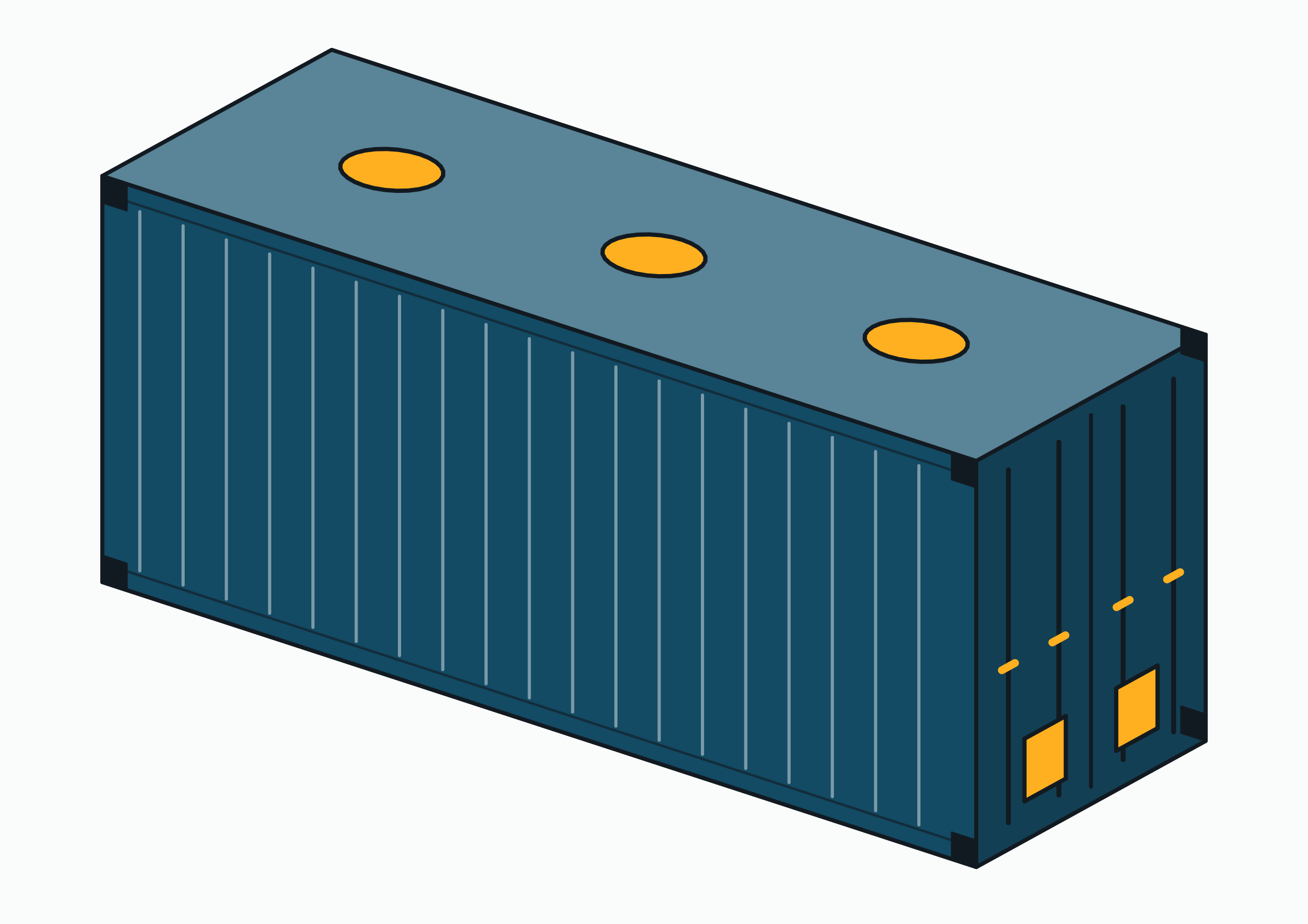
Loose cargo in a standard container travels in bags, big bags or a liner, and every one of them costs time and money at both ends. A bulk container is built so that the cargo itself is the load: three round hatches in the roof take a filling spout, and hatches in the bottom of the door let it run out when the container is tilted on a tipping chassis.
Outside it is a standard 20 ft box and handles like one. Inside, the published figures differ by a few centimetres between builders — Hapag-Lloyd gives 5.934 × 2.358 × 2.340 m, BISCO 5.898 × 2.352 × 2.390 m — which puts the volume between 32.5 and 33.1 m³. With the hatches shut and the end doors open it can still carry ordinary cargo back the other way.
Two makers agree on the weights: 30,480 kg maximum gross and about 2,600 kg tare. The ISO size/type code is 22B0, a dry bulk container (B) that is not pressurised.
The other heavy-loose-cargo box is the half-height: a low, open container for dense material like ore or stone that reaches its weight limit long before its volume. A bulker is for cargo that fills the box: grain, malt, coffee beans, feed, plastic pellets and minerals light enough to fill it before they hit 27 t.
One page, every container
Stop looking these numbers up
All 16 containers on one printable page: internal dimensions, door openings, tare, payload, volume and pallet counts, in metric and imperial. The sheet that stays by the desk.
The file downloads straight away. We email when the data changes, at most once a month, after you confirm your address once; opens and clicks on those emails are measured, and every one has a one-click unsubscribe. See our privacy policy.
Loading through the roof, unloading by tipping
Filling: the box stands under a silo spout or a conveyor, the roof hatches are opened and the cargo is poured in until it reaches the hatch rim; a spout moved between the three hatches fills it evenly from end to end. Builders disagree on the hatch diameter — 455 mm in one sheet, 610 mm in another — so match the spout to the unit, not to a catalogue.
Emptying: the container goes on a tipping chassis or a tilting platform, the discharge hatches in the door are opened, and the front end is raised until the cargo runs out by gravity. A liner bag is often used anyway for food-grade cargo, so the box itself stays clean between loads.
Bulker, lined dry box or half-height?
Many shippers move bulk in an ordinary 20 ft dry container fitted with a disposable liner and a bulkhead behind the doors. It needs no special equipment to find, but filling through the door is slower and the box cannot be tipped as cleanly. The bulker is worth seeking out on a regular lane where the silo and the tipping chassis are already there.
For dense cargo — ore, scrap, stone — a bulker fills to its weight long before its volume; a half-height open box is easier to load with an excavator and to empty with a grab. Every type is compared on the types of shipping containers page.
Frequently asked questions
What is a bulk container?
A bulk container is a 20 ft box with three loading hatches in the roof and discharge hatches in the door, for loose cargo poured in from above and tipped out: grain, malt, feed, plastic granules. Outside it is a standard 20 ft, 6.058 × 2.438 × 2.591 m (20′ × 8′ × 8′6″).
How much can a 20 ft bulk container carry?
About 27,880 kg (61,465 lb): two makers rate it at 30,480 kg gross with a tare of about 2,600 kg. Its volume is 32.5 to 33.1 m³ (1,148 to 1,169 ft³) depending on the builder, so light cargo fills it before heavy cargo reaches the weight limit.
What is the ISO code of a bulk container?
22B0: a 20 ft, 8 ft 6 in high container (22) of the dry bulk group (B), not pressurised (0). The code is on the door, under the container number.
How is a bulk container unloaded?
By tipping: the box goes on a tipping chassis or tilting platform, the 2 discharge hatches low in the door are opened and the front is raised until the cargo runs out by gravity. Without a tipper the cargo has to be dug or vacuumed out, which takes away most of the point of a bulker.
What is the difference between a bulk container and a half-height container?
A bulker is a closed 20 ft box of full height, about 33 m³, filled through roof hatches; a half-height is an open box about half as tall, loaded from above by excavator or grab. The bulker suits light loose cargo that fills it, the half-height dense cargo like ore that reaches the weight limit first.