Weight · 40 ft
How much does a 40 ft container weigh?
 Yuri Kan Checked against 29 of 88 published sheets Updated
An empty 40 ft container weighs about 8,157 lb (3,700 kg); its maximum gross weight is 71,650 lb (32,500 kg), so it carries up to 63,493 lb (28,800 kg) of cargo. The tare is the figure makers differ on most: per 9 of 16 sheets, and they range 3,530–4,000 kg (7,782–8,818 lb); the rating is per 12 of 15 sheets.
| Container | Tare (empty) | Max gross | Payload | Tare the sheets print |
|---|---|---|---|---|
| 20 ft | 4,916 lb (2,230 kg) | 67,197 lb (30,480 kg) | 62,281 lb (28,250 kg) | 2,080–2,570 kg (18 sheets) |
| 40 ft | 8,157 lb (3,700 kg) | 71,650 lb (32,500 kg) | 63,493 lb (28,800 kg) | 3,530–4,000 kg (16 sheets) |
| 40 ft HC | 8,444 lb (3,830 kg) | 71,650 lb (32,500 kg) | 63,207 lb (28,670 kg) | 3,700–4,300 kg (19 sheets) |
Checked : outside sizes set by ISO 668, read in IS 6566:2001, GOST R 51876-2008 and GOST R 53350-2009; every other figure against 29 published sheets of 20 lines, lessors and makers. A sheet agrees within ±5 mm, or ±2 % for a mass and ±1 % for a volume; a maximum gross is a rating and must be the same. Every figure and its sources
Data: Hapag-Lloyd Container Specifications · Maersk Container Specifications · CMA CGM Equipment Guide · CSC (International Convention for Safe Containers)

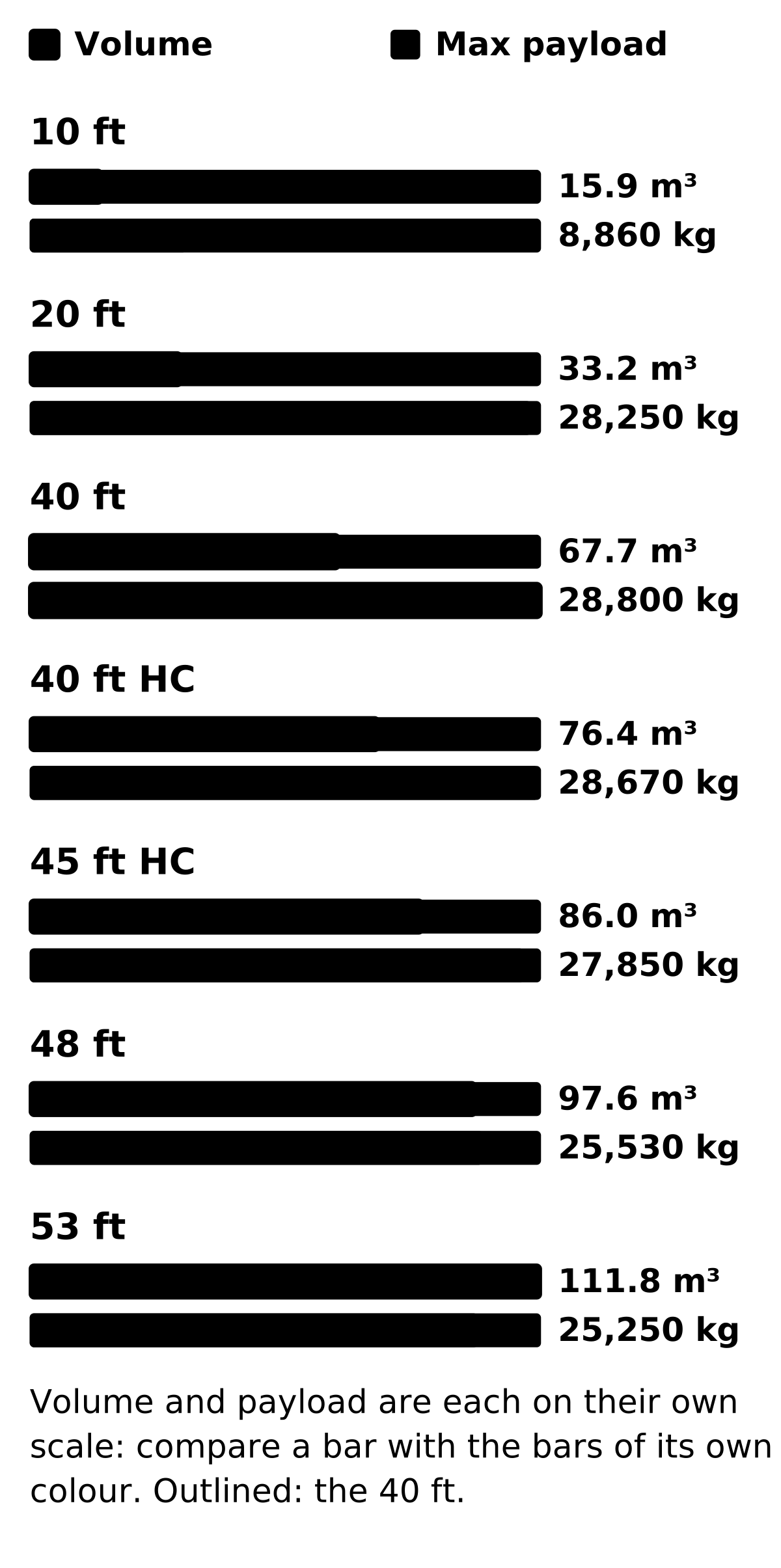
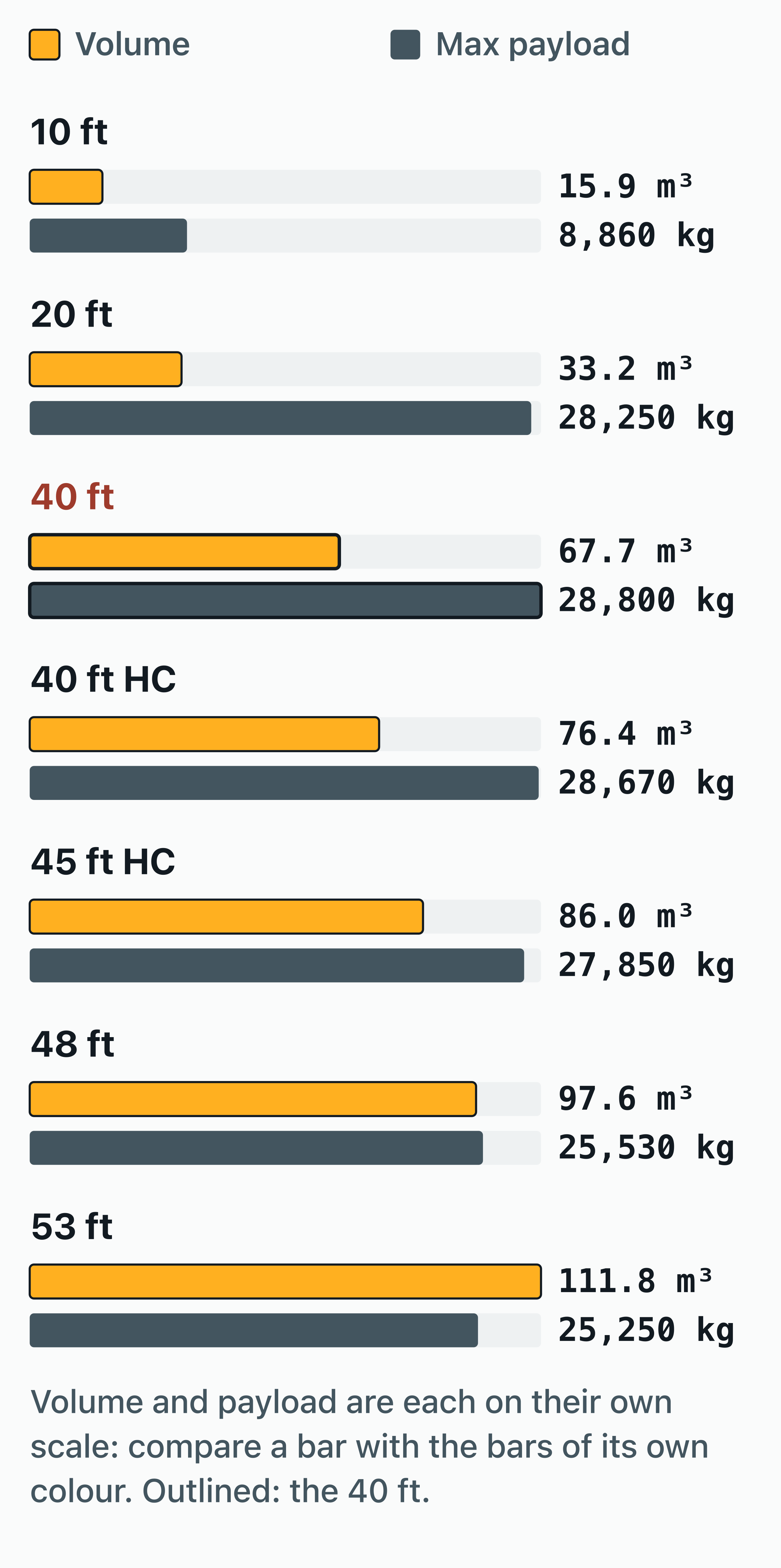
The numbers in this chart
| Size | Volume | Max payload |
|---|---|---|
| 10 ft container | 15.9 m³ · 562 ft³ | 8,860 kg · 19,533 lb |
| 20 ft container | 33.2 m³ · 1,172 ft³ | 28,250 kg · 62,281 lb |
| 40 ft container | 67.7 m³ · 2,391 ft³ | 28,800 kg · 63,493 lb |
| 40 ft high cube container | 76.4 m³ · 2,698 ft³ | 28,670 kg · 63,207 lb |
| 45 ft high cube container | 86.0 m³ · 3,037 ft³ | 27,850 kg · 61,399 lb |
| 48 ft container | 97.6 m³ · 3,447 ft³ | 25,530 kg · 56,284 lb |
| 53 ft container | 111.8 m³ · 3,948 ft³ | 25,250 kg · 55,667 lb |
Checked : the figures in this chart against 42 of 88 published sheets from 27 lines, lessors, makers and rail and road operators: those that print these figures. A sheet agrees within ±5 mm, or ±2 % for a mass and ±1 % for a volume; a maximum gross is a rating and must be the same. Every figure and its sources
Tare, max gross and payload
Three figures are painted on a 40 ft’s door. The tare is the empty box, steel and floor; the max gross is the most box and cargo may weigh together, the rating the CSC plate certifies; the payload is their difference, 32,500 kg − 3,700 kg = 28,800 kg. A 40 ft is good for exactly what its own plate says, so the door markings beat any table, this one included.
Why the sheets disagree on a 40 ft’s tare
Of the published line and lessor sheets read for the 40 ft, 9 of 16 sheets print a tare that agrees with 3,700 kg (a sheet counts within two per cent); the lightest prints 3,530 kg and the heaviest 4,000 kg. The spread in a 40 ft is real: a plywood floor weighs less than a steel one, a newer box less than an older one of thicker plate, and a lessor’s fleet mixes makers. Sheet by sheet, the 40 ft’s spread is on the spec variance page; every size’s tare, payload and max gross are in the container weight guide.
On the road the truck decides
A loaded 40 ft rarely gets to its rating on a road. In the US the vehicle limit is 80,000 lb, and tractor, chassis and the box itself come out of it before the 40 ft’s cargo; in the EU a five-axle vehicle may weigh 40,000 kg, 44,000 kg with a container in combined transport. Both leave less than the 63,493 lb (28,800 kg) a 40 ft is rated for. Every export box also needs a Verified Gross Mass before loading, which the VGM calculator works out from the 40 ft’s tare.
The 40 ft container on one page, plus the whole pack
Every dimension in millimetres, metres and feet, the door opening, tare, payload and volume, and the floor drawn to scale with EUR and US pallets on it. In the same email, the container pack: all 17 containers by the job, 17 sheets like this one, the 85 owner prefixes, an A3 wall chart and an Excel workbook.
- 17 containers, by the job
- 17 container sheets
- 85 owner prefixes
The bot check did not finish, so nothing was sent. Send the form again; if it stops again, allow challenges.cloudflare.com in your blocker or write to info@contsize.com from the address the file should go to.
Nothing was sent: the address could not be read, or a required box was not ticked. Check them and send the form again.
Frequently asked questions
How much does an empty 40 ft container weigh?
About 8,157 lb (3,700 kg): per 9 of 16 sheets, and the 16 sheets read for the 40 ft print 3,530–4,000 kg (7,782–8,818 lb). The tare painted on your 40 ft’s door is the figure to use.
How much can a 40 ft container carry?
Up to 63,493 lb (28,800 kg) of cargo in a 40 ft: the 71,650 lb (32,500 kg) maximum gross, per 12 of 15 sheets, less the 3,700 kg tare; road limits usually cap it lower.
How much does a 40 ft high cube container weigh?
About 8,444 lb (3,830 kg) empty, per 10 of 19 sheets; with the same 32,500 kg rating as the standard 40 ft, its payload is 63,207 lb (28,670 kg).