2 prefixes · shipping line
PIL (Pacific International Lines) container prefixes: PCIU, PILU

Track on pilship.com — official PIL (Pacific International Lines) tracker
Full PIL (Pacific International Lines) container tracking guide →
PCIU and PILU are the BIC owner prefixes registered to PIL (Pacific International Lines). A container number that starts with any of them belongs to the PIL (Pacific International Lines) fleet and is tracked free at pilship.com. The eleventh character of the number is a check digit; it is worked out below for each prefix.
PIL — Pacific International Lines — is Singapore’s largest privately-held line, strongest on Asia–Africa and Asia–Middle East trades.
Its two codes track on pilship.com, which is one of the few carrier sites to honour a full deep link with the number embedded.
4 letters + 7 digits, printed on the doors. It is on your bill of lading too.
The answer appears as you type. Nothing is sent anywhere.
All 2 PIL (Pacific International Lines) prefixes
| Prefix | A valid number | Check digit | Where the code comes from |
|---|---|---|---|
PCIU | PCIU 326409-6 | 6 | — |
PILU | PILU 535843-5 | 5 | — |
Prefix register verified against two independent sources on 2026-08-03. The example numbers are computed to show the arithmetic. They are valid by construction, not numbers we saw on a box.
Data: BIC Container Prefix Register · ISO 6346:2022
PCIU: check digit, worked through
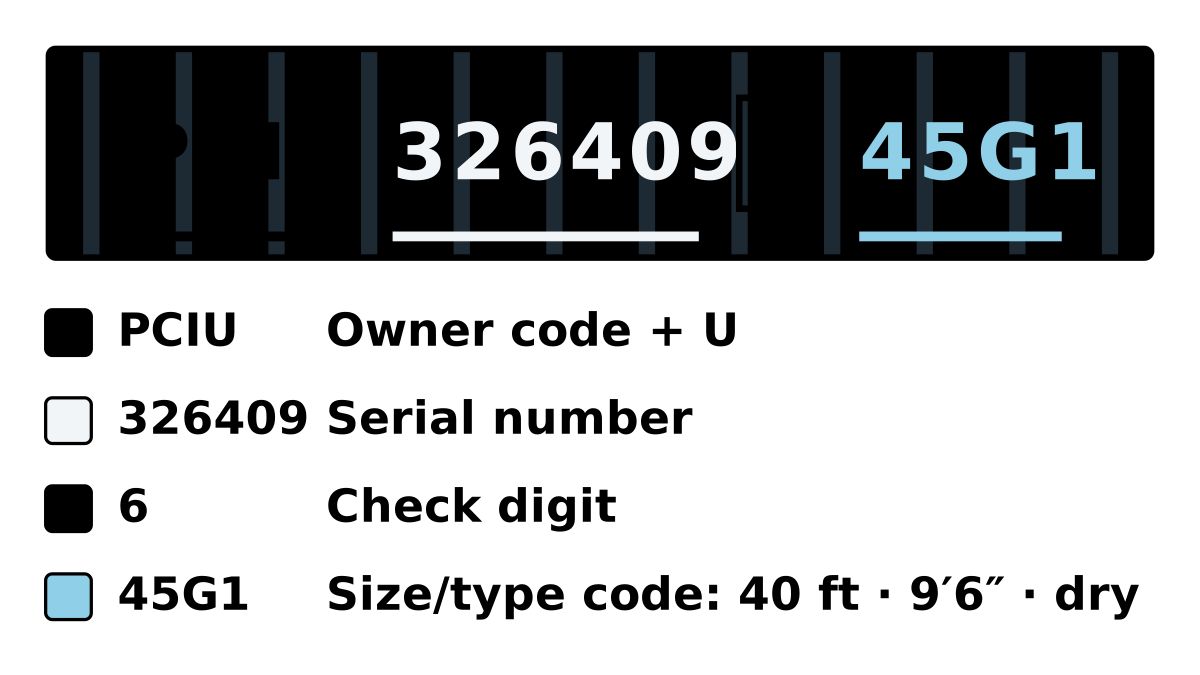
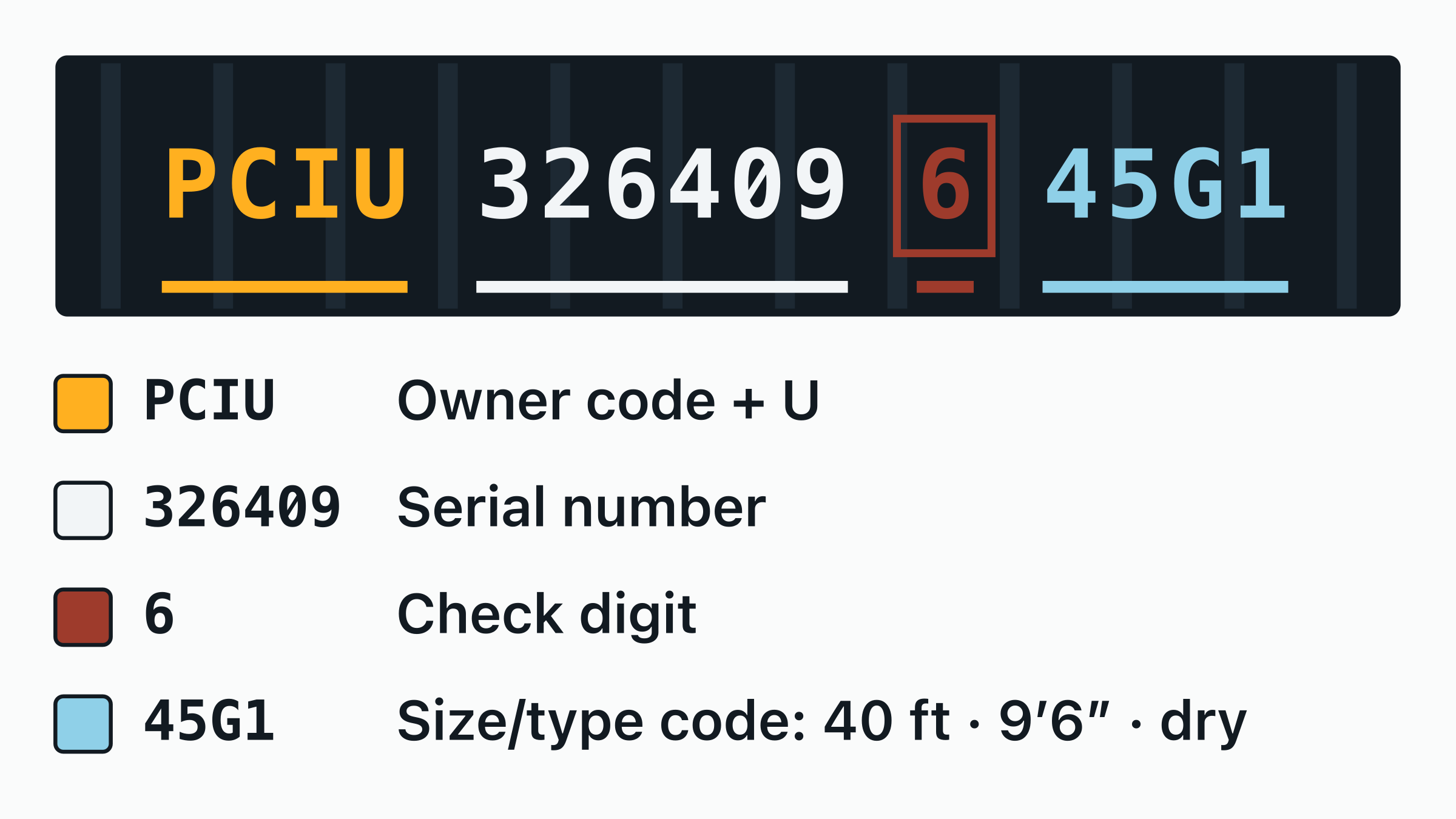
PCIU is registered to PIL (Pacific International Lines). Take PCIU 326409-6: each of its first ten characters has a value and a weight, the products are added, and the remainder after dividing by 11 is the check digit — here 6.
| Character | Value | Weight | Product |
|---|---|---|---|
P | 27 | ×1 | 27 |
C | 13 | ×2 | 26 |
I | 19 | ×4 | 76 |
U | 32 | ×8 | 256 |
3 | 3 | ×16 | 48 |
2 | 2 | ×32 | 64 |
6 | 6 | ×64 | 384 |
4 | 4 | ×128 | 512 |
0 | 0 | ×256 | 0 |
9 | 9 | ×512 | 4608 |
Sum 6001 → 6001 mod 11 = 6 → check digit 6 → PCIU 326409-6

PILU: check digit, worked through
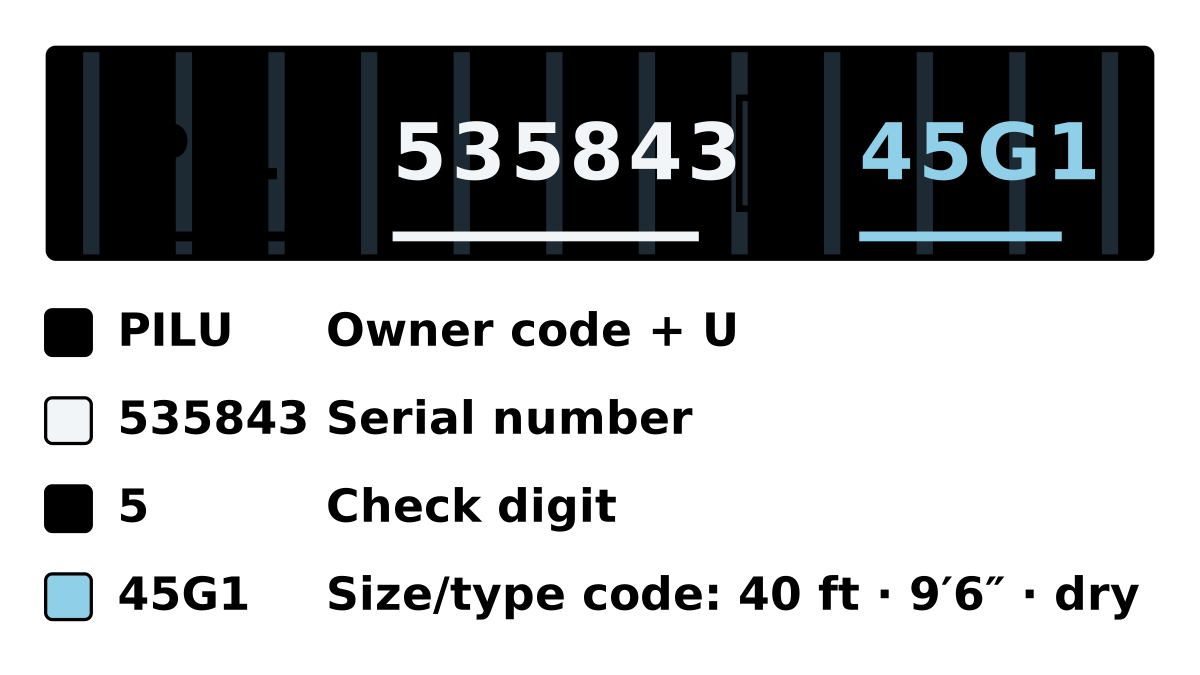
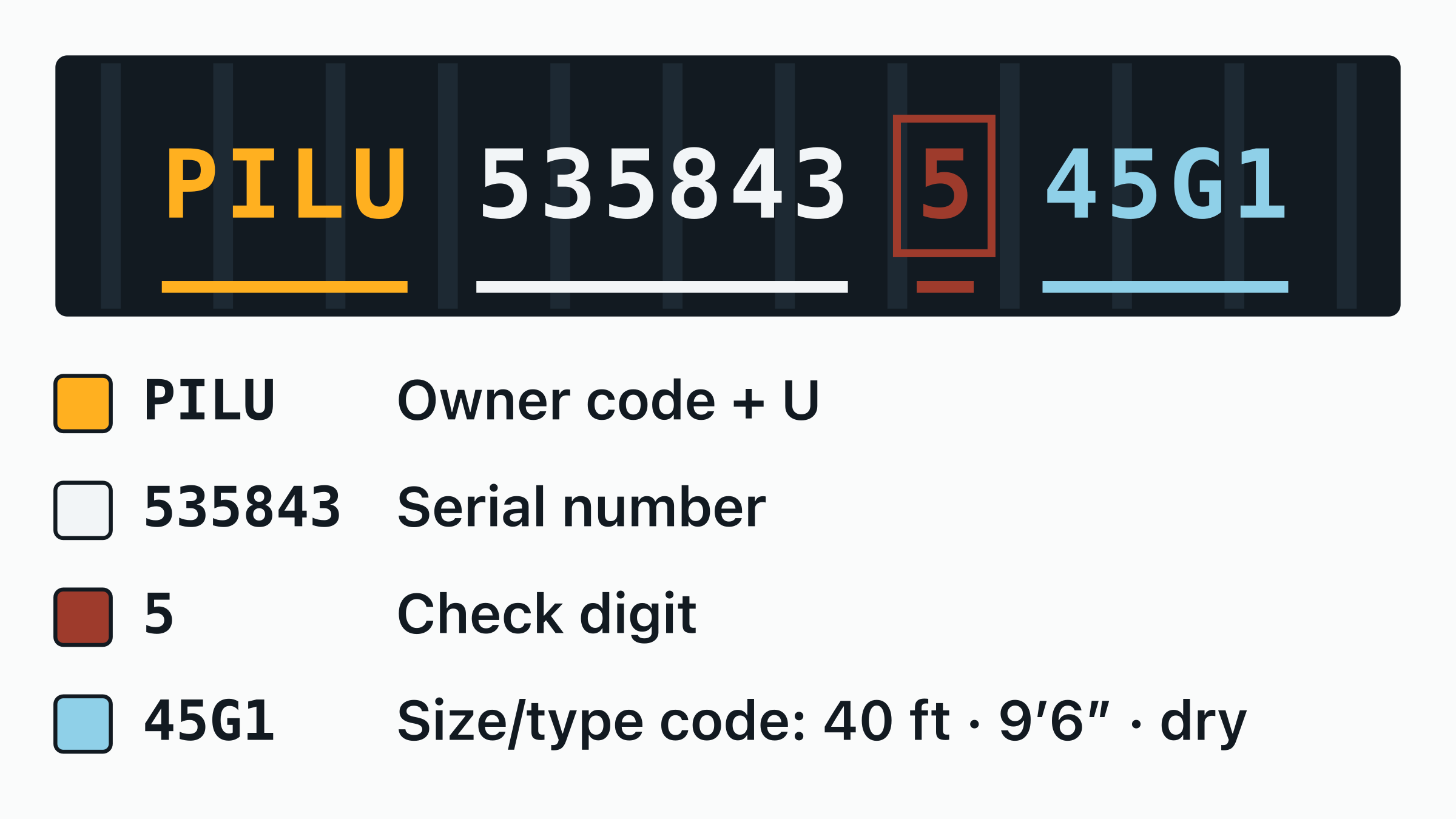
PILU is registered to PIL (Pacific International Lines). Take PILU 535843-5: each of its first ten characters has a value and a weight, the products are added, and the remainder after dividing by 11 is the check digit — here 5.
| Character | Value | Weight | Product |
|---|---|---|---|
P | 27 | ×1 | 27 |
I | 19 | ×2 | 38 |
L | 23 | ×4 | 92 |
U | 32 | ×8 | 256 |
5 | 5 | ×16 | 80 |
3 | 3 | ×32 | 96 |
5 | 5 | ×64 | 320 |
8 | 8 | ×128 | 1024 |
4 | 4 | ×256 | 1024 |
3 | 3 | ×512 | 1536 |
Sum 4493 → 4493 mod 11 = 5 → check digit 5 → PILU 535843-5

Tracking a PIL (Pacific International Lines) container
The tracker at pilship.com accepts the container number inside the link, which we confirmed in a browser: the checker on this page builds that link for you.
| Container number | ✓ yes |
|---|---|
| Bill of lading (B/L) | ✓ yes |
| Booking reference | — no |
| Mobile app | ✓ yes |
| Pre-filled link | ✓ opened with a live number and it worked |
| Its bill of lading starts with | no published prefix |
Browser-verified 2026-08-03
Can you see where the ship is?
Not from the container. A standard dry box has no power, no radio and no satellite receiver — it is a steel case with a number painted on it, and it reports nothing about itself. Every position you see against a PIL (Pacific International Lines) shipment was reported by something else: a terminal crane, a gate reader, or the ship.
A live map on a carrier’s tracking page is almost always plotting AIS, the transponder every large vessel broadcasts with its position, course and speed. That is genuinely useful at sea: it is a real position rather than a schedule, and an ETA recalculated from actual movement. It is also the ship’s position, not your box’s, and the two part company the moment the container is discharged.
On land the map goes quiet. Between the gate-out and the delivery there is no vessel to follow, and the road leg appears only as whatever events the terminal and the trucker report. A container sitting on a chassis in a yard shows the last position of a ship it left days ago. Only specialised IoT equipment reports its own location, and wherever that exists it is a paid product sold to the shipper, not something a tracking page gives away.
Frequently asked questions
Who owns PCIU and PILU containers?
PIL (Pacific International Lines) does, a shipping line founded in 1967 — the BIC register lists 2 owner prefixes under it: PCIU and PILU.
How do I track a PCIU container?
Free, on the official PIL (Pacific International Lines) tracker at pilship.com — paste the full 11-character number; no account is needed. The same tracker serves all 2 PIL (Pacific International Lines) prefixes.
Why does PIL (Pacific International Lines) have 2 prefixes?
Because one prefix holds only a million serial numbers and a fleet outgrows it — and because a line that buys another line keeps the codes painted on the boxes it bought. All 2 are tracked on the same pilship.com system.
Is PCIU a shipping line prefix or a leasing prefix?
A shipping line prefix — PIL (Pacific International Lines) both owns the box and moves it, so the owner and the tracker are the same company.
Is PCIU3264096 a valid container number?
Yes — PCIU 326409-6 passes the ISO 6346 check: the weighted sum for PCIU326409 leaves a remainder of 6 when divided by 11, which gives check digit 6. It is an example computed for this page, not a box we have seen.
One page, every owner code
Know whose box it is before you search
All 85 owner prefixes mapped to their line or leasing company, with the leased ones marked — so you can tell at a glance when to track with the line instead. Container dimensions are on page two.
The file downloads straight away. We email when the data changes, at most once a month, after you confirm your address once; opens and clicks on those emails are measured, and every one has a one-click unsubscribe. See our privacy policy.